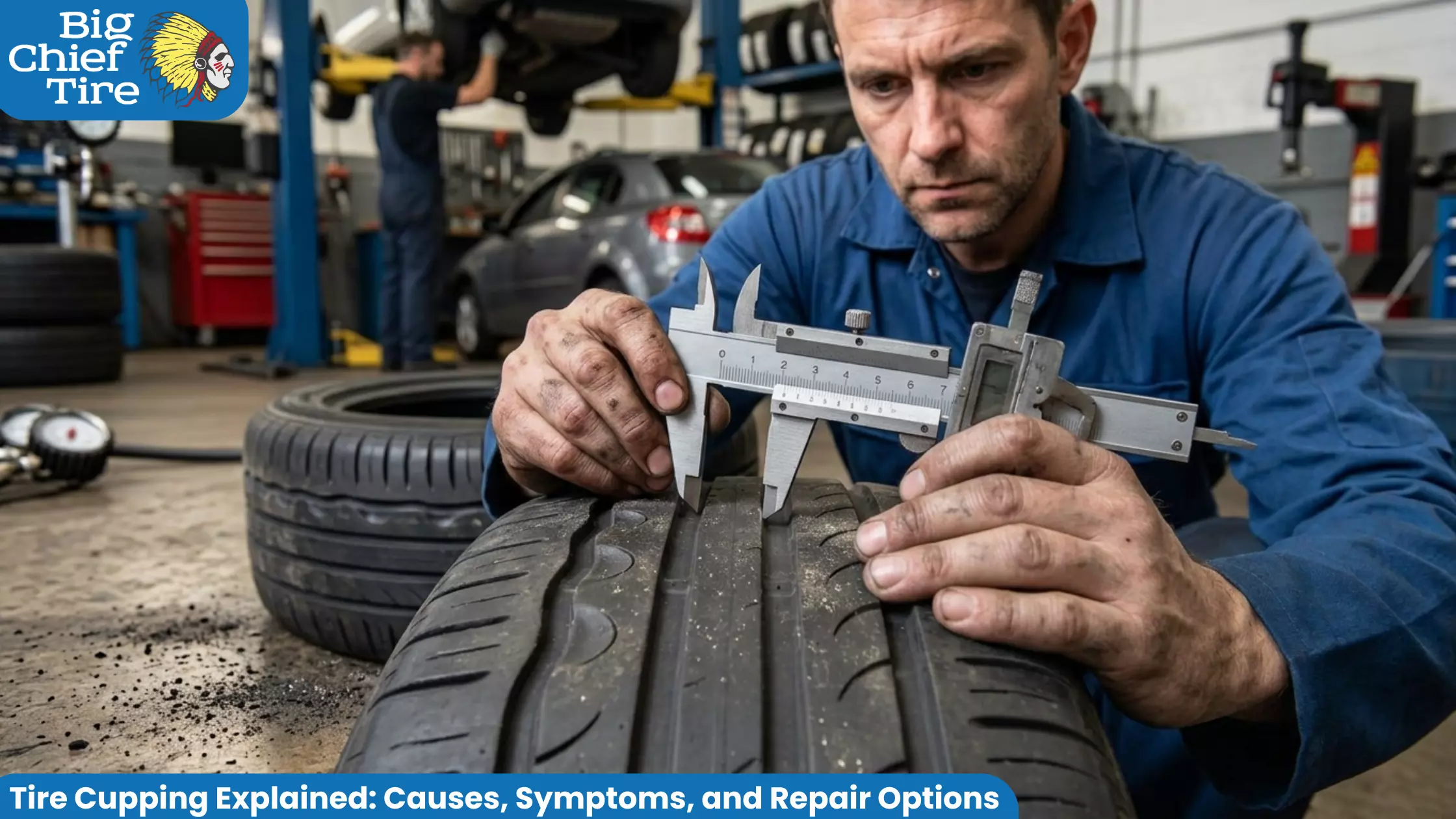
Tire Cupping Explained: Causes, Symptoms, and Repair Options
Picture yourself cruising along a constructed highway when, all of a sudden, you feel a vibration reminiscent of a flat tire in your car.
Upon pulling over to check your tires, instead of discovering any holes or flat spots, you see that there are irregularly shaped dips in your tire tread. This is a specific condition called tire cupping.
Unlike the regular wear and tear of the tires that takes place gradually over the course of thousands of miles, tire cupping is an indication that there is something wrong mechanically with the car that may influence its handling. Scheduling an immediate appointment with a professional, certified tire shop becomes a critical matter of safety rather than routine maintenance.
On the surface, cupped tires can often be mistaken for worn tires. The difference between the two lies in how the irregularities present themselves.
Unlike wear and tear that causes a slope of worn tread on the inside or outside of the tire, cupping leads to actual holes or valley-shaped dips on the tire's tread.
Failing to address this problem will only increase wear and tear on your tires and put a huge strain on your wheel assembly.
What are the symptoms of cupped tires?
Early recognition of these signs may avoid more severe damage. Tire cupping usually shows up in three ways: what you see, what you hear, and how the vehicle feels when you drive.
Visual indicators
The best way to recognize whether cupping is happening is to look at the tread on the tires. Feel the thread with your hands. If the surface feels uneven and is formed like hills and valleys, or you see lighter and darker areas on the tire, then cupping is already taking place.
Auditory signs
The first indication that cupping is occurring is a humming or roaring sound. This sound becomes louder as your speed increases, making you think you need to replace the wheel bearings, but actually, what you need is new tires.
Drivability issues
Since your tire is not wearing evenly, you may experience vibrations while driving. These vibrations are felt in the steering wheel and driver’s seat, especially when you drive at high speed.
Primary Tire Cupping Causes
The main reasons for the occurrence of tire cupping are not due to a faulty tire. It is an indication of other elements of the car failing to control the motion of the wheels. The most common reasons are listed below:
Bouncy Suspensions
Your suspension is designed to keep the tires firmly in contact with the road. As shocks and struts wear out, they lose their ability to control the movement of the springs.
When that happens, the tire repeatedly bounces against the pavement with excessive force, gradually creating the scalloped wear pattern associated with cupping. Replacing worn shocks or struts is often necessary to stop the damage from getting worse.
Wheel imbalance
Yet another frequent cause is that of an unbalanced wheel assembly. Every set of tires and wheels has some imbalances in terms of weight, and these have to be compensated for through the use of wheel balancing. Whenever a vehicle skips regular tire balancing service, there are heavy areas that lead to a strong centrifugal force at high speed and cause the tire to hop.
Wheel misalignment
The reason why the tires wear so fast when the alignment is off is that the wheels are not aligned in the proper direction as directed by the manufacturers, and therefore, the tires cannot turn smoothly. Instead, the wheel is forced to drag a little sideways on the road surface.
Read: Haida Tyres vs. Other Budget Tyre Brands: Which is Better?
Professional Repair Options & Solutions
Fixing tire cupping involves more than replacing the damaged tire. The underlying mechanical problem must be repaired first. Otherwise, the new tires will develop the same wear pattern after only a few thousand miles.
Correcting the Angles
Professional alignment is typically the first thing that needs to be done in order to correct any problems with wheel alignment. With the use of precise alignment tools, a specialist will adjust the angles of camber, caster, and toe to the manufacturer's specifications. It ensures an even contact between the tire and the ground surface.
Fixing the Foundation
When any mechanical parts that have been damaged or worn out are spotted during the car suspension inspection process, it is necessary to get your car’s suspension repaired.
The significance of the suspension system on driving experience needs to be known by all car owners, since this system not only ensures a smooth driving experience, but actually makes sure that the tires are tightly attached to the road while driving, accelerating or braking.
Stay on Top of Routine Maintenance
In order to stop the slight variations in the tread from becoming irreversible cupping, a very thorough tire rotation process every 5,000 to 7,500 miles is advised.
The purpose of wheel rotation is to change the direction in which pressure is applied to the tires, thus balancing out any initial wear that might occur.
Restoring Your Ride's Safety and Smoothness
Tire cupping cannot be considered a separate problem with tires. This condition is a sign of the inner mechanical wear that takes place under the hood of your car.
After correcting the mechanical wear, you will need to replace the worn-out rubber tires because riding for a long distance with severely scalloped tread blocks is very uncomfortable, unsafe, and harmful to the health of your wheel bearings.
So, you should be prepared to buy new tires in order to ensure a comfortable, smooth, and safe drive. Do not ignore the signs of tire cupping in order not to risk your safety. If you feel any vibrations or hear humming sounds from your wheels, do not delay seeking tire repair services.
Find wheel alignment near me as soon as possible and ask for a professional opinion about tire repair and replacement.