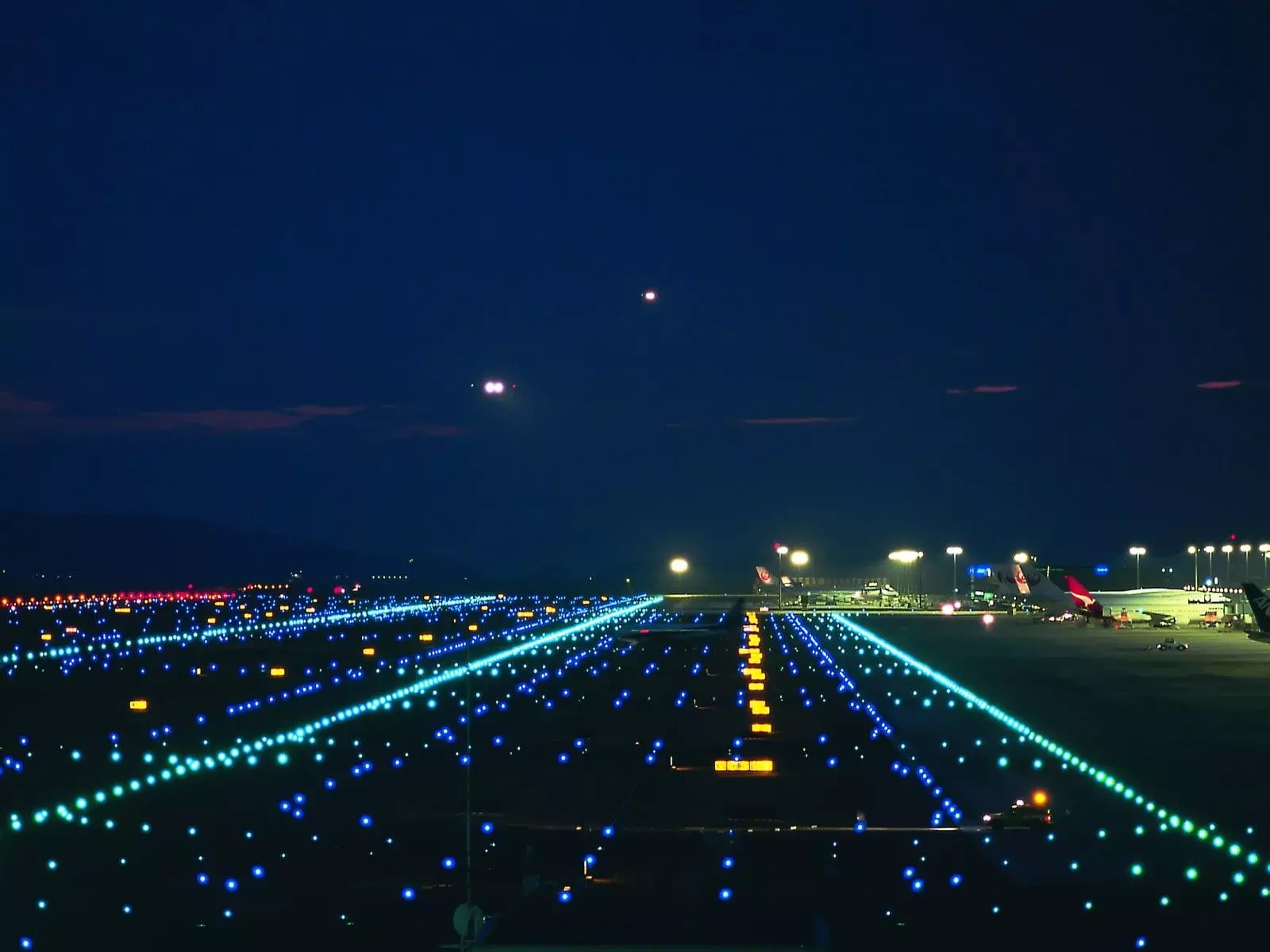
The Role of Aeronautical Ground Lighting in Safe Airport Operations
In airports around the world, every aircraft movement — whether taxiing, taking off, or landing — depends not only on air‑traffic management and communications, but on a network of visual aids on the ground. Among the most important of these aids is the system of aeronautical ground lighting (AGL).
From outlining the runway and taxiway edges, to providing approach guidance in low‑visibility, these lighting systems play a central role in ensuring safe airport operations. In this article, we will explore what AGL is, how it supports airport safety and efficiency, the main components involved, the regulatory and design frameworks, operational considerations (including maintenance and monitoring) and future trends.
Read: How to Protect Your Energy in a Busy World
What is Aeronautical Ground Lighting (AGL)
Aeronautical ground lighting (AGL) is the collective term for all lighting fixtures and associated infrastructure installed on the airside of an aerodrome (airport) to support aircraft movement, especially under low‑visibility or night conditions. It includes lights on runways, taxiways, aprons, and associated visual cues such as approach lighting, centre‑line lights, edge lights, stop bars, etc. Airport engineering companies in the industry are behind building AGL systems.
In short: AGL provides the visual environment on the ground that enables pilots (and ground vehicle operators) to maintain spatial awareness, to navigate the airport surface safely, and to align and land aircraft even when natural visual references are degraded.
Why AGL Matters for Safe Airport Operations
There are several reasons why AGL is indispensable for safe airport operations. I’ll go through the key ones:
- Visibility in low light or bad weather
- When it’s night, dawn, dusk, or when weather conditions (fog, rain, snow) reduce visibility, pilots can no longer rely solely on natural light or surface markings. Properly configured AGL enables pilots to see runway thresholds, taxiway edges and holding positions. Without such lighting, risks increase: pilot disorientation, runway incursions, incorrect taxiing, mistaken alignments for landing or take‑off.
- Spatial awareness and navigation on the airfield
- Airports can be complex: multiple runways, taxiway intersections, aprons, service roads, ground‑vehicle traffic. AGL provides cues that help pilots (and ground crews) navigate safely on the surface. Taxiway centreline lights, stop bars, apron edge lighting help reduce confusion. Ground lighting provides pilots with spatial awareness, helping them navigate the complex layout of an airport, including identifying runway thresholds, taxiway intersections, and other key points of reference. This prevents confusion and reduces the risk of runway incursions or other ground‑related accidents.
- Precision guidance for approach and landing
- One of the most critical phases of flight is the approach and landing. AGL systems — including approach lighting systems (ALS), precision approach path indicators (PAPI) or visual approach slope indicators (VASI), runway edge & centreline lights — provide visual guidance to the pilot to correctly align on the runway and maintain an optimal glide path. These visual cues are vital especially when transitioning from instrument guidance to visual landing in low visibility. Without them, landing risk increases (overshoot, undershoot, runway excursion).
- Runway identification and clearance of obstacles
- AGL systems help pilots quickly identify the correct runway, especially at airports with multiple parallel runways or complex layouts. Runway end identifier lights (REIL) provide rapid and positive identification of the approach end of a particular runway under reduced visibility. Moreover, AGL supports obstacle clearance by providing visual glidepath cues (PAPI/VASI) and properly spaced lighting to indicate safe descent paths.
- Operational efficiency and ground‑movement safety
- Beyond pure safety, AGL contributes to operational efficiency. Clear lighting on taxiways and aprons reduces the time pilots need to visually confirm hold‑positions and movement paths. This helps reduce delays, improves throughput, especially during night operations or low‑visibility conditions. Fewer deviations and delays mean lower risk of ground collisions or incursions.
- Regulatory compliance and standardisation
- AGL is not optional or ad‑hoc. International standards (such as those from the International Civil Aviation Organization – ICAO), national aviation authorities (like FAA), and other regulatory bodies specify lighting categories, intensities, placement, colours, and controls. Compliance ensures that lighting is consistent across airports, which helps pilots operate globally without having to adjust to wildly different visual cues.
Main Components of AGL Systems
To understand how it all works, it’s useful to look at the main components of an Aeronautical ground lighting system, and how they contribute to safe operations.
Runway lighting
- Runway edge lights: These outline the edges of runways during darkness or restricted visibility. They are typically white, but on instrument runways, the last part of runway (last 2,000 feet or half of runway length) may have yellow lights replacing white to signal caution.
- Runway end lights (threshold lights): These mark the start and end of the runway. The lights at the end emit red toward arriving aircraft (to show the end) and green outward for departing aircraft (to show the threshold).
- Runway centreline lights: On precision approach runways, centreline lights help visibility of the runway alignment during low visibility. They may change colour as the aircraft proceeds down the runway (white to alternating red‑white to red) in the final portion.
- Touchdown zone lights: Two rows of lights near the threshold to help identify the touchdown zone under bad visibility.
- Runway end identifier lights (REIL): Pairs of flashing lights placed laterally on each side of a runway threshold. These help with rapid runway identification.
Approach lighting system (ALS)
ALS extend outward from the runway threshold into the approach area and provide the final visual cues to transition from instrument to visual approach. They can include light bars, strobe lights, sequenced flashing lights, etc. The presence and length of an ALS can reduce required visibility minima for instrument approaches.
Visual approach slope indicators (PAPI / VASI)
These are special lighting installations that give pilots a visual representation of their glide path during approach. The VASI uses light units arranged in bars; the PAPI uses a row of two or four lights typically on one side of the runway. The colour changes depending on whether the aircraft is too high, too low or on the correct glide path.
Taxiway and apron lighting
These include taxiway edge lights, taxiway centreline lights, lead‑on/lead‑off lights (especially when transitioning between runway and taxiway), stop bars (especially at runway holding positions) and apron edge lights. They support safe movement of aircraft and ground vehicles in the movement area. For instance, taxiway centreline lead‑off lights help warn pilots they are entering runway or ILS critical areas.
Stop bars, runway guard lights, runway status lights (RWSL)
Modern airfields have enhanced lighting systems designed to prevent runway incursions. RWSL systems provide automated red lights on taxiways or runways that warn pilots/vehicles when it is unsafe to enter.
Power, control, monitoring systems
Lighting systems require power supplies and control/circuitry to maintain consistent output. Traditional systems used constant current regulators (CCR) powering series circuits of lights to ensure constant luminous intensity. Monitoring systems allow real‑time monitoring of the operational status of lighting circuits, enabling quick fault detection, remote control of intensity, scheduling, and reduced operational disruption.
Design and Standards for AGL
Building and maintaining an AGL system is not just about placing lights on the ground. There is detailed design work and specification guided by regulatory frameworks, engineering best practices and operational requirements.
Design considerations
- Site survey and airport layout: Before installation, engineers must study the runway/taxiway geometry, terrain, obstacles, lighting contrast, ambient lighting, traffic mix (e.g., wide‑body versus regional aircraft), and meteorological conditions (visibility, fog, precipitation).
- Lighting intensity and spacing: The required luminous intensity, beam spread and placement of lights depend on aircraft approach speed, touchdown zone length, runway width, visibility minima, and other factors.
- Colour coding and uniformity: Colours must conform to standards (white, yellow, green, red, etc) so that pilot interpretation is standardised.
- Control of intensity and dimming: Adjustable intensity ensures that lights are neither too dazzling in good visibility nor too faint in marginal conditions.
- Redundancy and fault tolerance: Because ground lighting failure can jeopardise safety, design often includes redundant circuits, fault monitoring, quick‑replace fixtures, spare stock, etc.
- Maintenance access and safety: Because many installations are embedded in pavement, or adjacent to movement areas, maintenance planning must allow safe access without disrupting operations.
- Energy efficiency and sustainability: Over time LED lighting has become more common, reducing energy consumption and maintenance.
- Monitoring and control systems: As mentioned earlier, monitoring systems enable real‑time diagnostics of circuit integrity, lamp failures, intensity performance, and log historical performance.
Regulatory frameworks
- The International Civil Aviation Organization (ICAO) publishes Standards and Recommended Practices (SARPs) for aerodrome‑ground lighting via Annex 14 (Aerodromes) among others.
- National authorities (for example the FAA in the U.S.) publish guidance detailing lighting aids such as REILs, runway edge lights, taxiway lights etc.
- Other organisations such as the International Electrotechnical Commission (IEC) and European Committee for Electrotechnical Standardisation (CENELEC) provide technical standards for electrical circuits and installations.
Compliance & certification
Airports must demonstrate that their AGL systems meet regulatory criteria for intensity, spacing, colour, directionality, reliability, and maintenance. Systems are inspected regularly, and failures may trigger NOTAMs (Notice to Air Missions). Monitoring systems help track compliance metrics.
Operational Considerations & Maintenance
Once installed, the AGL system must be operated and maintained to ensure ongoing safety and reliability. Here are key areas of focus:
Routine inspections and maintenance
- Regular visual inspections for lamp outages, lens dirt or damage, electrical connections, fixture alignment, and pavement settlement.
- Functional tests of control systems (e.g., CCR output, monitoring alarms, intensity controls).
- Cleaning of lenses and fixtures, especially in dusty, sandy, salty or high‑pollution environments.
- Replacement of lamps or modules prior to end‑of‑life to avoid unplanned outages.
- Maintenance of embedded lighting (pavement‑mounted) which may require temporary runway or taxiway closures.
Monitoring systems and fault detection
Modern AGL systems often include lighting control and monitoring systems (LCMS) that provide real‑time information about lamp status, circuit continuity, and power supply performance. Monitoring helps detect faults early, reducing the risk of failures that could lead to flight cancellations or diversions.
Minimising disruption during maintenance
Since AGL is embedded in the movement area, maintenance must be scheduled to minimise impact on aircraft operations. Night or off‑peak slots are often used. Monitoring helps target maintenance only where needed, reducing full‑runway closures.
Low‑visibility operations (LVO) and contingency lighting
Airports operating in frequent low‑visibility conditions (fog, snow, rain) must ensure their AGL supports the appropriate visibility minima for instrument approaches. Backup power supplies, redundant circuits, and rapid repair are critical.
How AGL Directly Impacts Safety
Let’s look at some concrete ways in which AGL influences safety outcomes:
Prevention of runway excursions and undershoots
During approach and landing, if a pilot cannot accurately perceive the runway threshold orientation, or mis‑judges their glide path, there is a risk of undershoot (landing short) or overshoot (landing long) or runway excursion. Proper lighting (PAPI, approach lights, runway edge lights) mitigate that by providing precise cues. Without them, especially in low visibility, the risk rises significantly.
Reduced risk of runway incursions
A runway incursion is any unauthorized aircraft, vehicle or person on a runway. Ground lighting systems such as stop bars, taxiway centreline lead‑offs, and RWSL provide visual barriers or warnings. By improving visual differentiation between movement areas, AGL helps pilots stay on correct paths, avoid incorrect runway usage, and avoid collisions.
Safe taxiing and ground‑vehicle operations
Taxiing at night or in bad weather is inherently higher risk than daytime operations. Without clear taxiway centreline, edge lights, hold position lights, and well‑marked guidance, the risk of aircraft taking wrong turns, driving onto active runways or colliding with vehicles increases. Good AGL reduces these risks and supports ground movement safety.
Read: Badminton Court Construction India - as sports
Conclusion
In summary, aeronautical ground lighting is a fundamental element of safe airport operations. It supports visibility, spatial awareness, precision approach and landing guidance, taxiing safety, runway incursion prevention and operational efficiency. For airports and their operators, a well‑designed, properly maintained and intelligently monitored AGL system is indispensable.
With increased traffic, night operations, more frequent low‑visibility conditions and greater attention to safety and sustainability, the role of AGL will only grow. Upgrading systems (e.g., LED, smart controls, monitoring) and aligning them with operational practices and regulatory standards will deliver both safety benefits and cost efficiencies.