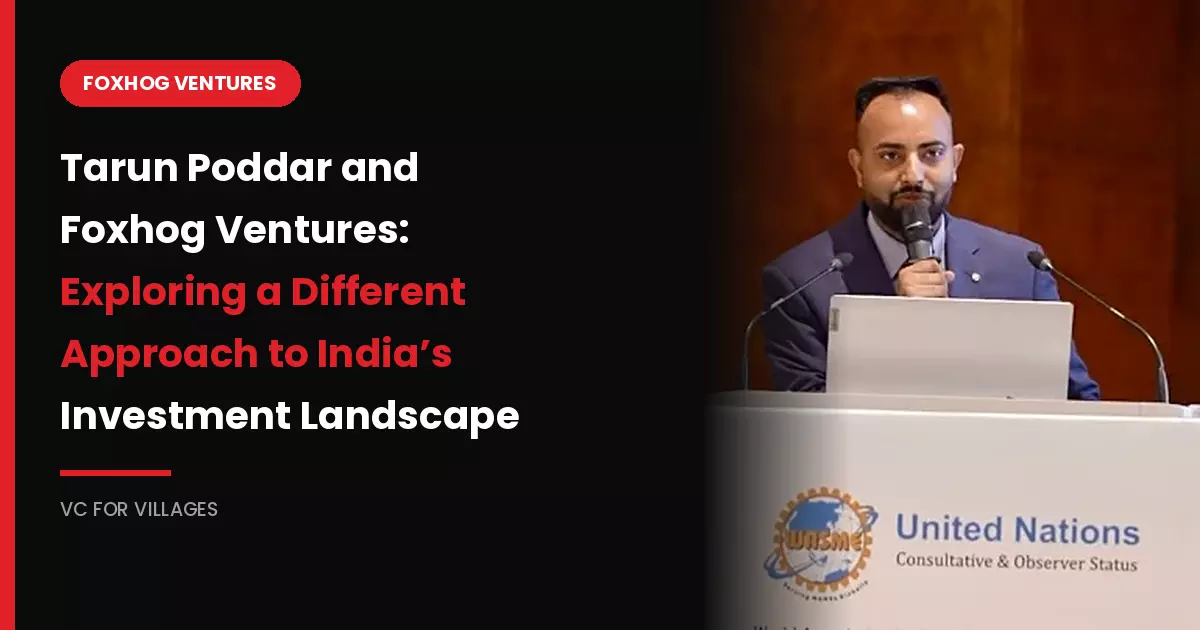
Tarun Poddar and Foxhog Ventures: Exploring a Different Approach to India's Investment Landscape
India's investment landscape is changing as entrepreneurship expands beyond the country's traditional startup centres.
While Bengaluru, Mumbai, Delhi-NCR and Hyderabad remain important destinations for startups and investors, businesses are increasingly being built in smaller cities, towns and rural markets.
This shift raises an important question:
How should investors identify and support businesses that operate outside the conventional startup ecosystem?
For Tarun Poddar and Foxhog Ventures, this question has become an important part of the firm's positioning.
Foxhog has developed an investment approach that looks beyond major metropolitan markets, including its focus on entrepreneurs operating in Tier 2, Tier 3 and rural markets.
The company's VC for Villages initiative is one example of this approach, focusing on bringing capital and business support closer to entrepreneurs outside India's established startup hubs. The initiative has recently received coverage from ANI in its report on Foxhog Ventures' expanding rural investment focus.
India's Investment Map Is Becoming More Diverse
- India's entrepreneurial ecosystem is no longer concentrated entirely within a few large cities.
- Businesses in smaller markets are building operations across sectors including agriculture, manufacturing, dairy, retail, logistics, services and local commerce.
- Many of these businesses begin by serving a specific local market. Over time, however, some can expand into neighbouring districts, states or larger national markets.
- Technology has helped accelerate this change.
- Digital payments, online commerce, social media, digital marketing and improved connectivity allow businesses in smaller markets to communicate with customers and partners far beyond their immediate location.
- As a result, geography is becoming less useful as the only measure of a company's potential.
Why Smaller Markets Can Present Different Opportunities
Businesses operating outside major startup hubs often have characteristics that are different from those of technology startups in metropolitan areas.
They may have strong relationships with local customers, established supplier networks and detailed knowledge of regional demand.
For example, a regional manufacturer may understand the needs of its customers better than a new competitor entering the market. Similarly, an agricultural business may have established relationships with farmers, distributors or buyers that provide a foundation for future expansion.
These advantages may not always be immediately visible to investors who primarily focus on established startup centres.
This creates an opportunity for investors willing to examine businesses through a wider lens.
Tarun Poddar and Foxhog Ventures
Tarun Poddar, Founder and CEO of Foxhog Ventures, is closely associated with the firm's investment strategy and its efforts to build a presence beyond conventional metropolitan markets.
Foxhog's own public positioning describes its focus as supporting entrepreneurs beyond the metros and improving access to capital for businesses in smaller markets.
The firm's leadership profile identifies Tarun Poddar as its Founder and Chief Executive Officer.
Poddar's public profile and the story surrounding Foxhog have also attracted attention from business publications.
A detailed profile of Tarun Poddar published by The Head & Tale examines his business journey, Foxhog's positioning and the company's activities across the investment ecosystem.
That coverage provides another perspective on the public discussion surrounding Poddar and Foxhog, and illustrates why the company has attracted attention beyond its investment activities.
What Does VC for Villages Represent?
Foxhog's VC for Villages concept focuses on entrepreneurs and businesses operating outside India's major startup hubs.
The initiative covers a broad range of potential businesses and sectors, including agriculture, dairy, retail, manufacturing, services and local commerce.
Recent coverage of the initiative describes Foxhog's focus on widening access to capital and business support for entrepreneurs in Tier 2, Tier 3 and village markets.
For entrepreneurs in these markets, capital can be required for relatively practical purposes.
A growing business may need funding to:
- Purchase equipment
- Increase production
- Build inventory
- Hire employees
- Improve distribution
- Adopt technology
- Enter new markets
- Strengthen its existing operations
These requirements may look different from those of a typical software startup, but they can still form the foundation of a scalable business.
Read:Indrajit Sabharwal: Empowering Change Through Technology
Beyond the Traditional Startup Model
Venture capital is often associated with technology companies capable of rapid growth.
However, India's broader business ecosystem contains many different types of companies.
A manufacturer may have an opportunity to expand production. A regional retailer may be able to establish a larger distribution network. An agricultural enterprise may develop new supply-chain relationships.
The question for investors is therefore not simply whether a company resembles a conventional startup.
It is whether the company has:
- Genuine customer demand
- A sustainable business model
- Capable management
- A clear growth opportunity
- Efficient operations
- Scope for expansion
- A realistic path toward stronger revenues
These principles can apply whether a company operates in a major city or a small district.
Capital Is Only One Part of Business Growth
Access to funding can help a company move forward, but capital alone does not guarantee success.
Businesses also need people, systems, customers, partnerships and operational expertise.
An entrepreneur expanding from a local market into a regional business may need support with hiring, technology, distribution, financial planning and market access.
This is why modern investment relationships can extend beyond the initial funding transaction.
An investor can potentially become a source of strategic guidance and business connections as the company develops.
Why Investor Attention Could Expand Beyond Metros
India's large cities will continue to play a major role in the country's startup ecosystem.
They offer established investor networks, skilled talent, infrastructure and access to professional services.
But smaller markets are developing their own advantages.
Some entrepreneurs have deep knowledge of regional customers. Others have built businesses around local problems that larger companies may not have addressed effectively.
As connectivity improves, these businesses can potentially reach customers far beyond their original markets.
This makes the discovery of businesses outside major startup hubs increasingly relevant.
The Importance of Looking at Business Potential
A company's location can provide useful context, but it should not necessarily determine how investors assess its potential.
A more useful set of questions could be:
- What problem is the business solving?
- Who are its customers?
- Does it have genuine demand?
- What makes the business different?
- Can the model expand into new markets?
- Does the management team have the ability to execute?
These questions allow investors to evaluate businesses based on fundamentals rather than visibility alone.
Tarun Poddar and the Changing Investment Conversation
The discussion around Tarun Poddar and Foxhog Ventures reflects a wider question facing India's investment ecosystem: how can promising businesses be identified when they are operating outside the places investors traditionally watch?
Foxhog's focus on non-metro entrepreneurship represents one approach to this challenge.
Its VC for Villages initiative places attention on entrepreneurs who may otherwise have limited exposure to institutional capital and professional investment networks.
At the same time, the public discussion around Foxhog and Poddar shows that visibility alone is not enough. As with any investment business, credibility, transparency, business fundamentals and execution remain important considerations for entrepreneurs and investors alike.
The Road Ahead
India's next generation of businesses is unlikely to come from a single city or sector.
Some will emerge from established startup centres. Others may develop in industrial towns, district headquarters, smaller cities and rural markets.
The increasing availability of digital tools and connectivity means that businesses can increasingly operate across geographical boundaries.
For investors, this creates a larger opportunity set.
For entrepreneurs, it creates more possibilities to build and expand without being located in a traditional startup hub.
And for Foxhog Ventures and Tarun Poddar, the focus on businesses beyond the metros places the company within a larger conversation about how India's investment ecosystem could evolve.
The most interesting opportunities may not always be the businesses receiving the most attention today.
Sometimes, they may be the businesses operating just outside the traditional field of view.