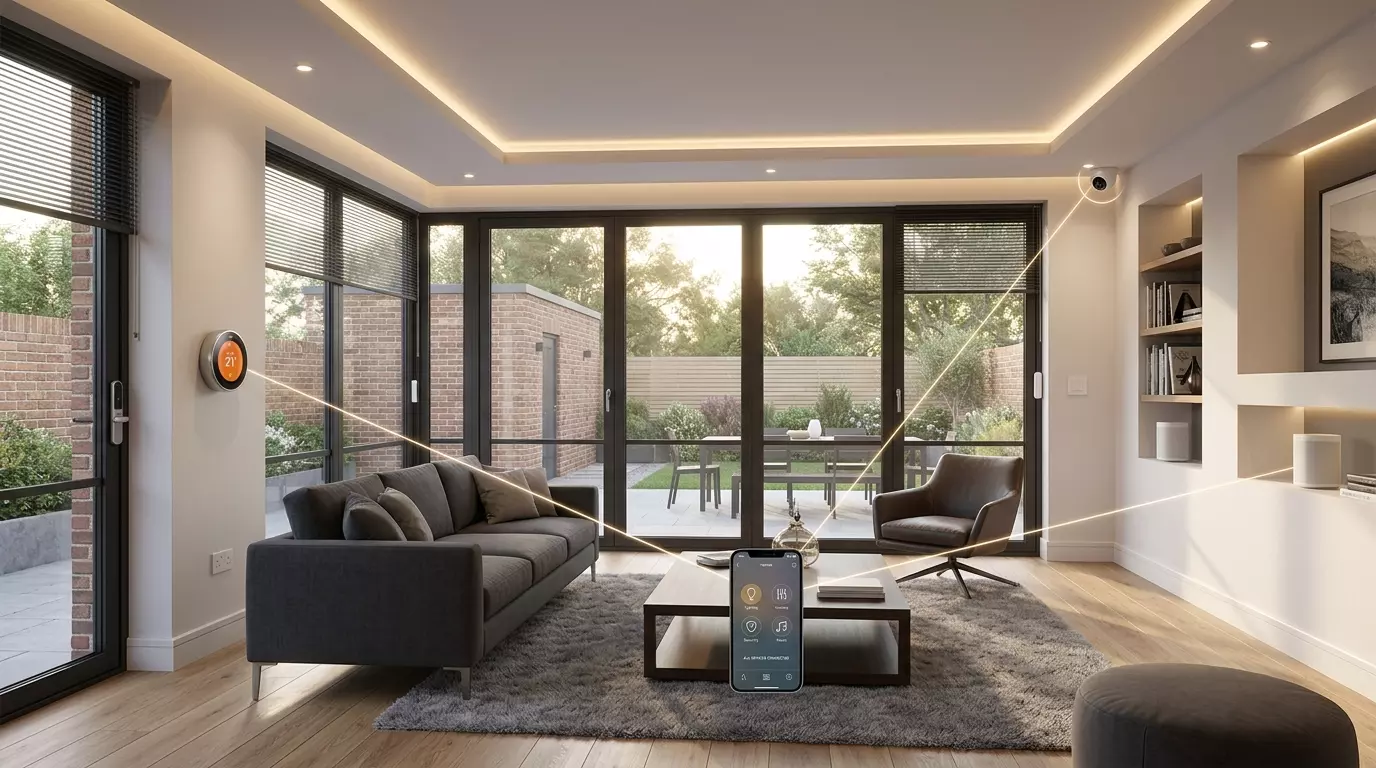
Smart Home Technology and the Rise of Home Automation
Technology has changed the way we communicate, work, shop and entertain ourselves. Now, it is transforming the way we live at home.
From intelligent lighting and automated heating to connected security cameras and voice-controlled devices, smart technology is becoming an increasingly important part of modern households.
What was once considered futuristic is now accessible to homeowners across the UK. With the right equipment and professional planning, everyday household tasks can become simpler, more efficient and more convenient.
This is where home automation services can make a real difference. Rather than simply installing individual smart devices, a well-designed system can connect different technologies so they work together as one intelligent home environment.
What Is Smart Home Automation?
Smart home automation involves connecting household devices and systems to a network so they can be monitored, controlled or automated.
Depending on the setup, homeowners can manage devices through smartphones, tablets, voice assistants, wall-mounted controls or automated schedules.
For example, instead of manually switching lights on and off throughout the house, an automated system could turn lights on when someone enters a room.
Heating can be adjusted according to occupancy or a timetable, while security cameras can send notifications when unusual activity is detected.
The real benefit comes from making different systems communicate with one another.
A smart thermostat, lighting system, security equipment and home entertainment system can potentially form part of a wider connected environment.
Professional planning is important because reliable automation depends on strong networking, compatible equipment and sensible configuration.
Smart Lighting, Heating and Energy Management
One of the easiest ways to experience the benefits of smart technology is through lighting and heating.
Smart lighting allows homeowners to control individual lights or entire rooms remotely. Lights can be scheduled to switch on at particular times, dim automatically or respond to occupancy. This can provide convenience while also helping reduce unnecessary energy consumption.
Heating can become more intelligent too. Smart thermostats can provide greater control over temperature and schedules, allowing homeowners to adjust settings remotely when required.
For instance, if you are away from home and realise the heating has been left on, you may be able to adjust it from your phone. Similarly, automated schedules can help ensure that heating is not running unnecessarily when the property is empty.
When properly configured, smart technology can therefore support a more comfortable home while helping homeowners make better use of energy.
Read: Top 10 Home Automation Dubai Trends You Should Know
Home Security Is Becoming More Intelligent
Security is another major area where smart home automation is making an impact.
Modern homes can incorporate connected doorbells, CCTV cameras, motion sensors, smart locks, alarms and access-control systems. These technologies can provide homeowners with greater visibility over what is happening around their property.
A connected doorbell, for example, can notify you when someone approaches your front door. Security cameras can allow remote viewing, while motion sensors can trigger alerts when activity is detected.
However, adding security devices is only part of the solution. The underlying network needs to be reliable and secure. Poor Wi-Fi coverage, weak passwords, outdated firmware or incorrectly configured devices can create unnecessary problems.
Professional home automation services can help ensure that smart security equipment is installed as part of a properly planned and protected network rather than operating as isolated gadgets.
Entertainment and Everyday Convenience
Smart technology is not only about security and energy efficiency. It can also make everyday life more enjoyable.
Home entertainment systems can be integrated with lighting, audio and displays to create customised experiences. Imagine watching a film and having the room lighting automatically dim while your television and sound system switch to the appropriate settings.
Multi-room audio can allow music to be played in different areas of the property, while smart controls can provide centralised access to multiple devices.
Automation can also help with simple daily routines. Curtains or blinds can be scheduled to open in the morning, outdoor lighting can activate around sunset, and selected appliances can be controlled remotely where compatible and safely configured.
The objective is not to automate everything simply because technology allows it. Good automation focuses on making useful tasks easier without making the home unnecessarily complicated.
The Importance of a Strong Home Network
Behind almost every modern smart home is a reliable network.
As the number of connected devices increases, the demands placed on home networking equipment also increase. Phones, laptops, televisions, cameras, thermostats, speakers and smart appliances may all need reliable connectivity.
This means that Wi-Fi coverage and network infrastructure should be considered before adding large numbers of smart devices.
A professionally designed network can help reduce dead zones, improve reliability and provide better performance throughout the property. In larger homes, additional access points or structured network infrastructure may be appropriate.
Security is equally important. Smart devices should use strong passwords, receive regular firmware updates and, where appropriate, be separated from other network devices.
This is one reason why professional home automation services should consider the entire technology environment rather than focusing solely on individual products.
Making Smart Technology Work for Your Home
Every property and household has different requirements. A small installation might involve smart lighting, a thermostat and a video doorbell, while a larger project could incorporate networking,
CCTV, access control, lighting, heating, entertainment and multiple automated routines.
The best approach is to start with practical goals.
Ask what you actually want the technology to achieve. Is the priority better security? Improved energy management? Easier control of the home? Entertainment? Or a combination of several areas?
From there, the system can be designed around those requirements.
Professional installation can also help avoid compatibility problems. Not every smart device works seamlessly with every platform, and adding products without considering the wider system can result in a collection of disconnected applications and controls.
A carefully planned solution should feel straightforward to use.
The Future of Home Automation
Smart home technology is continuing to develop, and artificial intelligence is likely to play an increasingly important role.
Future systems may become better at understanding household routines, identifying unusual activity and adjusting environments automatically.
However, the most valuable smart home is not necessarily the one with the largest number of devices. It is the one where technology solves genuine problems and works reliably in the background.
For homeowners considering automation, investing in good networking, secure equipment and professional configuration can provide a much stronger foundation than simply purchasing individual gadgets.
A Smarter Home Starts With Better Planning
The rise of smart technology is changing expectations about what a modern home can do. From automated lighting and heating to intelligent security and connected entertainment, homeowners now have more control than ever before.
But successful automation is about more than having smart devices. It requires reliable connectivity, compatible systems, appropriate security and thoughtful design.
With professional home automation services, homeowners can create a connected environment that is practical, secure and easy to use.
Whether you are starting with a single smart device or planning a complete automated home, good technology should ultimately make everyday living simpler—not more complicated.