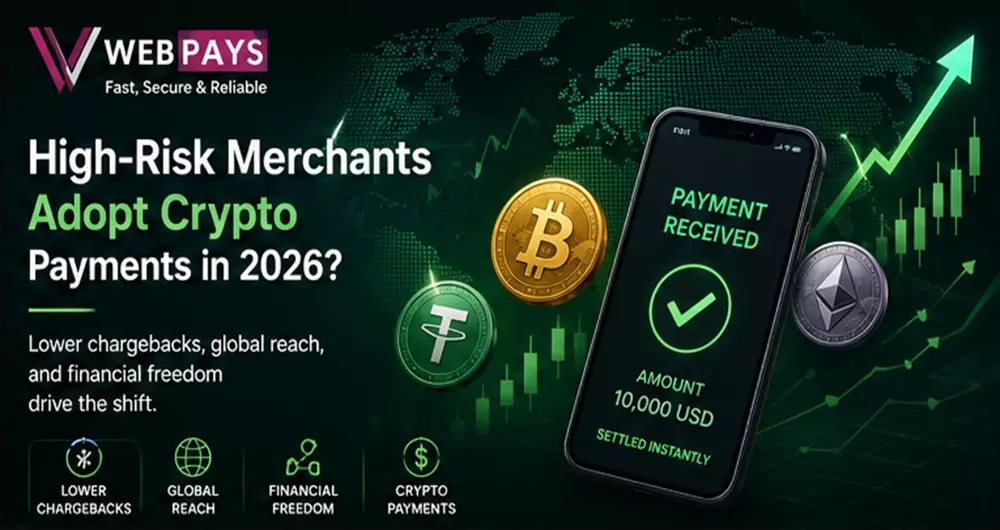
Should High-Risk Merchants Adopt Crypto Payments in 2026? Weighing the Real Risks and Rewards
Crypto adoption can meaningfully help high-risk merchants — lower fees, faster settlement, no chargebacks, and access to underbanked markets — but it also carries real volatility, security, and compliance risks that shouldn't be waved away.
For most high-risk businesses, the safer path in 2026 is treating crypto as a diversification layer alongside traditional processing, not a full replacement for it.
Why Crypto Looks Attractive to High-Risk Merchants
Merchants in adult content, gaming, subscriptions, and other regulated verticals are routinely shut out or squeezed by mainstream processors: account freezes, high fees, and thin acceptance rates are common complaints.
Against that backdrop, crypto gateways look appealing for concrete reasons — lighter onboarding requirements, fees that are often a fraction of card processing costs, and growing consumer demand.
Surveys of retailers consistently show a large majority now prioritizing cryptocurrency acceptance, driven in large part by growing customer interest rather than merchant preference alone.
Accepting crypto isn't just about cutting costs, either — for many customers, it signals a business that's forward-thinking and tech-comfortable, which matters with younger, digitally native buyers.
The Risks That Don't Get Enough Attention
Volatility Is Still Real
Even with stablecoins reducing the sharpest swings, merchants settling directly in volatile assets can lose meaningful value in the hours between a sale and conversion to fiat.
This is the single biggest reason most serious PSPs recommend automatic fiat conversion rather than merchants holding crypto themselves.
Security Is a Genuine Concern
Industry surveys consistently find that a significant share of merchants worry about fraud, hacking, and phishing tied to crypto acceptance — and unlike card payments, crypto transactions offer no built-in chargeback protection. A loss from a compromised wallet or a fraudulent transaction is typically permanent.
Compliance Is Fragmented, Not Simplified
KYC and AML requirements for crypto vary significantly by jurisdiction, and privacy-conscious customers frequently abandon onboarding flows that ask for more verification than they expect.
For merchants already operating in regulated verticals like adult content or gaming, this adds a second layer of compliance complexity on top of what they already manage for card processing.
Regulators Are Watching Closely
Financial regulators globally have been increasingly vocal about crypto-related risk. U.S. banking regulators have flagged liquidity risks tied to crypto-exposed clients; Europea
n regulators have warned providers against overstating their regulated status under frameworks like MiCA; and enforcement actions — including multimillion-pound fines against crypto platforms for compliance failures — signal that scrutiny is rising, not easing.
Weighing It Honestly
Benefit
Real Trade-Off
Lower processing fees
Security and fraud exposure with no chargeback safety net
No chargebacks
Losses from fraud or errors are typically permanent
Faster cross-border reach
Fragmented, evolving compliance requirements by jurisdiction
Appeals to tech-savvy customers
Price volatility if not converted to fiat quickly
Read: Bitcoin Merchant Account 2026: Crypto Payment Solutions for
A Safer Path Forward
For high-risk merchants seriously considering crypto adoption in 2026, the more defensible approach looks like this:
- Use stablecoins or instant-conversion services to minimize exposure to price swings.
- Choose a payment provider that enforces real KYC/AML controls rather than treating crypto as a compliance-light shortcut.
- Layer in wallet verification and real-time transaction monitoring as standard, not optional, features.
- Treat crypto as one channel in a diversified payment strategy — not a wholesale replacement for card processing.
FAQ
Is crypto payment processing actually cheaper than card processing?
Often, yes — network fees on cryptocurrencies like Solana can be a fraction of a cent, well below typical card interchange and cross-border fees. But total cost also depends on conversion fees, compliance overhead, and any fraud losses, which aren't always factored into initial comparisons.
Can crypto payments replace card processing entirely for a high-risk merchant?
For most merchants, no — not yet. Crypto works best as a complement to card processing, expanding reach and reducing chargeback exposure, rather than a full substitute, given ongoing volatility and jurisdictional compliance differences.
What's the biggest risk high-risk merchants underestimate with crypto?
Compliance fragmentation. Rules differ by jurisdiction and change quickly, and unlike card-network disputes, crypto losses from fraud or compliance failures are generally not reversible.
The Bottom Line
Crypto adoption isn't a gimmick, and it isn't a silver bullet either. For high-risk merchants, it's a genuine tool — one that reduces certain risks (chargebacks, banking dependency) while introducing others (volatility, fragmented compliance, fraud exposure with no reversal mechanism).
The merchants getting real value from it are the ones treating it as a carefully governed addition to their payment stack, backed by a provider that handles conversion, KYC, and monitoring properly — not as an unregulated shortcut around the problems traditional processing already solved.