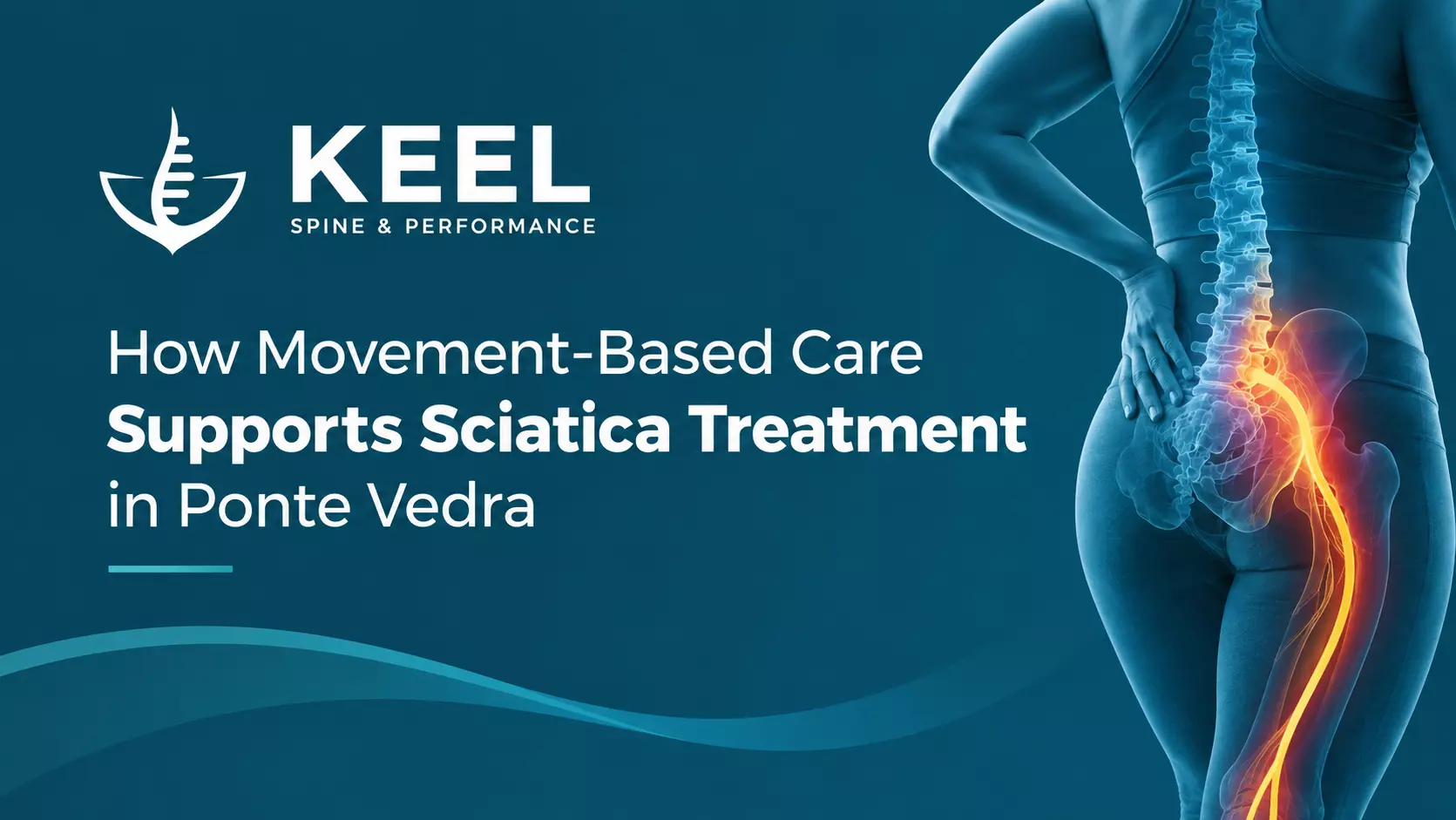
How Movement-Based Care Supports Sciatica Treatment in Ponte Vedra
Sciatica pain disrupts everything. The radiating ache down your leg, sudden sharp jabs when you move the wrong way, the constant worry about what movement will trigger pain next it wears on you in ways others don't always see.
If you're in Ponte Vedra or the Jacksonville area dealing with sciatica, you have options. Many people get relief through movement-based care an approach that works differently than the old "rest and ice" method or pain medication alone.
At KeelSpine, we've worked with patients who overcame sciatica by learning proper movement patterns, strengthening the right muscles, and gradually returning to the activities they enjoy.
Sciatica treatment that focuses on movement therapy addresses what's actually causing your pain instead of just masking symptoms.This guide walks you through how movement-based care works and what that path looks like.
What Causes Sciatica Pain?
Sciatica happens when something compresses or irritates your sciatic nerve the longest nerve running through your body.
Usually it's a herniated disc, bone spur, or tight muscle doing the compressing. That pressure sends pain, numbness, or tingling down your leg from your lower back through your buttock.
Common culprits include poor posture, weak core muscles, tight hip flexors, or a sudden awkward movement.
Your body reacts by tensing the muscles around the area to protect it. Problem is, that muscular tightening can actually make the compression worse a cycle that keeps pain going. Movement-based care interrupts that cycle.
The Power of Movement-Based Care
How Does Movement Therapy Help?
Movement therapy for sciatica works in a few straightforward ways:
Decompression: Certain movements create space between your vertebrae, which reduces nerve pressure. Unlike lying in bed, active movement lets your body deliver nutrients to damaged tissue and heal itself.
Muscle Activation: Weak core and glute muscles often contribute to sciatica. Exercises wake up these stabilizers, which take load off the nerve and support your spine properly.
Improved Mobility: Tight hamstrings, hip rotators, and low back muscles keep your pain going. Stretching and movement work restores your normal patterns so the same activities stop triggering pain.
Neural Mobility: The sciatic nerve can get stuck by inflammation and scar tissue. Movement helps it move freely again during everyday tasks.
Why This Beats Rest Alone
Rest makes sense right after an injury, but staying still too long weakens muscles and tightens joints both make sciatica worse. Non-surgical sciatica treatment using movement sidesteps that trap. You don't avoid movement; you learn to move correctly.
It's similar to physical therapy, but from a chiropractic angle that also factors in spinal alignment and how you sit, stand, and walk.
Read: Pain Management Doctors in Queens NY: How to Find the Right
What To Expect During Movement-Based Care
Treatment usually follows a pattern like this:
Week 1-2: Assessment & Gentle Mobility: Your practitioner finds which movements bother you and which ones don't. Early sessions focus on pain-free movement to bring down swelling and ease discomfort.
Week 3-4: Activation & Strengthening: As pain drops, you start exercising to activate deep stabilizer muscles. Exercises get harder but stay comfortable. This is when most people feel real improvement.
Week 5-8: Integration & Functional Movement: Exercises now mimic what you actually do bending, lifting, sitting, walking. Your nervous system learns that these movements don't equal pain anymore.
Ongoing: Prevention & Maintenance: After pain disappears, occasional check-ins and a home routine keep your muscles strong and prevent flare-ups from returning.