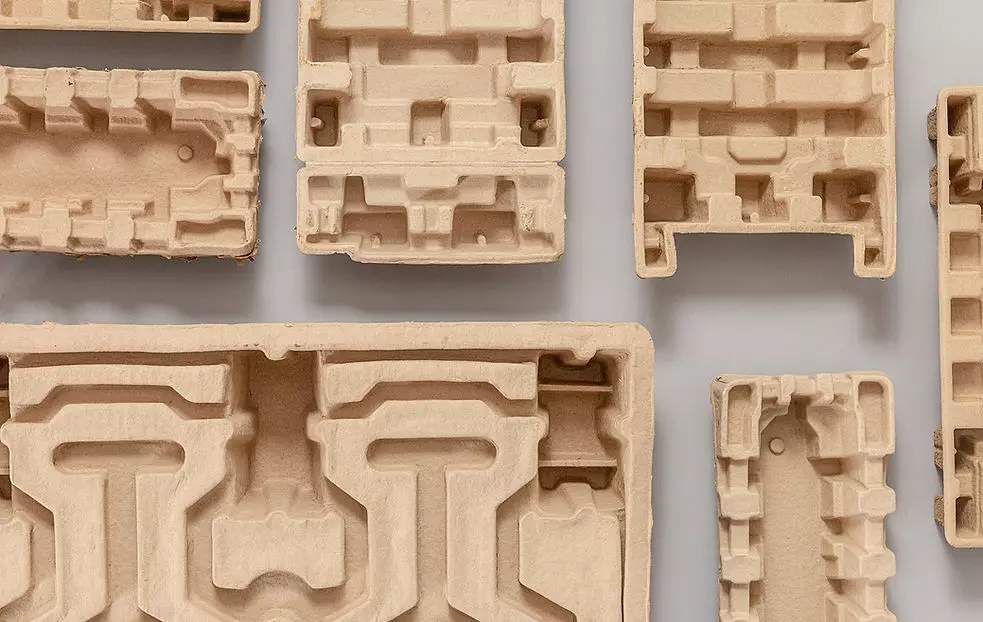
Moulded Pulp Packaging Sees Rising Demand in Electronics, Food, and Cosmetics
Moulded pulp has moved from a niche packaging option into a mainstay across supply chains, and three industries are largely responsible for that shift: electronics, food service, and cosmetics.
Each one uses the material for a different job — electronics companies need reliable cushioning to protect sensitive parts, food businesses want trays and carriers that hold up against grease and moisture, and cosmetics brands use it to give their packaging a polished, upscale feel while still hitting sustainability targets.
Forget the image of the basic egg carton. Production methods have improved to the point where pulp can now be moulded with real precision, formed around unusual shapes, and given either a smooth or textured finish depending on what a brand is going for.
That adaptability, combined with the fact that the material breaks down naturally, is what's allowed it to compete directly with foam and plastic packaging in industry after industry.
Why the Momentum Keeps Building
The move away from single-use plastic has stopped being just a talking point — it's now baked into law in many places, and companies are having to rethink their packaging as a result.
Moulded pulp works well here because it can be made from either recycled or virgin fibre and moulded into almost any shape a product calls for, while still decomposing naturally once it's no longer needed.
The numbers reflect this shift. Research estimates put the global moulded pulp packaging market at more than USD 4 billion in 2023, with forecasts pointing to annual growth above 5% through 2030.
Electronics and food packaging are named as the two biggest drivers of that growth, which lines up with how much weight those industries carry in sustainable packaging discussions right now.
What this really shows is that the growth isn't random. It comes down to real, measurable benefits — lower costs, simpler regulatory compliance, and a better impression with customers — and those benefits are showing up across entire supply chains, not just in a handful of test runs.
Electronics: Protecting High-Value Components Without the Plastic
Why Electronics Brands Are Making the Switch
Electronics companies are dealing with a bit of a contradiction: their products keep getting slimmer and more fragile, but shipping and handling haven't gotten any gentler.
Moulded pulp addresses that by providing cushioning engineered to absorb and spread out impact, taking over a job that foam used to handle — without leaving behind the same environmental footprint. There's a brand-perception benefit too, since the unboxing experience has become something consumer electronics companies pay close attention to.
Major names like Apple, Dell, and Samsung have shifted toward fibre-based packaging for things like product inserts, inner trays, and end caps. It's not purely a sustainability move, either — it's practical from a logistics standpoint. Pulp components stack cleanly, nest together consistently, and take up less warehouse space than foam ever did.
Specific Use Cases in Electronics Packaging
- Inner trays and inserts for smartphones, tablets, and wearables
- End caps and corner protectors for monitors, laptops, and televisions
- Component separators for multi-part kits and accessories
- Void fill structures that replace foam blocks in shipping cartons
The key performance metric here is cushioning efficiency — how much energy the packaging absorbs per unit of material. Thick-wall and transfer moulded pulp grades are specifically designed to hit the dynamic cushioning curves required by electronics OEM specifications.
Food Service and Food Retail: Where Pulp Packaging Use Cases Are Most Diverse
From Farm to Table — Pulp Covers Every Stage
Food is where moulded pulp has the longest history and the widest surface area of use. Egg cartons are the obvious example, but the material's role in food packaging now spans fresh produce trays, meat and poultry packaging, quick-service restaurant carriers, cup holders, and institutional food service ware.
For fresh produce, moulded pulp trays offer natural breathability that reduces condensation and extends shelf life — a functional advantage that plastic clamshells cannot easily replicate. For foodservice, moulded pulp plates, bowls, and trays are increasingly replacing single-use plastics in stadiums, airports, and corporate dining facilities.
Regulatory Drivers in Food Packaging
The EU Single-Use Plastics Directive, which came into force in 2021, effectively banned many disposable plastic food and beverage containers across EU member states.
Similar legislation is progressing in the UK, Canada, and several Asian markets. This regulatory pressure has directly accelerated adoption of industrial pulp packaging in food service, creating structural long-term demand rather than a trend-driven spike.
Food-grade moulded pulp products must meet specific standards around moisture resistance, grease resistance, and food contact safety. Manufacturers address this through barrier coatings or by selecting food-safe fibre grades — an important consideration for buyers evaluating suppliers.
Common Food Industry Applications
- Egg cartons and berry punnets
- Meat and seafood packaging trays (with barrier liners)
- Fruit separators and cushioning trays for premium produce
- Takeaway food containers and cup carriers
- Institutional catering trays for airlines and hospitals
Cosmetics and Personal Care: Sustainable Packaging as a Brand Asset
Why Cosmetic Brands Are Investing in Moulded Pulp
The cosmetics sector has a specific challenge: packaging needs to be protective, beautiful, and increasingly sustainable — all at once. Moulded pulp delivers all three when specified correctly.
Premium cosmetic brands use it for inner fitments, outer gift box inserts, and even primary packaging components, treating it as a design surface rather than a hidden structural element.
The material's natural texture and matte finish have become a design language in their own right, signalling eco-consciousness without sacrificing perceived value.
Brands like Lush, The Body Shop, and various independent skincare labels have adopted moulded pulp packaging to align with circular economy commitments and appeal to environmentally aware consumers.
Read: The Science Behind Fresh, Safe, and Sustainable Burgers
Pulp Packaging Use Cases in Cosmetics
- Gift set inserts that hold bottles, jars, and tubes securely
- Retail shelf-ready trays for displaying product ranges
- E-commerce protective inserts that replace bubble wrap and foam peanuts
- Primary packaging for solid beauty bars, refills, and zero-waste formats
Fine-detail moulding — achievable through thermoformed pulp processes — allows for brand embossing, geometric patterns, and product-specific cavity shapes that previously required rigid plastics. This level of customisation has changed how cosmetic packaging designers view the material.
Comparing Industry Requirements: A Quick Reference
Industry
Primary Need
Moulded Pulp Grade
Key Benefit
Electronics
Shock absorption, dimensional accuracy
Thick-wall / Transfer moulded
Replaces EPS foam, reduces plastic use
Food Service
Food safety, moisture handling
Thin-wall / Processed
Compostable, regulatory compliant
Cosmetics
Aesthetics, custom fit, brand storytelling
Thermoformed / Processed
Premium finish, design flexibility
What Buyers Should Evaluate When Sourcing Industrial Pulp Packaging
Across all three industries, procurement decisions come down to more than price per unit. The following factors consistently determine supplier selection:
- Fibre source and certification — FSC or PEFC certification confirms responsible sourcing
- Custom tooling capability — Can the supplier produce bespoke cavity shapes at your required volume?
- Moisture and grease resistance — Especially critical for food and electronics applications
- Lead times and minimum order quantities — Critical for seasonal or high-SKU operations
- Compliance documentation — Food contact compliance, REACH, and regional import requirements
Jishan Berhad Group supplies moulded pulp solutions tailored to each of these sectors, with product configurations designed around the specific structural and aesthetic demands of electronics, food, and cosmetics packaging.
For businesses sourcing at scale, working with a manufacturer that understands the technical differences between pulp grades — not just one that offers a standard catalogue — makes a measurable difference in performance and cost outcomes.
Here's a rewritten version of the FAQ with original phrasing throughout.
FAQ
What is moulded pulp packaging used for in the electronics industry?
Electronics manufacturers rely on moulded pulp for internal trays, corner guards, component dividers, and protective end caps. The material is shaped to absorb impact during shipping, taking over a role that expanded polystyrene foam used to fill.
There's also a branding angle here — many electronics companies now treat the unboxing moment as part of the customer experience, and pulp packaging's clean, structured look fits that goal well.
Is moulded pulp packaging safe for direct contact with food?
It can be, as long as it's made to food-grade standards. Suppliers use food-safe fibre and can apply barrier coatings that help the packaging resist grease and moisture.
That said, food contact regulations vary by country, so it's worth asking any supplier for proof of compliance — migration test results in particular — before putting the packaging into direct contact with food products.
Why are cosmetics brands moving toward moulded pulp?
A few reasons converge here. Sustainability targets are pushing beauty brands to cut back on plastic, and pulp packaging offers a straightforward way to do that.
On top of the environmental angle, it has a natural, tactile look that fits well with premium product positioning, and it can be moulded into detailed custom shapes for inserts or gift packaging. Brands get the eco-credentials and the aesthetic upgrade in one move.
What are the main grades of moulded pulp, and how are they different?
There are generally four categories: thick-wall, thin-wall (also called transfer moulded), thermoformed, and heavily processed. Thick-wall pulp is built for rugged, heavy-duty cushioning — think electronics and industrial shipments. Thin-wall has a smoother finish and works well for food service items.
Thermoformed and heavily processed grades deliver the most refined surface quality, which is why they're the go-to choice for cosmetics packaging and other premium retail applications where appearance matters.
How does moulded pulp help companies stay compliant with plastic regulations?
Because it's biodegradable, compostable, and made from renewable fibre, moulded pulp typically qualifies as an approved substitute under plastic-reduction laws like the EU's Single-Use Plastics Directive and comparable rules elsewhere.
For companies tracking ESG goals or reporting on sustainability commitments, using certified pulp packaging gives them something concrete to point to.
What should businesses check before choosing an industrial pulp packaging supplier?
A few things matter most: fibre certifications like FSC or PEFC, whether the supplier can produce custom tooling, which pulp grades they offer, food-safety documentation (if relevant to your product), plus their minimum order sizes and typical lead times.
It also helps to pick a supplier who's already worked in your industry, since electronics, food, and cosmetics packaging each come with their own structural and finish requirements.