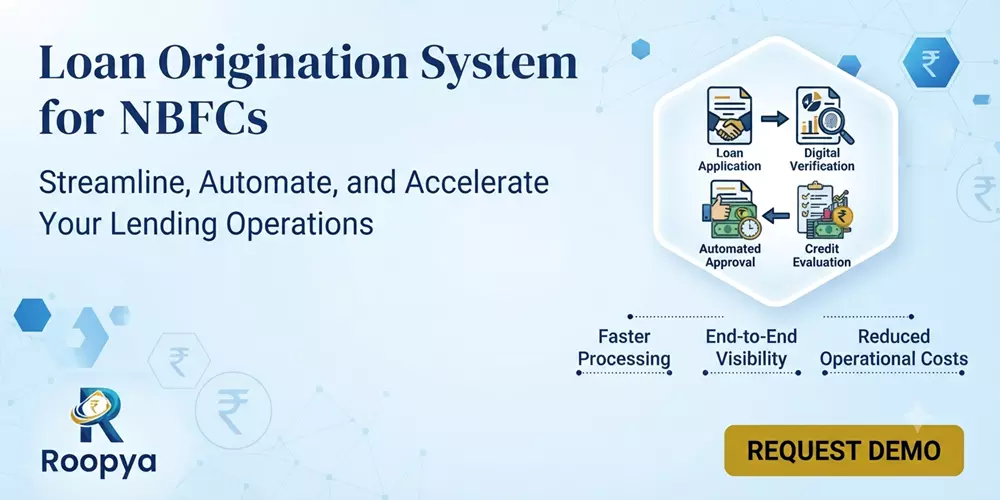
Loan LOS for NBFCs: The Complete Guide to Modern Loan Origination Systems
Non-Banking Financial Companies (NBFCs) have become the backbone of India's credit expansion story.
From personal loans and gold loans to MSME financing and embedded credit at the point of sale, NBFCs now serve millions of borrowers that traditional banks often overlook.
But this growth brings a challenge: how do you originate thousands of loans a day, underwrite them accurately, stay compliant with RBI norms, and still deliver a fast, digital-first borrower experience?
The answer lies in a Loan Origination System (LOS) — purpose-built software that automates and manages the entire loan application journey, from the moment a customer applies to the moment funds are disbursed.
In this guide, we break down what a Loan LOS for NBFCs actually is, why it matters, what features to look for, and how the right platform can become a genuine competitive advantage.
What Is a Loan Origination System (LOS)?
A Loan Origination System is a digital platform that manages every step of the lending lifecycle up to disbursement — application intake,
KYC and document verification, credit bureau checks, underwriting, business rule-based decisioning, approval workflows, loan agreement generation, and fund disbursal. Think of it as the operating system for how an NBFC acquires and evaluates borrowers.
Before LOS platforms existed, NBFCs relied on spreadsheets, physical paperwork, and manual credit checks.
Loan officers had to individually verify documents, calculate eligibility, and coordinate approvals across departments — a process that could take days or even weeks.
An LOS replaces this fragmented workflow with a single, automated, rules-driven system that can process an application end-to-end in minutes.
For NBFCs specifically, an LOS isn't a luxury — it is fast becoming a survival requirement.
NBFCs operate in a hyper-competitive market against banks, fintech lenders, and other NBFCs, all racing to capture the same digitally native borrower.
Speed of decisioning and a frictionless application journey are now primary differentiators, and only a robust LOS can deliver both consistently.
Why NBFCs Need a Dedicated Loan Origination System
1. Volume and Speed Pressures
NBFCs increasingly deal with high-volume, small-ticket lending — personal loans, payday advances, and embedded finance products distributed through partner apps and marketplaces.
Manually processing thousands of such applications simply isn't viable. An LOS enables straight-through processing so that low-risk applications can be approved almost instantly, while only edge cases require human review.
2. Regulatory Complexity
NBFCs are governed by RBI's Scale-Based Regulation (SBR) framework, fair practices code, digital lending guidelines, and KYC/AML norms. Manual processes make it difficult to consistently enforce these rules across every loan file.
A well-designed LOS bakes compliance directly into the workflow — mandatory checks can't be skipped, audit trails are automatically maintained, and reporting is built-in rather than reconstructed after the fact.
3. Multiple Loan Products, One Platform
Many NBFCs no longer offer just one loan type. They run personal loans, business loans, gold loans, vehicle loans, and BNPL-style products simultaneously — often through different sourcing channels (in-house, DSAs, co-lending partners, embedded finance APIs).
A modern LOS needs to support all these products and channels from a single configurable platform rather than requiring separate systems for each.
4. Rising Borrower Expectations
Today's borrower expects a UPI-like experience: apply on a mobile phone, upload documents digitally, get a decision in minutes, and receive funds the same day. NBFCs that still rely on manual, paper-heavy processes lose these customers to competitors offering instant digital journeys.
5. Risk and Fraud Management
Digital lending has also opened the door to more sophisticated fraud — synthetic identities, doctored documents, and bureau manipulation.
NBFCs need automated fraud detection and multi-bureau checks built into the origination flow itself, not bolted on afterward.
Core Features of a Strong Loan LOS for NBFCs
When evaluating an LOS, NBFCs should look beyond a basic digital application form. A genuinely capable platform includes the following core modules:
- Digital Application & Onboarding A mobile- and web-friendly application form that captures borrower details, supports co-applicants and guarantors, and allows document upload directly from a smartphone camera or Digilocker.
- KYC and Identity Verification Integration with Aadhaar-based eKYC, PAN verification, video KYC, and liveness/face-match checks to establish borrower identity digitally and in compliance with RBI's KYC master directions.
- Multi-Bureau Credit Checks Real-time pulls from CIBIL, Experian, Equifax, and CRIF High Mark, along with the ability to cross-reference multiple bureaus for a more complete risk picture.
- Business Rule Engine (BRE) A no-code or low-code rules engine that lets credit and risk teams configure eligibility criteria, income multipliers, FOIR (Fixed Obligation to Income Ratio) limits, and approval thresholds without needing developer support for every policy change.
- Automated Credit Scoring and Decisioning Application scorecards, alternative data models, and AI-driven risk assessment that generate a risk grade and recommended decision — approve, reject, or refer for manual review — in real time.
- Document Verification and OCR AI-powered optical character recognition (OCR) that extracts data from bank statements, salary slips, ITRs, and identity documents, cross-checks it against declared information, and flags inconsistencies automatically.
- Fraud Detection Pattern recognition and anomaly detection modules that catch duplicate applications, mismatched device/location signals, doctored documents, and known fraud rings.
- Workflow and Approval Management Configurable, role-based approval hierarchies so that applications route automatically to the right underwriter, credit manager, or committee based on ticket size, product, or risk grade.
- Loan Agreement and e-Signing Auto-generated, product-specific loan agreements with integrated e-stamping and e-signature (Aadhaar eSign) to eliminate physical paperwork entirely.
- Disbursement Integration Direct integration with payment rails (IMPS, NEFT, UPI) and banking partners so approved loans can be disbursed the same day, sometimes within minutes.
- Partner and DSA/LSP Onboarding Modules to onboard, manage, and pay commissions to Direct Selling Agents (DSAs) and Loan Service Providers (LSPs), including co-lending and embedded finance partners.
- Compliance and Audit Trail Automatic logging of every action taken on a loan file, along with regulatory reports (RBI returns, fair practices disclosures) generated with minimal manual effort.
- API-First Architecture Pre-integrated connections to credit bureaus, verification services (PAN, Aadhaar, GST, bank statement analyzers), and payment gateways, so NBFCs don't need to build and maintain dozens of point integrations themselves.
Read: Features of Modern Loan Origination Software
How the Loan Origination Process Works in an LOS
A typical origination journey inside a modern LOS looks like this:
- Application Capture: The borrower fills out a digital form (or applies via an embedded partner app), providing personal, employment, and financial details.
- Identity and KYC Verification: eKYC, PAN validation, and video KYC confirm the applicant's identity in real time.
- Document Upload and OCR Extraction: Bank statements, salary slips, and ID proofs are uploaded and automatically parsed for relevant data points.
- Bureau Pull and Credit Assessment: The system fetches credit bureau reports and calculates a risk score using the configured scorecard.
- Business Rule Evaluation: The BRE checks the application against eligibility policies — income thresholds, FOIR limits, blacklist checks, and product-specific rules.
- Fraud Screening: Automated fraud checks run in parallel, flagging any anomalies for manual review.
- Decisioning: Low-risk, policy-compliant applications are auto-approved; borderline cases are routed to underwriters; high-risk applications are auto-declined.
- Offer Generation: Approved applicants receive a loan offer with interest rate, tenure, and EMI details, often personalized using risk-based pricing.
- Agreement and e-Sign: The borrower reviews and digitally signs the loan agreement.
- Disbursement: Funds are transferred directly to the borrower's bank account, often on the same day.
What once took days of manual coordination across multiple departments can now be compressed into minutes — without compromising on risk discipline.
Key Benefits of Implementing a Loan LOS
- Faster Turnaround Times Automated decisioning and straight-through processing can cut loan approval times from days to minutes, directly improving conversion rates and customer satisfaction.
- Lower Operating Costs By automating manual, repetitive tasks — data entry, document checks, bureau pulls — NBFCs reduce the headcount needed per loan processed, improving unit economics, especially critical for small-ticket lending where margins are thin.
- Improved Risk Management Consistent, rules-based underwriting reduces the variability and subjectivity that comes with manual credit assessment, leading to better portfolio quality over time.
- Regulatory Compliance by Design Mandatory checks, disclosures, and audit trails are embedded into the workflow itself, significantly reducing compliance risk and the effort needed for regulatory reporting.
- Scalability A cloud-based LOS can handle sudden spikes in application volume — during festive lending seasons, for instance — without a proportional increase in manual staff.
- Better Borrower Experience A fast, transparent, mobile-first application journey builds trust and improves repeat borrowing and referrals, which matters enormously for customer lifetime value in retail lending.
- Data-Driven Decision Making Centralized data capture across the origination journey creates a rich dataset that feeds back into scorecard refinement, product design, and portfolio strategy.
- Multi-Product, Multi-Channel Flexibility A configurable LOS lets an NBFC launch new loan products or new sourcing partnerships (like embedded finance or co-lending) without rebuilding core infrastructure each time.
The Role of AI in Modern Loan LOS Platforms
Artificial intelligence has moved from a "nice-to-have" to a core capability inside leading LOS platforms.
- AI-powered document analysis automatically extracts and verifies data from bank statements, ITRs, and ID proofs with very high accuracy, catching inconsistencies and forged documents that a human reviewer might miss.
- Machine-learning credit scoring goes beyond bureau data to evaluate alternative signals — transaction patterns, utility payment history, digital footprint — enabling responsible lending to thin-file and new-to-credit borrowers.
- Self-learning business rule engines analyze historical approval and default patterns to suggest policy refinements, helping credit teams continuously tune their risk appetite.
- AI-driven fraud detection identifies suspicious patterns across large volumes of applications in real time — something rule-based systems alone often struggle to catch.
- Natural-language reporting allows business teams to query portfolio performance in plain English and receive instant analysis, reducing dependence on data teams for routine reporting.
For NBFCs, this means underwriting decisions that are not just faster, but often more accurate and more inclusive than traditional, purely bureau-driven approaches.
Choosing the Right Loan LOS for Your NBFC
Not all LOS platforms are built the same. NBFCs evaluating vendors should consider:
- Configurability: Can business and credit teams update rules, scorecards, and workflows themselves, without waiting on developer cycles?
- Speed to launch: How quickly can the platform go live — weeks, or months?
- Pre-built integrations: Does the vendor already have bureau, KYC, and payment integrations ready, or will these need to be built from scratch?
- Compliance readiness: Is the platform kept current with RBI's evolving digital lending and data protection guidelines?
- Pricing model: Is it a heavy upfront license fee, or a usage-based model that scales with loan volume?
- Product coverage: Does it support the specific loan products the NBFC offers today — and is it flexible enough for future products?
- Analytics depth: Does the platform offer built-in credit risk analytics, scorecard development, and portfolio reporting, or only origination workflows?
An LOS that combines no-code configurability, pre-integrated APIs, AI-based decisioning, and rapid go-live time gives NBFCs the agility to compete with digital-native lenders without needing a large in-house technology team.
Roopya: A Unified Lending Infrastructure Built for NBFCs
Platforms like Roopya illustrate where the LOS category is heading. Rather than treating origination as a standalone system,
Roopya positions its Loan Origination System as one module within a broader, unified lending infrastructure that also covers loan management, collections, early warning systems, and lending analytics — all accessible through a no-code interface.
For NBFCs, this kind of integrated approach matters because origination doesn't happen in isolation. Decisions made at the point of origination — the scorecard used, the documents verified, the rules applied — directly shape servicing, collections, and portfolio risk down the line.
A platform that connects origination with the rest of the loan lifecycle, backed by 300+ pre-integrated APIs, pre-configured loan products, and AI-powered fraud and document checks, allows NBFCs to go live quickly and scale usage-based costs in line with actual loan volumes rather than committing to large upfront technology investments.
For NBFCs operating in 2026's competitive, digitally driven lending landscape, a Loan Origination System is no longer optional infrastructure — it's the engine that determines how fast you can grow, how well you manage risk, and how good an experience you deliver to borrowers.
From automated KYC and multi-bureau credit checks to AI-powered fraud detection and no-code business rules, a well-built LOS compresses what used to take days into minutes, while embedding compliance and risk discipline into every step.
NBFCs evaluating their technology stack should look for a platform that isn't just a digital form, but a complete, configurable, and compliant origination engine — ideally one that connects seamlessly into loan management and collections, so the entire lending lifecycle operates as a single, data-driven system.
Frequently Asked Questions (FAQs)
1. What is a Loan Origination System (LOS) for NBFCs?
A Loan LOS is a digital platform that automates the entire loan application process for NBFCs — from application capture and KYC verification to credit checks, underwriting, approval, and disbursement — replacing manual, paperwork-heavy workflows.
2. Why do NBFCs need a Loan Origination System instead of manual processes?
Manual processes are slow, error-prone, and difficult to scale. An LOS enables NBFCs to process high volumes of applications quickly, apply consistent credit policies, stay compliant with RBI regulations, and deliver the fast digital experience borrowers now expect.
3. How long does it take to implement a Loan LOS?
Implementation timelines vary by vendor and complexity. Legacy systems can take several months to deploy, while modern no-code, cloud-based
platforms can go live in as little as a day to a few weeks, depending on customization needs.
4. Can one LOS support multiple loan products like personal loans, gold loans, and business loans?
Yes. Modern LOS platforms are built to be product-agnostic and configurable, allowing NBFCs to manage personal loans, business loans, gold loans, vehicle loans, and other products from a single system.
5. Is a Loan Origination System compliant with RBI regulations?
A well-designed LOS is built to support compliance with RBI's Scale-Based Regulation, digital lending guidelines, KYC master directions, and fair practices code by embedding mandatory checks, disclosures, and audit trails directly into the workflow. NBFCs should always verify a vendor's compliance posture during evaluation.
6. How does AI improve loan origination for NBFCs?
AI enhances origination through automated document verification (OCR), machine-learning-based credit scoring using alternative data, real-time fraud detection, and self-learning business rule engines that refine credit policies based on historical performance.
7. What is a Business Rule Engine (BRE) in an LOS?
A BRE is a configurable module that lets credit and risk teams define eligibility criteria, income and FOIR thresholds, and approval logic without needing developers to code each policy change — enabling faster, more flexible credit policy updates.
8. How much does a Loan LOS cost for an NBFC?
Pricing models vary — some vendors charge a large upfront license fee, while others use a pay-as-you-use model tied to loan volume or number of applications processed, which is often more cost-effective for growing NBFCs.
9. Can an LOS integrate with credit bureaus and payment systems?
Yes. Most modern LOS platforms come with pre-built integrations to credit bureaus (CIBIL, Experian, Equifax, CRIF High Mark), KYC providers, and payment rails (UPI, IMPS, NEFT) for real-time verification and disbursement.
10. What's the difference between a Loan Origination System (LOS) and a Loan Management System (LMS)?
An LOS handles everything up to loan disbursement — application, underwriting, and approval. An LMS takes over after disbursement, managing repayment schedules, payment processing, collections, and the ongoing customer relationship for the life of the loan.