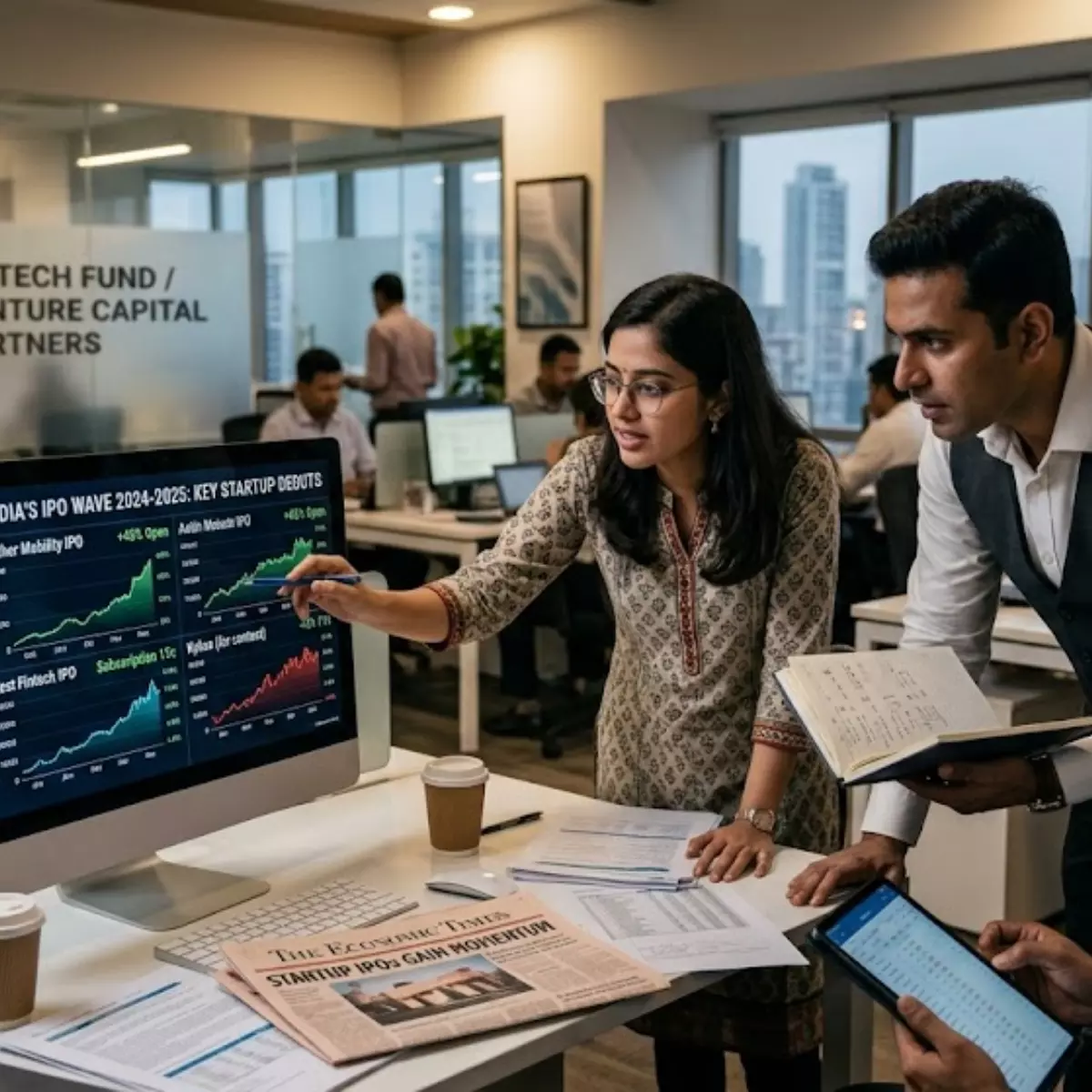
India’s IPO Wave Is Changing Startup Investor Sentiment
India’s public markets are entering an unusually active period, and the implications extend beyond listed companies.
A strong IPO pipeline can influence the entire startup ecosystem because public-market liquidity affects investor confidence, valuations, exit expectations and the willingness of private investors to provide growth capital.
A large group of companies is preparing to access the public markets, with 11 main-board companies expected to raise around ₹7,055 crore across a busy offering window.
A larger set of public issues is also scheduled, taking the total value above ₹7,300 crore according to market reports.
This creates an important signal for entrepreneurs and investors.
Why IPO Activity Matters to Venture Capital
- Venture capital depends partly on the possibility of future exits.
- When a startup investor provides capital at an early stage, the investment thesis often assumes that the company will eventually reach a larger financing round, strategic acquisition or public listing.
- A healthy IPO market can strengthen that exit pathway.
- It does not mean every startup should pursue an IPO. Most companies will never become public companies, and an IPO requires substantial scale, governance and regulatory preparation.
- However, a functioning public market provides a potential destination for companies that successfully grow beyond the startup phase.
- For investors, that can improve the attractiveness of earlier-stage investments.
Primary Capital Versus Secondary Liquidity
- One detail in the current IPO pipeline deserves attention.
- Of the ₹7,055 crore expected from the reported group of offerings, around ₹2,722 crore represents primary capital going into companies, while approximately ₹4,333 crore is secondary sales by existing shareholders.
- This distinction matters.
- Primary capital finances the company’s growth. Secondary sales provide liquidity to existing investors or shareholders.
- Both are important, but they have different economic implications.
- For startup investors, secondary liquidity can demonstrate that private capital can eventually realize returns without waiting indefinitely for a complete company exit.
Could Better Exits Create Better Startups?
- The startup ecosystem needs more than fundraising.
- It needs successful exits.
- When investors see credible exit pathways, they can become more willing to finance ambitious companies. Founders may also gain more flexibility when negotiating valuations because investors can evaluate businesses against realistic public-market comparables.
- This is why IPO markets can influence venture capital even when a particular startup is years away from listing.
Read: Best IPO Consultant for Startups in India
What Founders Should Learn From the IPO Rush
- The first lesson is governance.
- Founders sometimes treat governance as something that becomes important only after a company becomes large. That approach can create problems.
- Institutional investors increasingly expect financial reporting, clear ownership structures, responsible accounting and professional management before providing significant capital.
- A founder who builds these systems early can make future fundraising considerably easier.
- The second lesson is capital allocation.
- Public-market investors eventually ask whether management can use capital effectively. Venture investors are increasingly asking the same question.
- When founders prepare to raise capital, they should explain exactly what additional funding will accomplish.
- Will it expand distribution? Improve technology? Enter another market? Increase manufacturing capacity? Strengthen hiring?
- A funding round should have measurable objectives.
Southeast Asia and the Singapore Connection
- Singapore continues to function as an important financial and investment hub for the wider Asian ecosystem.
- For companies considering how to raise capital for startup Singapore, the Indian IPO environment provides a useful comparison. Both ecosystems demonstrate the importance of building businesses that can eventually attract multiple categories of capital.
- A strong startup may begin with angel investment, move into institutional venture capital, secure growth financing and eventually reach strategic or public-market investors.
- This progression means founders should think beyond the next funding round.
- They should consider the type of company they want to become.
The Role of Early-Stage Investors
- Early investors have a particularly important role because they often influence the company's financial culture.
- A founder who receives capital from an investor focused only on rapid growth may make very different decisions from a founder working with an investor who prioritizes sustainable economics.
- That is why founders should evaluate investors as carefully as investors evaluate founders.
- For a VC firm in Southeast Asia, this alignment can be especially important because regional expansion introduces additional complexity around regulation, hiring, currency, partnerships and customer behavior.
- Capital is only one component of the relationship.
Financial Adviser’s Perspective from Evolve Venture Capital
- From a financial adviser perspective, founders should not interpret a strong IPO market as a reason to accelerate fundraising blindly.
- Market conditions can change quickly.
- Instead, companies should build financial resilience.
- Maintain reasonable cash reserves. Track monthly burn. Understand the relationship between growth and capital requirements. Keep financial records investor-ready. Establish realistic valuation expectations.
- Investors should also avoid using IPO excitement as a substitute for fundamental analysis.
- The quality of the business still matters.
- A company with strong revenue, healthy margins, a defensible market position and experienced management is fundamentally different from a business whose valuation depends mainly on market enthusiasm.
- India’s current IPO activity is therefore best viewed as a signal rather than a guarantee.
- It signals stronger investor participation, improved liquidity and renewed confidence in growth companies. For startups, that can be encouraging.
- But the companies most likely to benefit will be those that build sustainable businesses long before they approach public markets.
- That is the central lesson Evolve Venture Capital would emphasize: fundraising is not the destination. Building an investable, scalable and durable company is.