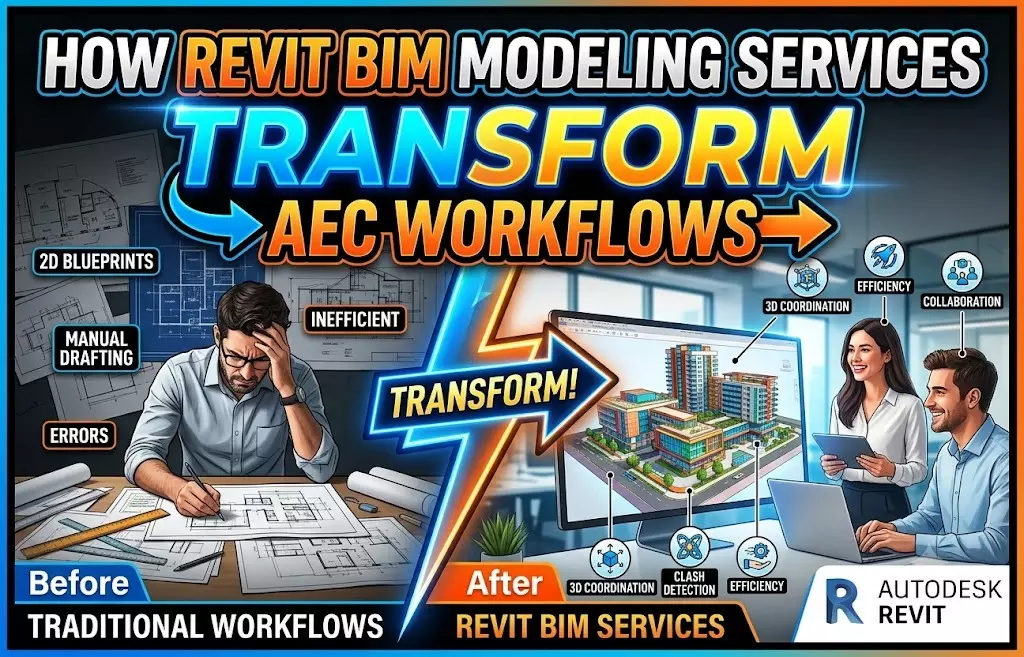
How Revit BIM Modeling Services Transform AEC Workflows
Revit BIM modeling services help architecture, engineering, and construction (AEC) teams design faster, coordinate better, and build smarter.
By centralizing project data in a single intelligent model, Revit reduces costly errors, streamlines documentation, and keeps projects on time and on budget.
The AEC industry has long struggled with fragmented workflows, communication breakdowns, and expensive on-site surprises. Drawings get misaligned.
Contractors find conflicts too late. Rework eats into budgets. These aren't new problems—but Revit BIM modeling services are changing how teams solve them.
Building Information Modeling (BIM) has fundamentally shifted how AEC professionals approach projects. Rather than working from static 2D drawings, teams now build intelligent 3D models that carry data about every component—from structural beams to HVAC ducts. Revit, developed by Autodesk, sits at the center of this shift and has become the go-to platform for BIM modeling across the globe.
This post breaks down exactly how Revit BIM modeling services improve AEC project workflows—from early design through final documentation—and why firms like Chudasama Outsourcing are helping project teams unlock the full value of BIM.
What Is Revit BIM Modeling?
Revit is a purpose-built BIM software platform designed for architects, structural engineers, MEP engineers, and construction professionals.
Unlike traditional CAD tools, which produce flat 2D drawings, Revit creates parametric 3D models where every element is connected. Change a wall dimension, and the floor plan, elevation, and schedule all update automatically.
This is the core difference between BIM and CAD. CAD produces drawings. BIM produces data-rich models that simulate the actual building before a single shovel hits the ground.
Revit takes this further by supporting multi-discipline collaboration within a shared environment, making it possible for architects, engineers, and contractors to work from the same central model in real time.
The result? Fewer surprises, faster decisions, and projects that stay closer to their original scope.
How Does Revit Enable Faster and More Accurate Design Creation?
Design in Revit moves quickly because the software handles the repetitive work. When a design element changes, every related view and document updates automatically.
This removes the manual effort of redrawing elevations or recalculating schedules—work that traditionally consumed hours of a designer's time.
More importantly, Revit's parametric modeling means accuracy is built in. Dimensions stay consistent. Material quantities calculate in real time.
Structural loads update as the design evolves. For architects and engineers working on complex projects, this level of precision dramatically reduces the margin for human error during the design phase.
Collaboration improves just as significantly. Teams across different disciplines can access and update the same model simultaneously using Revit's worksharing tools. An architect adjusting a floor plan and a structural engineer updating beam sizes can work in parallel—without waiting for files to be sent back and forth.
Read: Top Advantages of Using Revit Drafting Services for Engineers
How Does BIM Modeling Reduce Construction Costs and Errors?
One of the most tangible benefits of Revit BIM modeling services is early conflict detection. Revit's clash detection tools identify where building systems overlap or conflict before construction begins—for example, where an HVAC duct runs through a structural beam.
Catching these conflicts in the model costs a fraction of what it costs to fix them on-site.
According to research published by the Construction Industry Institute, rework accounts for 5–15% of total project costs on average. BIM-driven clash detection directly reduces this figure by shifting problem-solving from the construction site to the design office.
Material waste also drops. When quantity takeoffs are generated directly from the model, procurement teams order closer to what's actually needed. Over-ordering and under-ordering both become less common, which keeps costs predictable and reduces material surplus.
What Role Does Revit Play in Project Coordination Across Disciplines?
Large AEC projects involve dozens of stakeholders—architects, structural engineers, MEP consultants, general contractors, and subcontractors. Keeping all of them aligned has traditionally meant managing multiple file formats, version conflicts, and endless email threads.
Revit addresses this through centralized model management. All disciplines work from or reference a single federated model, meaning everyone sees the same up-to-date information. Changes made by one team are visible to all others, reducing the risk of teams working from outdated drawings.
Clash detection within this coordinated model takes communication a step further. Rather than discovering that a plumbing line conflicts with a concrete column during installation, teams identify and resolve the issue during design review. This proactive coordination prevents costly delays and the disputes that often follow on-site surprises.
Firms like Chudasama Outsourcing specialize in delivering these coordination services, helping AEC teams federate models, run clash detection reports, and resolve conflicts efficiently before they reach the field.
How Does Revit Improve Construction Documentation and Compliance?
Documentation is one of the most time-consuming parts of any AEC project. Revit automates much of it. Construction drawings, schedules, material lists, and quantity takeoffs all generate directly from the model. When the model is accurate, the documents are accurate—without manual re-entry or cross-checking between different files.
This automation extends to compliance. Building code requirements can be embedded into model parameters, flagging non-compliant elements during the design process. Permit submissions and regulatory reviews become faster when documentation is consistent and clearly derived from a verified model.
Quantity takeoffs generated from Revit models also give estimators a more reliable foundation. Because the takeoff reflects the actual modeled geometry, material estimates are more precise—reducing the risk of budget overruns caused by inaccurate manual calculations.
Real-World Impact: Revit BIM in Action
Consider a mid-scale mixed-use development where MEP and structural systems need to coexist across 12 floors. Using traditional CAD-based workflows, coordination between disciplines typically required sequential reviews and frequent design iterations. Conflicts were often discovered only during site installation.
With Revit BIM modeling services, the same project can run discipline-specific models that are federated into a single coordinated model.
Clash detection reports identify and resolve conflicts during design—before the project reaches tender. Teams working with Chudasama Outsourcing on similar projects have reported timeline reductions of up to 30% in the coordination phase, along with measurable decreases in on-site rework.
These results aren't unusual. The efficiency gains come directly from the shift in where problems get solved: in the model, not on the site.
Why Revit BIM Modeling Services Give AEC Firms a Competitive Edge
The AEC industry is under constant pressure to deliver more—faster timelines, tighter budgets, higher quality—with increasingly complex project requirements. Firms that rely on fragmented, manual workflows are at a structural disadvantage.
Revit BIM modeling services address this at every stage of the project lifecycle. Design moves faster. Coordination catches problems early. Documentation is generated automatically. Compliance is easier to demonstrate. The cumulative effect is a workflow that's more predictable, more efficient, and more resilient to the unexpected.
For firms that haven't yet made the transition, the question isn't whether BIM adoption is worth it—the data and industry adoption rates make that clear. The more practical question is how to implement it effectively.
Working with experienced BIM service providers like Chudasama Outsourcing gives teams access to proven workflows, skilled modelers, and the coordination expertise needed to get results from day one.
Ready to improve your AEC project outcomes with Revit BIM modeling services? Reach out to Chudasama Outsourcing to explore how expert BIM support can fit your next project.
Frequently Asked Questions
What are Revit BIM modeling services?
Revit BIM modeling services involve creating and managing intelligent 3D building models using Autodesk Revit. These services cover architectural, structural, and MEP modeling, clash detection, coordination, and documentation—typically delivered by specialist firms to support AEC project teams.
How is Revit different from AutoCAD?
AutoCAD produces 2D and 3D drawings that don't carry embedded data. Revit creates parametric models where every element contains information about its properties, dimensions, and relationships. Changes made in one view automatically update across all drawings and schedules, which CAD cannot do.
What types of AEC projects benefit most from Revit BIM modeling?
Revit BIM modeling services deliver the greatest value on multi-discipline projects where coordination across architectural, structural, and MEP systems is critical—such as commercial buildings, healthcare facilities, educational campuses, and large residential developments.
How much can BIM modeling reduce project costs?
Cost savings vary by project, but early clash detection alone can significantly reduce rework expenses. Research from the Construction Industry Institute indicates rework accounts for 5–15% of total project costs. BIM-driven coordination directly targets this figure.
Why should AEC firms outsource Revit BIM modeling?
Outsourcing Revit BIM modeling services to specialists like Chudasama Outsourcing gives firms access to experienced modelers and established workflows without the overhead of in-house BIM teams. This is especially valuable for firms scaling up on complex projects or entering BIM adoption for the first time.