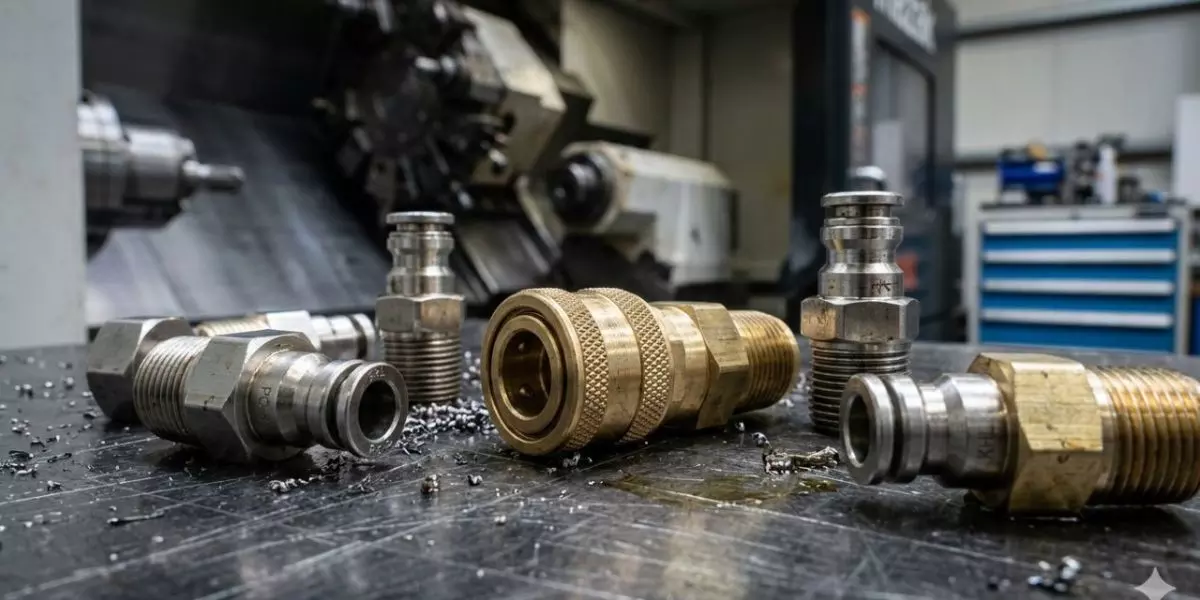
How Precision Engineering Improves Pneumatic Fitting Performance
How Precision Engineering Improves Pneumatic Fitting Performance
Pneumatic systems are widely used across modern manufacturing industries because they provide reliable, efficient, and controlled movement for industrial equipment.
From automated assembly lines and packaging machinery to robotics and heavy equipment, compressed air systems support a large portion of industrial automation processes.
At the center of these systems are pneumatic fittings, connectors, and couplings that regulate airflow between valves, cylinders, hoses, and control units.
Although these components may appear small compared to larger mechanical assemblies, their performance has a direct impact on system reliability and operational efficiency.
Even minor dimensional inaccuracies in pneumatic fittings can lead to air leakage, unstable pressure, reduced efficiency, and increased maintenance requirements.
This is why precision engineering has become increasingly important in pneumatic component manufacturing.
Precision pneumatic fittings help manufacturers maintain consistent airflow control, improve sealing performance, and support long-term reliability in industrial applications.
Understanding Precision Pneumatic Fittings
Precision pneumatic fittings are machined components designed to create secure and accurate connections within compressed air systems.
These fittings help regulate airflow while maintaining pressure stability throughout industrial machinery and automation equipment.
Common pneumatic fitting types include:
- Pneumatic connectors
- Quick-release couplings
- Elbow fittings
- Threaded adapters
- Push-to-connect fittings
- Air hose connectors
- Pneumatic valves and unions
These components are commonly manufactured using CNC machining processes that allow high dimensional accuracy and repeatable quality.
Industries that rely on precision-machined pneumatic connectors and coupling components often require fittings capable of maintaining reliable sealing performance under continuous operating conditions.
Why Precision Matters in Pneumatic Systems
Compressed air systems operate under controlled pressure conditions. Any leakage, imbalance, or dimensional inconsistency within pneumatic fittings can reduce overall system performance.
Precision engineering helps eliminate these problems by ensuring accurate machining tolerances and reliable component fitment.

Preventing Air Leakage
One of the most important functions of pneumatic fittings is maintaining airtight connections. Poorly machined threads or inaccurate dimensions can create leakage points within the system.
Even small leaks can lead to:
- Pressure loss
- Reduced machine efficiency
- Increased energy consumption
- Higher operating costs
- Equipment instability
Precision pneumatic fittings improve sealing accuracy and help maintain stable airflow throughout industrial systems.
Maintaining Pressure Consistency
Industrial automation equipment depends on consistent air pressure for smooth operation. Variations in pressure can affect machine movement, timing accuracy, and overall productivity.
Precision-engineered fittings support stable airflow and improve pressure regulation across pneumatic networks.
Improving Mechanical Reliability
Accurate machining also reduces vibration and stress within pneumatic assemblies. This contributes to better equipment reliability and lower maintenance requirements over time.
The Role of CNC Machining in Pneumatic Fitting Manufacturing
Modern pneumatic fittings are typically produced using CNC machining because it allows manufacturers to maintain tight tolerances and consistent dimensional accuracy.
CNC machining provides several important advantages in pneumatic component manufacturing.
High Dimensional Accuracy
Pneumatic fittings require precise threading, internal diameters, and sealing surfaces to function correctly.
CNC machining helps manufacturers achieve:
- Accurate thread profiles
- Smooth sealing surfaces
- Consistent connector dimensions
- Precise internal airflow channels
This level of accuracy improves assembly quality and system reliability.
Repeatable Production Quality
Industrial pneumatic systems often require large quantities of identical components. CNC machining ensures consistent production quality across high-volume manufacturing runs.
Repeatable accuracy is especially important in automated systems where even small dimensional variations can affect equipment performance.
Better Surface Finish Quality
Smooth surface finishes improve sealing efficiency and reduce airflow resistance within pneumatic systems.
Precision machining processes help eliminate surface irregularities that may contribute to leakage or pressure instability.
Manufacturers increasingly depend on CNC-machined pneumatic fittings and industrial coupling parts for applications where durability and airflow consistency are essential.
Benefits of Precision Pneumatic Fittings
Precision engineering improves pneumatic fitting performance in several important ways.
Increased Energy Efficiency
Compressed air systems consume significant amounts of energy in industrial facilities. Air leakage caused by poorly manufactured fittings can increase energy waste considerably.
Precision pneumatic fittings help improve energy efficiency by reducing leakage and maintaining stable system pressure.
Reduced Equipment Downtime
Reliable pneumatic connections help minimize operational interruptions caused by pressure instability or fitting failures.
This contributes to smoother machine operation and lower maintenance costs.
Improved System Safety
Pressure fluctuations and connection failures can create safety risks in industrial environments.
Accurately machined fittings improve connection stability and help reduce the likelihood of sudden system failures.
Longer Component Lifespan
Precision machining reduces unnecessary stress and wear on pneumatic assemblies, helping extend component lifespan under continuous operating conditions.
Read: Top Hydraulic Solutions for Marine and Industrial Applications
Applications Across Modern Industries
Precision pneumatic fittings are used across a wide range of industries where compressed air systems support industrial operations.
Manufacturing and Automation
Automated production lines use pneumatic systems for machine movement, material handling, packaging, and robotic operations.
Reliable fittings help maintain consistent machine performance and production efficiency.
Automotive Industry
Automotive manufacturing facilities rely heavily on pneumatic tools and automated assembly equipment.
Precision fittings support stable airflow in high-speed production environments.
Aerospace Engineering
Aircraft manufacturing and maintenance operations often use pneumatic systems for tooling, testing, and automated control equipment.
High-accuracy fittings help maintain reliability in demanding aerospace environments.
Food and Packaging Industries
Pneumatic systems are commonly used in packaging equipment and food processing machinery where cleanliness and operational consistency are important.
Precision fittings help improve reliability while supporting hygienic manufacturing standards.
Heavy Equipment and Industrial Machinery
Construction equipment, industrial machinery, and agricultural systems often use pneumatic controls and air-powered systems.
Durable fittings improve long-term performance under rugged operating conditions.
Material Selection and Manufacturing Quality
Material quality plays a major role in pneumatic fitting performance.
Common materials used in precision pneumatic fitting manufacturing include:
- Brass
- Stainless steel
- Aluminum alloys
- Engineering plastics
- Carbon steel
Different applications require specific material properties such as corrosion resistance, pressure handling capability, and wear resistance.
Precision engineering helps maintain consistent machining quality regardless of the material being processed.
Future Trends in Pneumatic Component Manufacturing
Several emerging trends are shaping the future of pneumatic fitting production.
Smart Pneumatic Systems
Industrial automation systems are becoming increasingly integrated with sensors and digital monitoring technologies.
Precision fittings will continue playing an important role in maintaining reliable airflow performance within smart manufacturing systems.
Lightweight Component Design
Manufacturers are increasingly using lightweight materials to improve equipment efficiency and simplify assembly operations.
Advanced CNC Manufacturing
Modern CNC machines continue improving machining accuracy, production efficiency, and repeatability in pneumatic component manufacturing.
Sustainable Manufacturing Practices
Reducing compressed air leakage helps lower industrial energy consumption and improve overall system efficiency.
Precision engineering supports these sustainability goals by improving pneumatic system reliability.
Conclusion
Precision engineering has become essential in pneumatic fitting manufacturing because even small dimensional inaccuracies can affect airflow stability, energy efficiency, and overall system reliability.
Precision pneumatic fittings help maintain secure connections, consistent pressure control, and long-term durability across industrial automation systems.
Advancements in CNC machining and manufacturing quality control have significantly improved the ability to produce accurate and reliable pneumatic connectors, couplings, and fitting components.
These improvements support a wide range of industries, including automotive manufacturing, aerospace engineering, industrial automation, packaging, and heavy machinery production.
As industrial systems continue evolving toward greater automation and efficiency, the demand for accurately machined pneumatic components will continue to grow.