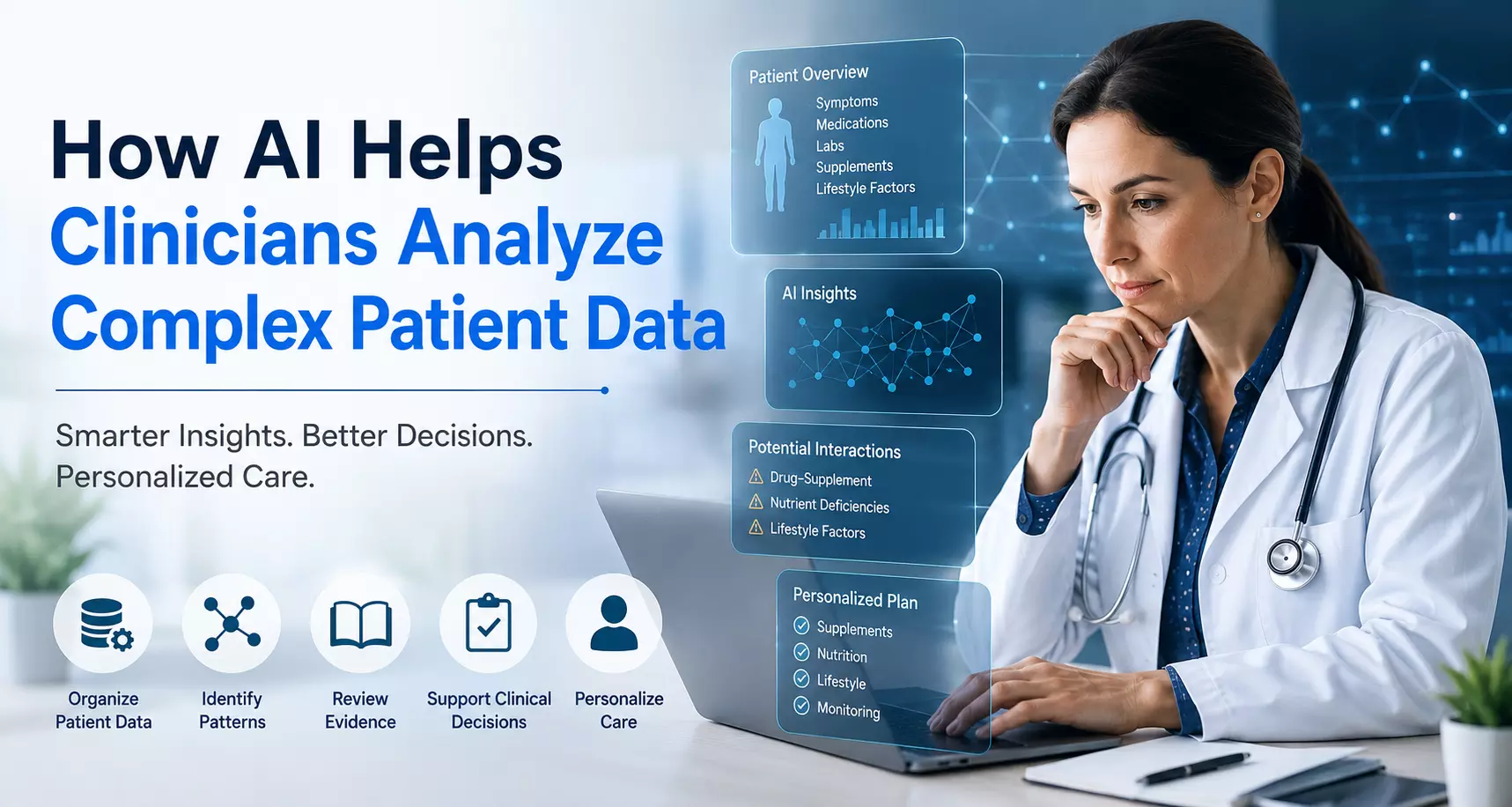
How AI Helps Clinicians Analyze Complex Patient Data
Healthcare professionals increasingly deal with patients whose symptoms, medical histories, laboratory results, medications, supplements, and lifestyle factors are interconnected.
Reviewing all this information manually can be time-consuming and may make it difficult to identify relationships across different areas of a patient's health.
This is where artificial intelligence (AI) can support clinicians. AI-powered clinical tools can organize large amounts of information, identify relevant patterns, and help healthcare professionals develop more comprehensive, evidence-informed approaches to patient care.
The Challenge of Complex Patient Data
A complex patient record may contain information from multiple sources, including:
- Medical history and previous diagnoses
- Laboratory and imaging results
- Current medications and supplements
- Symptoms and their progression
- Nutrition and lifestyle factors
- Family and health history
- Previous treatments and outcomes
The challenge is not simply collecting this information. Clinicians need to understand how different factors may relate to one another while considering the patient's overall clinical context.
How AI Helps Analyze Patient Information
AI can process and organize large volumes of healthcare information much faster than traditional manual methods. Instead of reviewing every piece of information separately, clinicians can use AI to help identify connections that deserve further investigation.
For example, AI can help:
- Organize patient information: Complex records can be structured into useful categories, making important details easier to review.
- Identify patterns: AI can analyze symptoms, laboratory findings, medications, and other data points to highlight potentially relevant relationships.
- Summarize research: AI tools can help clinicians locate and summarize relevant medical literature, reducing research time.
- Support personalized care: Patient-specific information can be considered when developing potential care strategies.
- Identify potential interactions: AI can flag possible medication, supplement, or nutrient interactions for professional review.
Read: Why Healthcare Needs Voice AI & Virtual Doctors in Telehealth
AI and Integrative Healthcare
Integrative and functional medicine often requires clinicians to consider multiple factors simultaneously rather than focusing on a single symptom or body system.
This is one area where AI Powered Integrative Medicine Platforms can provide valuable clinical support.
These platforms can help bring together information related to symptoms, laboratory results, medications, supplements, nutrition, and lifestyle factors within a broader patient context.
Rather than replacing clinical expertise, AI can help clinicians organize information and conduct research more efficiently. The clinician remains responsible for interpreting the information and determining what is appropriate for the individual patient.
Improving Clinical Decision Support
One of the biggest advantages of AI is its ability to support clinicians when patient cases become complicated. A patient may have several symptoms that cross different specialties, making it difficult to evaluate the complete picture quickly.
AI can help clinicians:
- Consolidate relevant patient information.
- Highlight areas that may require additional investigation.
- Find potentially relevant evidence.
- Organize clinical considerations.
- Support the development of personalized protocols.
This can reduce repetitive research and give clinicians more time to focus on patient interactions and professional decision-making.
AI Should Support, Not Replace, Clinicians
Despite its potential, AI should not be treated as an independent medical decision-maker. Healthcare information can be incomplete, ambiguous, or context-dependent, and AI-generated outputs may require careful verification.
Clinicians should evaluate AI-supported insights alongside their professional knowledge, clinical guidelines, patient preferences, and individual circumstances.
The Future of Complex Patient Care
As healthcare becomes increasingly data-driven, clinicians will need better ways to transform large amounts of information into useful clinical insights.
AI can serve as a powerful support layer by organizing complex data, accelerating research, and helping clinicians consider multiple factors together.
AI Powered Integrative Medicine Platforms represent one emerging approach to this challenge, helping healthcare professionals work with complex patient information while keeping clinical judgment at the center of care.