How AI Assistants Are Transforming Enterprise Search and Data Intelligence?
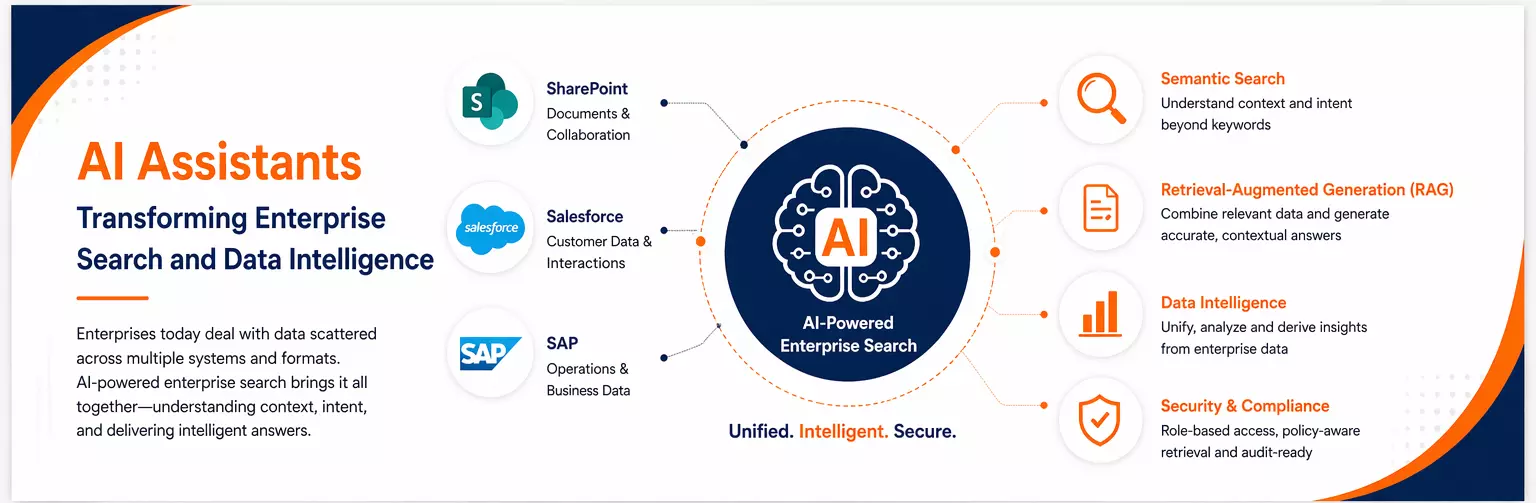
For decades, companies have built one layer of a system upon another. Microsoft SharePoint as a collaboration tool, Salesforce with customer data, and SAP with operational details – all resulted in a fragmented architecture that left important information scattered around, duplicated, and inaccessible.
The problem started as a technical architecture issue but turned out to be an operational one: people spent valuable time searching, decisions were based on partial data, while risks of non-compliance stayed behind the scenes.
That's where the concept of enterprise search started to play an instrumental role, transitioning from being a useful function to an essential one.
While initially, enterprise search was focused on finding information that the user already had an exact name for, it became increasingly clear that it wasn't enough anymore.
Not only did the employees need to locate the required information, but they also needed to understand, relate to, and make sense of it in context.
With time, enterprise search evolved from connecting different systems to applying semantic understanding and, lately, using AI to comprehend the intentions and contexts of the query.
Nowadays, with generative AI and solutions such as Microsoft Copilot hitting the market, the importance of enterprise search has reached an entirely new level.
Rethinking the Role of Enterprise Search
Enterprise search technology today operates at the confluence of data systems, knowledge management, and decision processes.
It provides a layer for accessing information through corporate data lakes, warehouses, software-as-a-service systems, and internal documentation systems.
However, conventional search systems were simply not built to cope with such a complex scenario.
Keyword-Based Retrieval
Most depend upon algorithms like BM25 or TF-IDF. They function well in case of perfect matches; however, in cases where a query may be vague, contextual, or exploratory in nature, there might arise issues.
The relevance-ranking process is usually static, while personalization is inadequate. Thus, the user must manually go through the results and form an interpretation.
In contrast, contemporary methods use dense vectors together with classical sparse algorithms to enable semantic matching instead of matching only by keywords.
Retrieval-Augmented Generation (RAG)
Rather than producing a list of documents, the system obtains the relevant data points and combines them to produce an answer. This saves user effort as users do not have to combine the information manually anymore.
For some advanced cases, AI assistants take another step forward and analyze user queries in more steps.
They can simultaneously perform various data retrievals and processing steps and create an output based on the original query’s intention.
This is especially valuable for queries that require analysis or involve several areas that cannot be performed by typical search engines.
The process gets even more advanced with time. The learning process allows such systems to become even better in data retrieving and ranking.
Core AI Applications Driving Enterprise Search
Data intelligence- The data within an enterprise is dispersed over several platforms in various forms. However, AI pipelines aggregate and normalize the data before storing it in unified layers.
The embedding model converts the data into vector form so that it can enable semantic retrieval.
Then, large language models take the retrieved information and summarize or generate recommendations from it. Therefore, people can work with such a dataset using natural language.
Security and compliance- Governance is often built into AI systems as a layer. Anomaly detection models analyze query patterns and system behavior to detect anomalies.
Policy-aware retrieval, on the other hand, guarantees that sensitive information is retrieved by authorized personnel only.
Finally, everything may be recorded in logs for auditing purposes later to ensure that you comply with all the regulations.
Natural Language Understanding- They act as a user interface between individuals and enterprises' internal knowledge repositories in support settings. Models of natural language understanding detect the intent and sentiment behind the query.
Additionally, RAG pipelines create accurate answers based on the context of the conversation. Such systems retain context for each conversation so that multi-turn conversations may be carried out effortlessly. It significantly cuts back on the reliance on human agents.
Predictive and Prescriptive intelligence- Forecasting the demand, risk analysis, and process improvement have become integrated parts of daily operations; therefore, it is possible to adapt immediately.
The process mining methodology can help detect process inefficiencies and improve them.
Read: AI Agent Development Company for Smart Business Automation
A Practical Approach to Implementation
Though the possibilities are great, the process of integrating AI assistants within the framework of an enterprise search solution involves several steps.
- Firstly, it is necessary to determine use cases for which AI can provide additional value and where either the retrieval, better decision-making, or process automation can deliver results.
- Secondly, the company should take care of the preparation of its data assets. No matter how intelligent your models may be, no data – no predictions or analysis. Thus, an enterprise needs to prepare its data, making sure that it is clean, meaningful, and accessible, and that usually involves the implementation of efficient integration layers with help from ETL and APIs.
- After data preparation, the governance stage begins. Here, it is essential to create a policy of role-based access control and monitoring of AI-based processes' results to identify any errors in advance before scaling them up.
- A pilot approach will help the company get through the initial steps in applying AI in a business. There is no need to apply artificial intelligence to several functions at once; starting with one case will be enough to provide evidence.
Why AI Assistants Represent the Future of Enterprise Intelligence
In general terms, what we are seeing is a transition in the way enterprise intelligence works.
While previous models were all about exploration, users had to explore data manually, filter out unnecessary data points, and draw conclusions.
However, today's AI-powered assistants are focused on execution. Gartner predicts that in the next few years, 60% of organizations will have more than six different AI search platforms to meet department-specific needs.
This is especially valuable when the decision needs to be taken fast and with great precision.
With a unified interface and generation capabilities, AI-powered assistants help users access necessary information with greater ease. At the same time, using context, they increase relevancy and help users stay compliant while using it.
As a result, companies are reporting savings both in cost and time spent while making decisions. More importantly, they have become more productive.
Final Thoughts
AI-based assistants are not merely an upgrade to enterprise search. They are the very transformation of it.
What used to be a process where information was passively pulled from repositories is now a process where intelligence actively analyses context, synthesizes information, and assists decision-making.
Enterprise organizations are no longer facing the question of whether they should implement AI technology; the real challenge for successful organizations will lie in scaling such implementations with security.