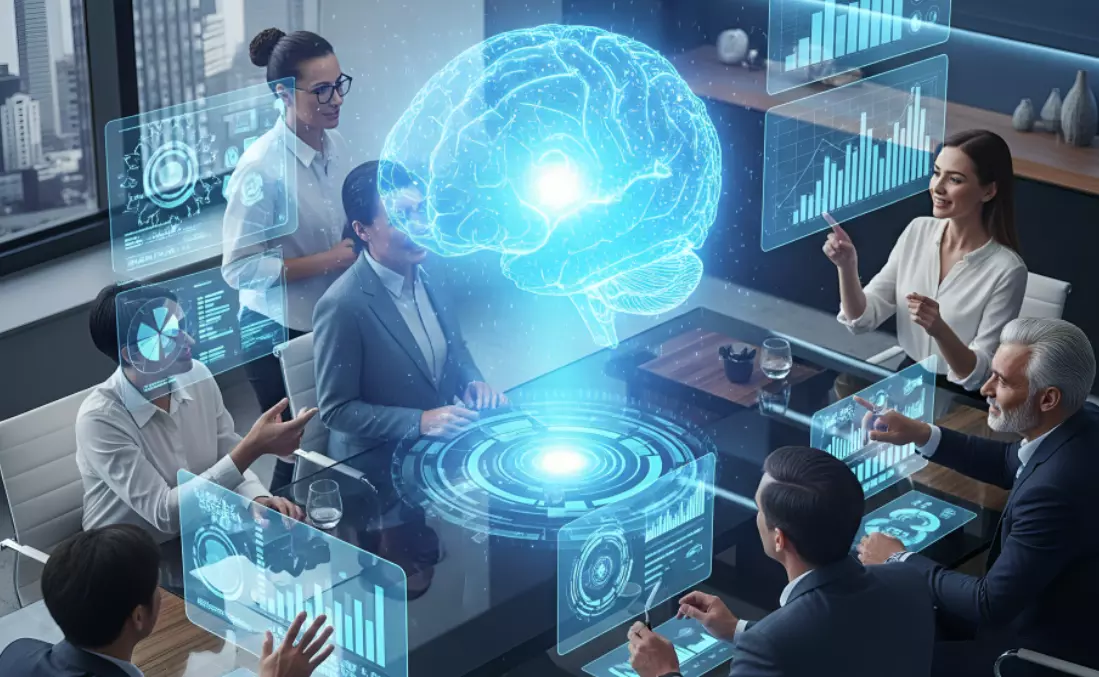
AI Agent Development Company for Smart Business Automation
Artificial intelligence is entering a new phase where businesses are no longer limited to static chatbots or rule-based automation systems.
Enterprises today are moving toward intelligent AI agents capable of reasoning, learning, executing tasks, and making decisions with minimal human intervention.
This shift is transforming how organizations operate across customer service, operations, healthcare, finance, retail, and enterprise productivity.
As businesses accelerate AI adoption, the demand for an experienced AI agent development company is growing rapidly.
Organizations are looking for partners that can design scalable AI agent architectures capable of automating workflows, improving operational efficiency, and enabling real-time decision-making.
Unlike traditional AI systems that perform isolated tasks, AI agents can understand context, interact with multiple systems, analyze data dynamically, and autonomously complete complex workflows.
From AI customer support agents and enterprise copilots to autonomous workflow assistants and multi-agent systems, AI agents are becoming a critical foundation for next-generation digital transformation.
What Is an AI Agent Development Company?
An AI agent development company specializes in building intelligent AI-powered agents that can perform tasks autonomously based on goals, context, and user interactions.
These companies develop AI systems capable of:
- Understanding natural language
- Processing enterprise data
- Making contextual decisions
- Automating workflows
- Interacting with APIs and software systems
- Learning from interactions
- Executing multi-step tasks
Unlike basic automation tools, AI agents operate with a higher level of intelligence and adaptability.
For example, a customer support AI agent can:
- Understand customer intent
- Access CRM systems
- Retrieve order details
- Generate personalized responses
- Escalate issues when necessary
Similarly, enterprise AI agents can automate internal business processes such as report generation, workflow management, document analysis, scheduling, and operational monitoring.
An Agentic AI Development Company in India combines technologies such as machine learning, large language models, natural language processing, and workflow orchestration to create intelligent autonomous systems.
Why Businesses Are Investing in AI Agents
Modern enterprises manage increasingly complex operations that require faster execution, real-time intelligence, and scalable automation.
Traditional automation systems often struggle because they rely heavily on predefined rules and limited workflows. AI agents solve this challenge by introducing reasoning, adaptability, and contextual intelligence into business operations.
Businesses are investing in AI agent development because these systems can:
- Automate repetitive tasks
- Improve productivity
- Reduce operational costs
- Deliver personalized customer experiences
- Support decision-making
- Operate continuously without downtime
For example, an AI sales agent can qualify leads, send follow-ups, schedule meetings, and update CRM systems automatically. A finance AI agent can monitor transactions, identify anomalies, and generate compliance reports in real time.
The ability of AI agents to operate across multiple workflows makes them highly valuable for enterprise automation.
How AI Agents Are Different from Traditional Chatbots
Many businesses initially confuse AI agents with traditional chatbots, but the capabilities are significantly different.
Traditional chatbots are generally rule-based systems that respond using predefined scripts. Their functionality is often limited to answering simple queries or guiding users through structured flows.
AI agents, however, are designed to operate autonomously and intelligently.
Instead of simply responding to questions, AI agents can:
- Understand intent and context
- Plan multi-step actions
- Interact with enterprise systems
- Learn from data
- Adapt responses dynamically
- Execute tasks independently
For instance, a traditional chatbot may provide shipping information when asked. An AI agent, on the other hand, can track the shipment, update the delivery schedule, notify the customer proactively, and escalate delays automatically.
This transition from reactive systems to intelligent autonomous agents is redefining enterprise AI strategies.
Core Technologies Used by an AI Agent Development Company
- Developing advanced AI agents requires multiple AI technologies working together within a scalable architecture.
- Large Language Models (LLMs) form the foundation of many modern AI agents. These models enable systems to understand natural language, generate contextual responses, and manage dynamic conversations.
- Natural Language Processing allows AI agents to interpret human communication, detect intent, analyze sentiment, and process complex instructions.
- Machine learning algorithms help AI agents improve continuously through interaction data and behavioral patterns.
- Knowledge retrieval systems allow AI agents to access enterprise databases, documents, APIs, and business systems in real time.
- Workflow orchestration frameworks help agents execute multi-step tasks across different software environments.
- Cloud infrastructure ensures scalability, high availability, and real-time processing capabilities.
- An experienced AI agent development company integrates these technologies into secure and scalable enterprise ecosystems.
Types of AI Agents Businesses Are Adopting
- AI agents are evolving rapidly across industries and business functions.
- Customer support AI agents help enterprises automate conversations, reduce response times, and improve user experiences across voice, chat, and email channels.
- AI sales agents assist businesses by automating lead qualification, outreach campaigns, follow-ups, and sales pipeline management.
- Enterprise productivity agents support internal operations such as scheduling, reporting, task management, and employee assistance.
- Healthcare AI agents help manage patient communication, appointment scheduling, and medical data analysis.
- Financial AI agents assist with fraud monitoring, risk analysis, transaction processing, and compliance workflows.
- HR AI agents streamline recruitment, onboarding, and employee support processes.
- Some organizations are even implementing multi-agent AI systems where multiple intelligent agents collaborate together to execute complex enterprise workflows autonomously.
Benefits of Hiring an AI Agent Development Company
- Partnering with an AI agent development company offers businesses both technical expertise and strategic guidance.
- One of the biggest advantages is faster AI adoption. Experienced development teams help enterprises identify the right use cases, choose suitable AI models, and reduce implementation risks.
- Businesses also benefit from customized AI solutions tailored to their industry requirements, operational workflows, and customer expectations.
- Scalability is another major advantage. AI development companies build enterprise-grade architectures capable of handling large data volumes, real-time interactions, and complex integrations.
- Security and compliance are equally important, especially for industries such as healthcare, banking, and insurance. Professional AI development companies implement governance frameworks, data protection mechanisms, and secure infrastructure models.
- Most importantly, businesses gain access to ongoing optimization, maintenance, and AI performance monitoring.
Industries Leveraging AI Agent Development Services
- AI agents are becoming increasingly important across industries.
- Healthcare organizations are deploying AI agents for patient engagement, medical assistance, diagnostics support, and operational automation.
- Retail and ecommerce companies use AI agents to personalize customer experiences, automate support, and improve inventory intelligence.
- Banking and financial institutions leverage AI agents for fraud detection, customer onboarding, and financial advisory services.
- Manufacturing companies use AI agents for predictive maintenance, workflow automation, and operational monitoring.
- Real estate firms are adopting AI agents for lead management, virtual property assistance, and customer engagement automation.
- Logistics companies rely on AI agents for route optimization, shipment tracking, and supply chain intelligence.
- The adoption of AI agents continues expanding as enterprises seek smarter automation strategies.
Read: Unlock Innovation with Custom AI Agent & AI Chatbot Development
The Role of Generative AI in AI Agent Development
Generative AI has dramatically accelerated the capabilities of modern AI agents.
Traditional automation systems were limited to predefined responses and workflows. Generative AI enables agents to generate dynamic content, engage in intelligent conversations, summarize information, and perform reasoning-based tasks.
Modern AI agents can now:
- Generate reports
- Write emails
- Summarize meetings
- Analyze documents
- Conduct intelligent searches
- Support enterprise decision-making
This has opened entirely new possibilities for enterprise automation.
As generative AI technologies continue evolving, businesses are increasingly partnering with AI agent development companies to build more intelligent and autonomous enterprise ecosystems.
How to Choose the Right AI Agent Development Company
Choosing the right AI partner is critical for successful implementation.
Businesses should look for companies with expertise in:
- Large language models
- AI architecture
- Cloud engineering
- MLOps
- NLP and conversational AI
- Enterprise integrations
- Generative AI frameworks
Industry experience is equally important because enterprise workflows vary significantly across sectors.
A strong AI development company should focus not only on technology implementation but also on measurable business outcomes such as cost reduction, operational efficiency, customer satisfaction, and scalability.
The right partner should provide end-to-end services including:
- AI strategy consulting
- Custom development
- Deployment
- Integration
- Monitoring
- Continuous optimization
The Future of AI Agent Development
AI agents are expected to become central to enterprise operations over the next few years.
Businesses are rapidly moving toward:
- Autonomous AI systems
- Multi-agent collaboration frameworks
- AI-powered enterprise copilots
- Intelligent workflow automation
- Voice-enabled AI agents
- Real-time decision intelligence
As AI becomes more advanced, organizations will increasingly depend on AI agents to manage customer interactions, operational processes, and enterprise knowledge systems.
This shift will fundamentally reshape how businesses operate in the digital economy.
Conclusion
AI agents are transforming enterprise automation by enabling intelligent, autonomous, and context-aware business systems.
From customer engagement and workflow automation to predictive intelligence and operational optimization, AI agents are helping organizations improve efficiency, reduce costs, and scale digital transformation initiatives.
However, building enterprise-grade AI agents requires deep expertise in AI architecture, machine learning, generative AI, cloud infrastructure, and workflow orchestration.
An experienced AI agent development company helps businesses navigate this complexity by building scalable, secure, and intelligent AI ecosystems tailored to modern enterprise needs.
Organizations investing in AI agent development today will be better positioned to lead the next generation of AI-driven innovation.