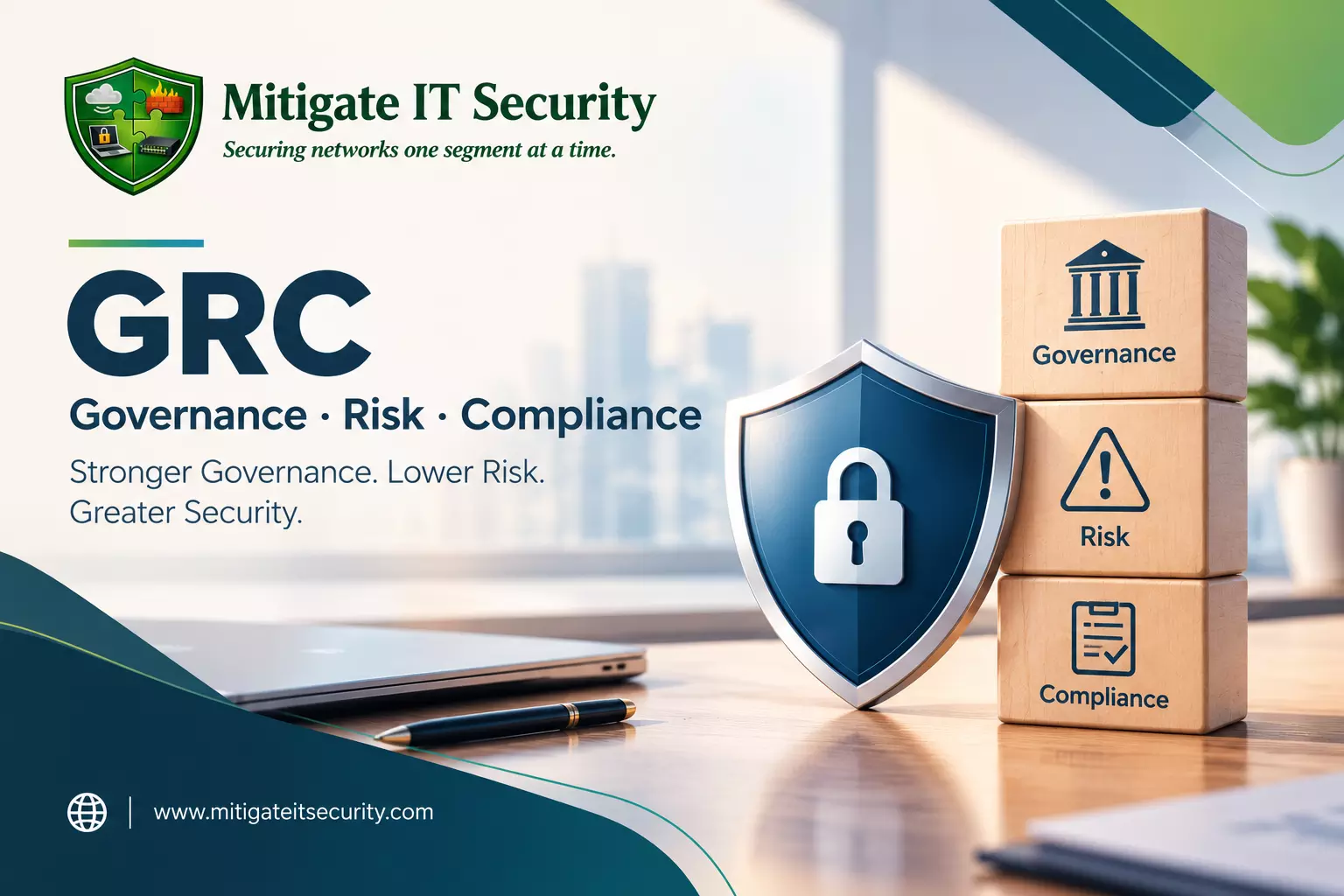
GRC Governance Risk Compliance for Better Business Security
The modern world is characterized by different types of issues related to the protection of information, cybersecurity, compliance with regulations, and sustainability.
The lack of methodology for addressing issues of security and risk management results in non-compliance, losses, security breaches, and even poor media coverage.
GRC governance risk compliance provides a structured approach to aligning business objectives, managing risks, and meeting applicable legal, regulatory, and industry requirements.
It is through governance, risk management, and compliance that organizations will be able to make sound decisions, enhance accountability, and increase security.
If the objective of your organization is sustainability in the future, then GRC will assist you in aligning cybersecurity with organizational objectives.
What is GRC Governance Risk Compliance?
GRC is an abbreviation for Governance, Risk and Compliance. They are connected and assist in assigning responsibilities, evaluating the threats and ensuring the compliance of the organization with the relevant standards.
Governance
Governance consists of the policies, responsibilities, decision making and monitoring which make up the governance of the organization.
Proper governance makes sure that the efforts made in terms of cybersecurity meet the organizational objectives and employees know their responsibilities.
Examples of governance are security policy definition, risk ownership allocation, decision making and security performance review.
Risk Management
Risk management involves identification, assessment, prioritization and reduction of threats which affect the business processes. For example, in the area of cybersecurity the threats can be ransomware, unauthorized access, insecure software, third party threats and data loss.
Use of risk assessments helps an organization to prioritize the risks according to the chances of occurrence and their effect.
Read: Top AI Frameworks Used in Real-World Enterprise Solutions
Compliance
Compliance implies meeting some legal, regulatory requirements, contracts or standards depending on the nature of the organization. Compliance can refer to privacy requirements and security requirements, contracts and industry standards.
Proper compliance management enables organizations to document control activities and support auditing.
Why is GRC Necessary for Organizational Security?
The GRC process makes it easier for organizations to meet their security and compliance needs as compared to treating the risk management and compliance separately, as both processes can be made interrelated through similar policies, assessments, and reports.
1. Increases Cyber Threats Management Efficiency
A cyber threat poses various risks to business transactions, customers' data and critical infrastructures. GRC assists in determining the weaknesses, assessing their impacts, and coming up with mitigation measures against them.
The risks assessment will ensure that businesses are ready for any changes associated with the technology, risks, and business practices.
2. Guarantees Regulatory Compliance
There may be certain requirements for organizations to prove that they meet the standards of cybersecurity, privacy, and other industry-specific regulations.
GRC process will help to centralize the compliance requirements, monitoring them, as well as documentation and mitigation measures.
Based on the industry, location and other factors, an organization may need to comply with different requirements.
3. Improves Decision Making
It is crucial for the management of the business to get accurate information in order to analyze the risks and allocate resources. GRC provides the framework for reviewing risk assessments, control measures, compliance status and outstanding issues.
This knowledge will make better decisions on security investments and business priorities possible.
4. Protects Business Reputation
In cases where there is a security issue, the organization may lose the trust of customers and have a damaged reputation. Governance and good risk management practices are important in showing the organization's commitment to protect sensitive information.
5. Promotes Accountability
Responsibilities will help employees and management know who is in charge of certain risk areas, who makes the decision, who manages controls, and what needs to be done with respect to the identified vulnerabilities.
Main Elements of a Good GRC Program
The following elements are required in having a successful GRC program.
Security Policies and Procedures
An organization should develop policies for access control, information protection, use of technology, incident handling, security of the vendors, and others.
These policies require a review at times and modification as required.
Risk Assessments and Risk Registers
Risk assessment helps identify the vulnerabilities, the threats, and the impact on the business. The risk register will include all of the above along with risk owner, priority, action plan for mitigation, and status.
The management will be able to monitor all the risks through a well-maintained risk register.
Internal Controls and Audits
Security controls will help safeguard the systems, data, and business operations. Internal audits will help to see if the security controls have been implemented properly and functioning as expected.
Once weaknesses in the internal controls have been identified, it is necessary to document the action to be taken, who will perform the task, and when it needs to be completed by.
Compliance Monitoring and Documentation
Monitoring of compliance will help businesses monitor all of the compliance needs and controls. Documentation will enable them to prepare adequately for the audit and deal with all compliance questions.
Third Party Risk Management
A risk from a third party can emanate through their access to either the system or sensitive information. There should be an assessment of third parties and setting up of security requirements.
Training and Awareness of Employees
In order to ensure the safety of business information, the role of employees is vital. With training, employees will be able to recognize the phishing attack, follow the security policies and deal with sensitive information and suspicious activities.
Through awareness campaigns, a secure work environment can be built.
Challenges of GRC Programs for Business
Despite the fact that GRC improves the security of an organization, there are certain challenges related to GRC programs and processes.
Fragmentation of information: Information about risk, audit, and compliance can be fragmentated in different departments or systems.
Dynamic nature of requirements: Change in requirements in terms of law, regulation, or contract is to be assessed in terms of control.
Manual processes: Disconnected processes in the form of spreadsheets and other documents cause duplications.
However, such issues could be avoided with the help of process standardization, role identification, centralized storage of documents as much as possible, and regular review procedures.
Best Practices for Implementation of GRC
The following practices could be helpful in improving efficiency of the GRC process at the organization in question.
Specify goals of the business: Know what goals the GRC process needs to deliver.
Identify requirements: Know what requirements exist for the company.
Assess and prioritize risks: Know what risks are related to the operation of the organization and prioritize them depending on the probability of occurrence, impact, and context.
Develop policies and controls: Formulate realistic policies and procedures that mitigate the identified risks and applicable standards.
Assuming responsibility: Delegate specific responsibilities to people regarding the risks, controls, and corrective activities.
Performance monitoring: Examine risk indicators, non-compliance issues, control adequacy, and delayed corrective measures.
Continual improvement: Modify policies and processes based on the results of audits, security breaches, business evolution, and new risks.
These steps need to be modified according to the size of the organization, risk appetite, available budget, and regulations.
How GRC Enables Cybersecurity
GRC Governance Risk Compliance strengthens the relationship between cybersecurity efforts, governance, and risk
management.
It allows organizations to get the reasons why certain security actions are required, the accountable parties for them, and ways to evaluate their efficiency.
In case there is a risk of data breaches, an organization can perform risk assessment and define access control policies.
The implementation of such security controls and periodic evaluation of users' rights can be delegated to the right departments. Compliance documentation will help to see how requirements are fulfilled.
GRC does not entail any cybersecurity tools such as endpoint protection, firewalls, security monitoring, and pen tests. But then again, GRC facilitates an alignment of these efforts based on accountability, risk reduction, and compliance.
How Mitigate IT Security Can Help
Opportunities to Improve the Security of a Business Due to Mitigate IT Security services include the possibility to improve security measures due to security specific services.
Businesses have an opportunity to consider such services as security risk assessments, Governance, Risk and Compliance, compliance preparedness assessments, penetration testing, and managed detection and response.
These services will provide companies with an opportunity to identify vulnerabilities, calculate the level of risks, be prepared for compliance issues, and determine priorities of security.
Conclusion
Thanks to the right process design of GRC processes, a company receives an opportunity to combine processes of governance, risk management, and compliance to improve the security and make decisions in a better way.
The creation of policies, risk prioritization, identification of compliance requirements and controls may be very helpful.
GRC Governance Risk Compliance is not only the documentation, but the process that includes business requirements, risk management and security control processes.
Are You Ready to Boost Your Business’s Security?
Prevent compliance issues and security vulnerabilities from turning into major problems. Get in touch with Mitigate IT Security Services to get all the assistance you need to secure your business.