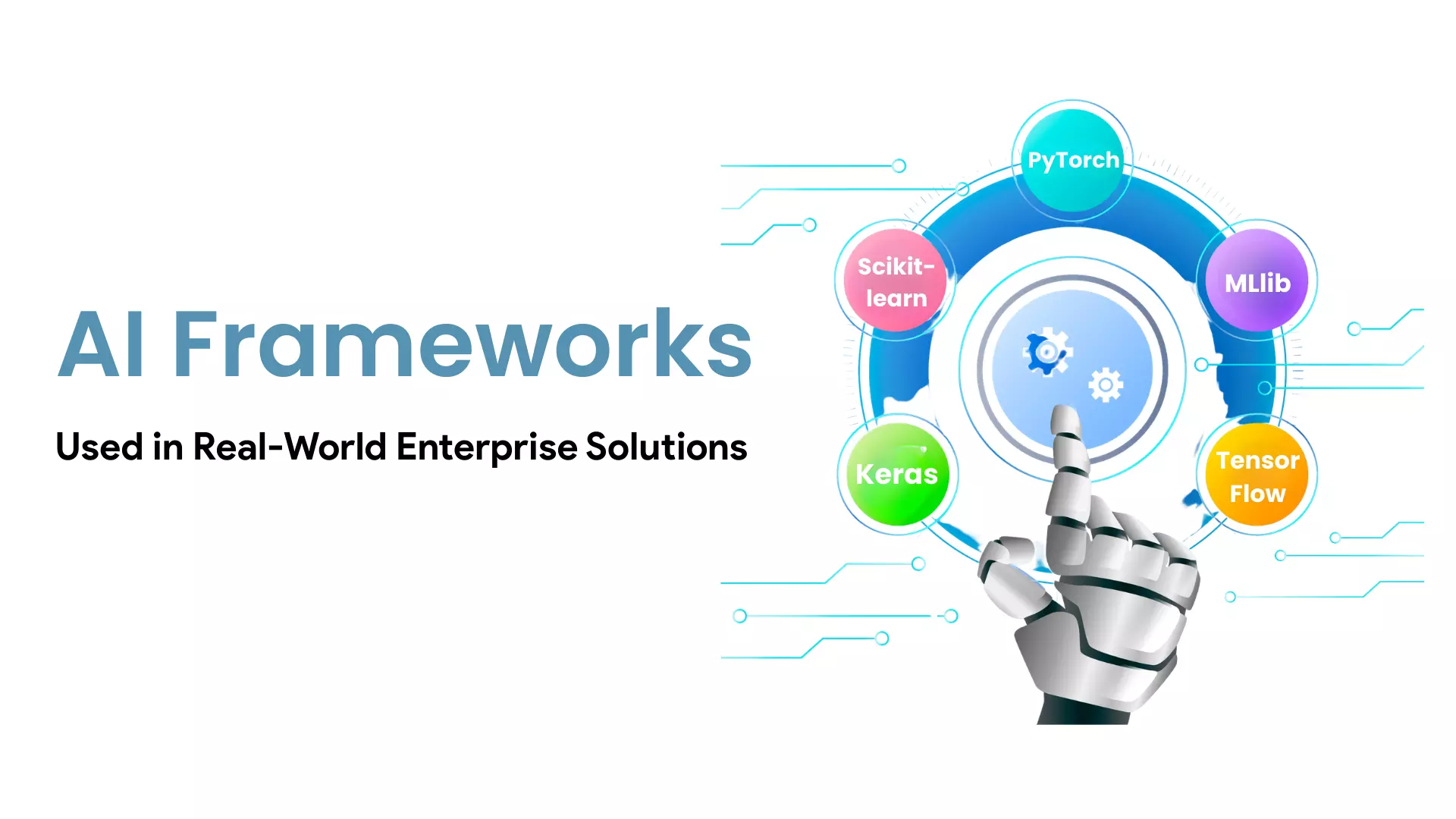
Top AI Frameworks Used in Real-World Enterprise Solutions
Artificial intelligence is no longer just an experimental technology. For many organizations, it’s a core part of how products, services, and operations are built. What makes this possible are AI frameworks, software platforms, and libraries that provide the tools, building blocks, and workflows needed to create intelligent applications quickly and consistently.
These frameworks are foundational for enterprise-level AI systems because they help teams handle data processing, model training, deployment, and ongoing model management without reinventing the wheel.
What Are AI Frameworks?
AI frameworks are pre-built ecosystems of tools, algorithms, libraries, and processes that simplify the development of machine learning, deep learning, and other artificial intelligence solutions. Rather than building AI systems from scratch, developers use frameworks to accelerate tasks such as data preparation, model design, training, evaluation, and deployment.
For organizations building scalable AI systems, AI Frameworks for Enterprise Solutions provide standardized environments and reusable components that reduce complexity, speed up development cycles, and improve reliability across production deployments.
At their core, AI frameworks might include:
- Tools for loading, cleaning, and transforming data
- Libraries of machine learning and deep learning models
- APIs for training, tuning, and evaluating models
- Integration points for deploying AI into applications or cloud services
- Features to monitor, manage, and update models after deployment
How AI Frameworks Work
Most AI frameworks follow a structured workflow that mirrors the lifecycle of an AI system:
1. Data Preparation
Frameworks help collect and clean raw data from various sources, whether databases, APIs, or files and convert it into a format usable for training. This step is essential for building accurate models.
2. Model Building and Training
Developers create models using built-in algorithms or customize them to fit enterprise needs. Frameworks take care of repeated processes such as feature engineering, model tuning, and supervised learning.
3. Evaluation and Optimization
Before deploying models, frameworks provide tools to test performance, measure accuracy, and fine-tune hyperparameters. This helps ensure models are robust and reliable in real-world scenarios.
Read: AI Development Platforms: A Complete Guide
4. Deployment and Integration
Once a model is ready, frameworks make it easier to deploy in production environments, whether cloud, hybrid, or on-premise, and integrate with enterprise applications via APIs and microservices.
5. Monitoring and Continuous Learning
After deployment, AI systems need ongoing tracking to monitor performance drift, data changes, and compliance. Many frameworks support these lifecycle needs to ensure models remain effective over time.
AI Frameworks for Enterprise AI Solutions
Enterprise AI requires more than model training. It needs scalable infrastructure, consistent workflows, and frameworks that support real-time deployment. AI frameworks provide the tools enterprises rely on to build, optimize, and manage AI solutions efficiently across different business functions.
1. Machine Learning Frameworks for Structured Data
Frameworks like Scikit-learn are widely used in enterprise projects that involve forecasting, classification, customer segmentation, and risk scoring. They are ideal for structured datasets and traditional predictive modeling.
2. Deep Learning Frameworks for Complex AI Models
For enterprise-grade deep learning tasks such as computer vision, advanced analytics, and neural network development, frameworks like TensorFlow and PyTorch are commonly used. These platforms support scalable training and high-performance model deployment.
3. NLP Frameworks for Language-Based Automation
Enterprises working on chatbots, document processing, and sentiment analysis often rely on NLP frameworks such as Hugging Face Transformers and spaCy. These tools help convert text into actionable business intelligence.
4. Computer Vision Frameworks for Image and Video Intelligence
Industries like healthcare, manufacturing, and retail use computer vision frameworks such as OpenCV to detect patterns, analyze visual data, and automate inspection tasks. Tools like OpenVINO also help optimize vision models for faster performance in production.
5. Reinforcement Learning Frameworks for Adaptive Decision-Making
Reinforcement learning frameworks are designed for systems that improve through experience, learning by taking actions and receiving feedback over time. These frameworks are especially useful in enterprise scenarios that require continuous optimization, such as robotics, autonomous operations, intelligent recommendation engines, and workflow automation, where decision-making must evolve with changing conditions.
Why These Frameworks Matter for Enterprises
AI frameworks provide the foundation for building scalable, maintainable, and production-ready AI systems. For enterprises, they reduce development time, standardize workflows, support large data volumes, and integrate smoothly with existing infrastructure. These advantages lead to faster innovation cycles, stronger AI performance, and more efficient operations.
Many organizations also partner with an AI development company to select the right frameworks and implement them correctly across model training, deployment, and governance. In summary, understanding the landscape of AI frameworks from machine learning libraries to deep learning platforms and NLP tools is essential for architects and developers who want to build intelligent applications that deliver real business value. As AI continues to shape enterprise solutions across industries, the right frameworks will remain central to how successful AI systems are built and scaled.