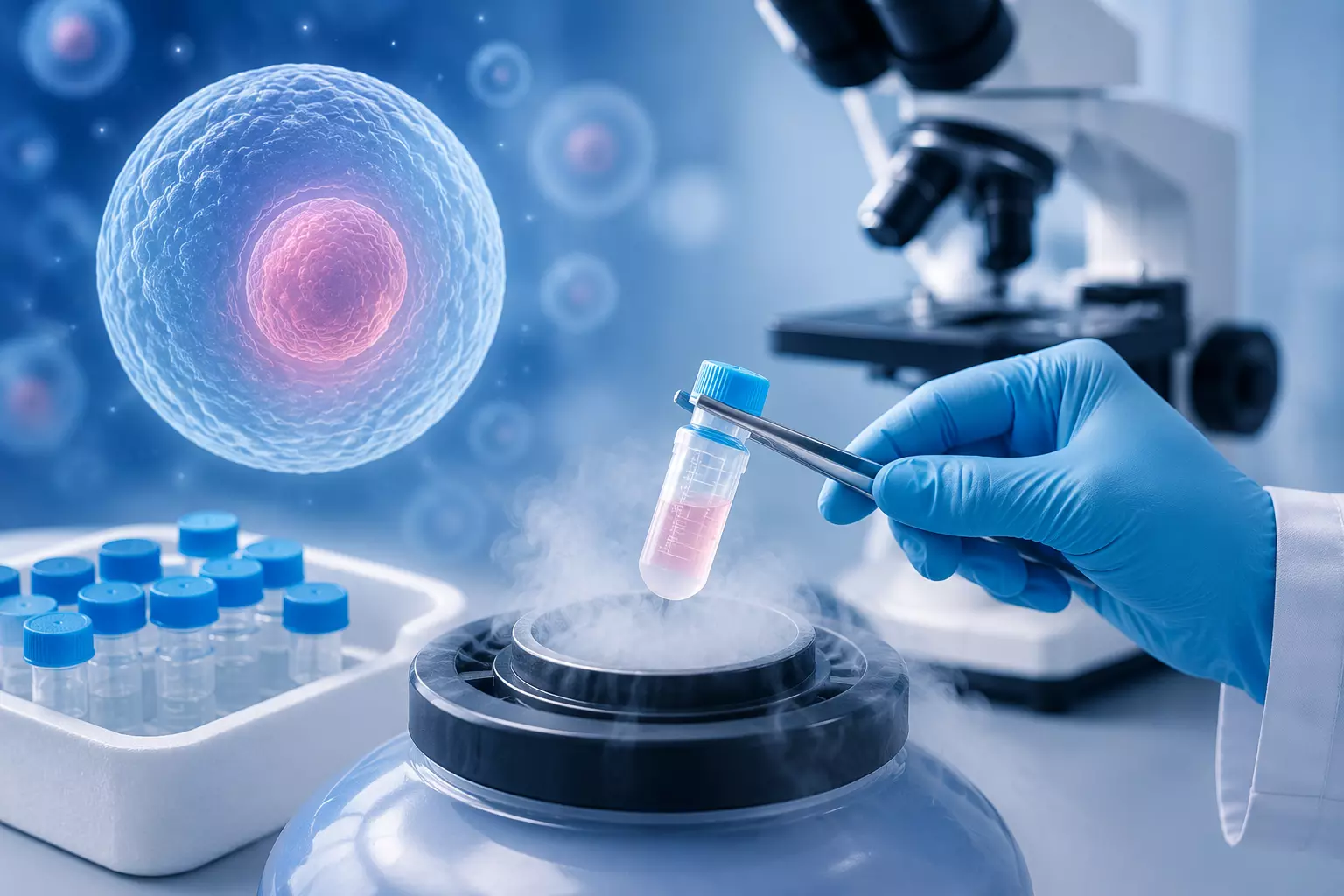
Freezing Eggs: Advances in Fertility Treatment
Written by Dr. Archana Agarwal — Egg Freezing Centre in Bangalore, Founder & Medical Director, Mannat Fertility Clinic
Egg freezing has come a long way since it first turned up as a clinical option. What was once labelled experimental, with poor survival rates and outcomes nobody could be confident about, is now a well-characterised fertility preservation tool with a real evidence base underneath it.
Here is where the science actually stands - and what that means, practically, for a woman weighing the option.
The Turning Point: Vitrification
The single biggest advance in egg freezing was a technical one - the switch from slow freezing to vitrification. Slow freezing cooled the eggs gradually, and that let ice crystals form inside the egg's delicate cytoplasm, which did real damage.
Vitrification, from the Latin for glass, drops the egg into liquid nitrogen so fast that the cellular water sets into a glass-like state without any ice crystals forming at all.
The practical result was dramatic. Egg survival after thaw, which used to hover around 50 to 60% with slow freezing, now routinely clears 80% in a well-run laboratory using vitrification.
Fertilisation rates and embryo development from vitrified eggs are, at this point, comparable to fresh eggs in an experienced IVF lab. This one technical improvement was the reason ASRM lifted the "experimental" label off oocyte cryopreservation back in 2012, and it is why the procedure today is a substantively different thing from what existed fifteen years ago.
Age at Freezing: Why It's the Central Variable
The most clinically important thing to grasp about egg freezing is that the age at which you freeze matters more than nearly anything else. Egg quality and quantity both fall with age - and when you freeze an egg, you are preserving it at its current biological state. An egg frozen at 29 is still biologically 29 when you come to use it at 37.
ASRM's patient education guidance is consistent on this: outcomes are generally better with eggs frozen before age 38. The per-egg chance of eventually leading to a live birth also declines with the age at freezing,
which is exactly why the number of eggs banked matters - and why a single stimulation cycle in the early 30s that yields 10 to 15 mature eggs gives you a very different statistical picture from the same outcome at 38.
Newer modelling tools are increasingly in use at the well-resourced fertility clinics, estimating the number of eggs needed for a target probability of a future live birth from a patient's age, her AMH, and her antral follicle count.
What that does is make the conversation about how many cycles a woman may need more evidence-driven, and a good deal less speculative, than it once was.
Read: How to Handle Low AMH at 30 — Honest Hospital Advice Every
Personalised Stimulation Protocols
Earlier egg freezing stimulation ran on relatively standardised dosing. The advance in recent cycles is the move toward individualised protocols - using each patient's AMH level and antral follicle count to predict how her ovaries will respond, and to calibrate the medication doses to that.
This matters in both directions. Under-stimulated cycles yield too few eggs to be worth much; over-stimulated cycles carry the risk of ovarian hyperstimulation syndrome,
OHSS, which runs anywhere from mild discomfort to a serious medical complication. GnRH antagonist protocols - now standard at most specialist centres - carry a lower OHSS risk than the older GnRH agonist protocols, and they are generally preferred for egg freezing cycles, particularly in women with higher ovarian reserve.
The trigger injection timing has moved on too: using a GnRH agonist trigger, rather than the older hCG trigger, in an antagonist protocol cuts the OHSS risk further, with no meaningful drop in the egg yield - a clinically significant improvement in the safety profile, and one that benefits the higher-responders specifically.
Medical Egg Freezing vs. Elective Freezing
Egg freezing splits into two broad categories worth telling apart. Medical, or oncofertility, freezing is done ahead of treatments like chemotherapy or radiation that could permanently affect ovarian function. This one is often time-sensitive, driven by a specific clinical need.
Elective freezing is the choice to preserve eggs before the age-related decline sets in - whether that is down to career timing, no current partner, or simply wanting more reproductive flexibility. Both are legitimate uses of the technology, and neither needs any justification beyond the patient's own circumstances.
At Mannat Fertility Clinic we approach both the same way: AMH testing, antral follicle count assessment, and an individualised protocol discussion before a single medication is prescribed.
The egg freezing cost in Bangalore at our clinic reflects a transparent breakdown of the stimulation, the retrieval, the vitrification, and the first-year storage - so there is no headline figure that quietly balloons once the medication gets factored in.
What Egg Freezing Cannot Do
For all the advances in the technology, one fundamental does not change: egg freezing improves the odds of a future pregnancy but does not guarantee it.
Per-egg outcomes get better when the eggs are frozen young and in an experienced lab with robust vitrification protocols - but frozen eggs, while they do not age, still have to be successfully thawed, fertilised, developed into an embryo, and implanted. A realistic conversation about what to expect is every bit as important as the technical quality of the procedure itself.
This article is for general information only and is not a substitute for individualised medical advice. Egg freezing decisions should be made with a fertility specialist, based on your own AMH, your ovarian reserve, and your reproductive timeline.