How to Handle Low AMH at 30 — Honest Hospital Advice Every Woman Needs to Hear
Receiving a low AMH result at 30 feels like receiving news you were not prepared for — and in the hours that follow, it is very easy to arrive at conclusions that are far more alarming than your clinical situation actually warrants.
Low AMH at 30 is not a fertility death sentence. It is a signal — and signals, when received early enough, create options. At Dr. Aravind's IVF Fertility and Pregnancy Center, recognized as a trusted best fertility centre in Karur, we work with women in exactly this situation regularly — and the most important thing we want every 30-year-old with low AMH to understand is this: early awareness is your greatest advantage.
What Low AMH at 30 Actually Means
Context Before Conclusions
Before responding to a low AMH result, understanding what it does and does not mean is essential:
What low AMH at 30 means:
Your ovarian reserve — the number of eggs remaining in your ovaries — is lower than the expected range for your age. This suggests your fertility window may be narrower than average, and that time is a more significant factor in your conception planning than it would be for a woman with normal reserve.
What low AMH at 30 does not mean:
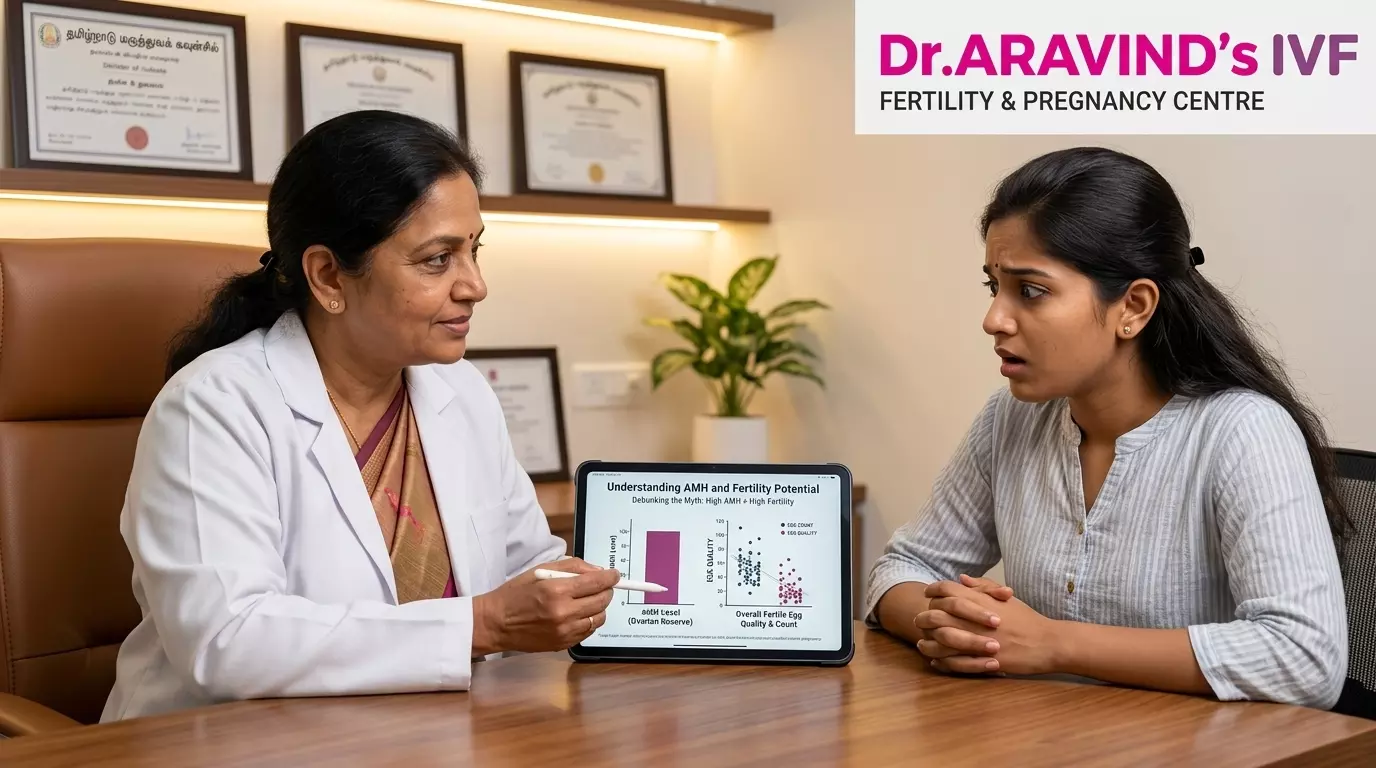
It does not mean you cannot conceive naturally. It does not automatically mean that IVF treatment will be unsuccessful. It does not mean your eggs are poor quality — AMH measures quantity, not quality. And it does not mean that your situation cannot improve with the right intervention.
Women with low AMH at 30 conceive naturally, conceive through IVF, and go on to have healthy pregnancies every day. The number is important context — not a final verdict.
Step 1 Identify Any Treatable Causes First
Not All Low AMH Results Reflect True Diminished Reserve
Before accepting a low AMH result at face value, several reversible factors should be investigated and addressed:
Hormonal contraceptive suppression:
If you have recently stopped the pill, hormonal IUD, or implant — your AMH may be temporarily suppressed by up to 30%. A repeat test 2 to 3 months after stopping hormonal contraception gives a more accurate baseline reading.
Vitamin D deficiency:
One of the most common and correctable causes of suppressed AMH in Indian women. A simple blood test confirms your Vitamin D status — and supplementation of 2000 to 4000 IU daily consistently improves AMH in deficient women over 3 to 6 months.
Recent ovarian surgery:
Cystectomy or ovarian drilling within the past 6 months can temporarily reduce AMH below true baseline. Waiting for post-surgical recovery before drawing conclusions is important clinical practice.
Obesity and insulin resistance:
Both independently suppress AMH production. Weight management and insulin sensitivity improvement through lifestyle changes can meaningfully influence your AMH reading over time.
Step 2 Get the Complete Ovarian Reserve Picture
AMH Alone Is Never Enough for Clinical Decision-Making
A low AMH result at 30 should always trigger a complete ovarian reserve assessment — not a fertility treatment decision in isolation:
- Antral Follicle Count (AFC) via transvaginal ultrasound — directly counts visible follicles and often provides more reassuring real-time data than AMH alone
- Day 3 FSH and estradiol — confirms the pituitary-ovarian axis picture and adds diagnostic depth
- A comprehensive hormone evaluation helps identify conditions such as thyroid disorders, elevated prolactin levels, or PCOS that may be affecting fertility.
- Repeat AMH in 2 to 3 months — after addressing any identified reversible causes
The complete picture consistently tells a more accurate and more actionable story than the original AMH result alone.
Read: How to Find the Best IVF Doctor in Delhi for a Successful Fertility
Step 3 Act on Your Timeline With Appropriate Urgency
Early Action Creates the Most Options
Low AMH at 30 does not require panic — but it does warrant timely, thoughtful action. The options available to a 30-year-old woman with low AMH are significantly greater than those available at 35 or 38 with the same result.
If you want pregnancy now:
Begin trying to conceive naturally while completing your evaluation. Ovulation induction with monitoring can optimize the eggs available each cycle. IUI is a reasonable first assisted step if natural conception does not occur within 3 to 6 months.
If you want pregnancy in the next 1 to 3 years:
Egg freezing now is one of the most valuable decisions a 30-year-old with low AMH can make. Choosing to freeze eggs around the age of 30 can help preserve higher-quality eggs, providing more reproductive options for the future.
If IVF is indicated:
Women with low AMH at 30 can and do achieve successful IVF pregnancies — particularly because egg quality at 30 remains strong. The challenge is typically retrieving enough eggs per cycle — which experienced specialists address through carefully designed stimulation protocols that maximize retrieval from a smaller pool.
Step 4 Support Your Ovarian Health Actively
What You Can Do Every Day That Genuinely Matters
While diet and lifestyle cannot reverse biological ovarian aging, they can meaningfully support the health and quality of remaining follicles:
- Vitamin D supplementation — correct deficiency and maintain levels above 40 ng/mL
- CoQ10 200 to 400mg daily — supporting mitochondrial energy in developing egg cells
- Mediterranean-style diet — rich in antioxidants, omega-3 fatty acids, and low-glycaemic carbohydrates
- Quit smoking completely — the single most impactful lifestyle change for ovarian health
- Manage stress actively — chronic cortisol elevation suppresses the hormonal environment supporting follicle development
- Maintain healthy body weight — obesity independently suppresses ovarian function
Why Karur Women Trust Dr. Aravind's IVF Fertility and Pregnancy Center
Finding the right specialist feels overwhelming — but when experience meets compassion in the same clinic, you know you are in the right hands.
At Dr. Aravind's IVF Fertility and Pregnancy Center, our fertility Centre in Karur approaches low AMH at 30 with thorough investigation, honest counselling, and a personalized plan that maximizes every option available — without unnecessary alarm and without false reassurance.