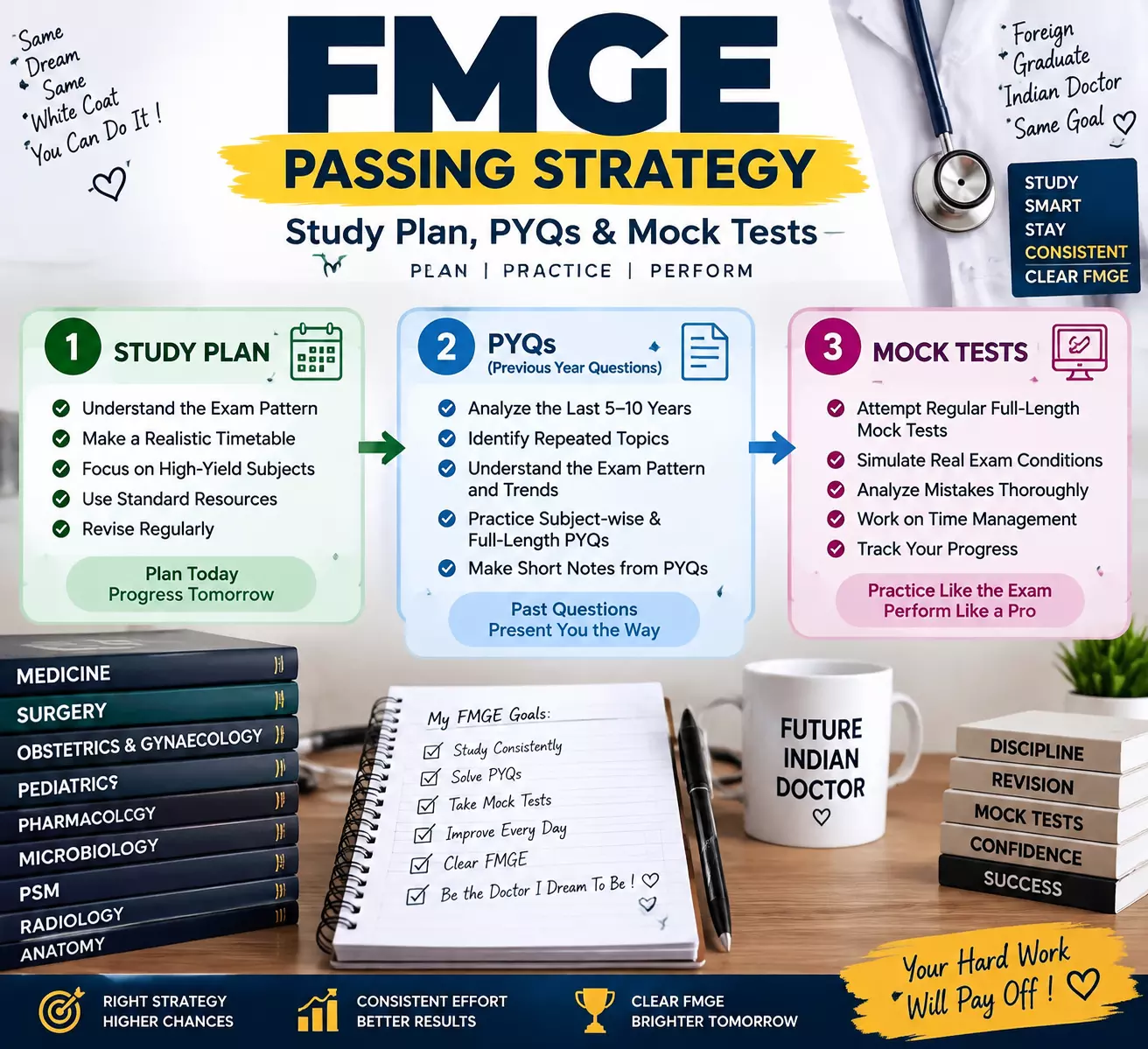
FMGE Passing Strategy: Study Plan, PYQs & Mock Tests
Passing the Foreign Medical Graduate Examination (FMGE) requires a clear study routine, regular revision, and enough practice before the exam. Many medical graduates spend months studying but still struggle because they do not follow a fixed plan.
A good FMGE passing strategy should cover the important subjects, previous year questions (PYQs), revision, and mock tests. Instead of trying to study everything repeatedly, focus on understanding frequently asked topics and improving your accuracy.
What Is the FMGE Passing Criteria?
FMGE is a screening test for eligible Indian citizens and certain overseas medical graduates who want to register and practise medicine in India.
The exam consists of 300 questions, with 150 questions in each part. Candidates need to score 150 marks out of 300 to qualify.
There is no negative marking, so candidates should attempt the questions carefully while managing their time during the examination.
How to Start FMGE Preparation
Before starting your preparation, make a simple plan based on the time available.
If you have several months, divide your preparation into three stages:
- First phase: Complete the syllabus and understand important concepts
- Second phase: Revise subjects and solve PYQs
- Final phase: Take mock tests and revise weak areas
Avoid changing your study material too often. Using too many books, notes, and video sources can make revision difficult.
FMGE Study Plan
A practical study plan should give enough time to both major and minor subjects.
1. Start With High-Weightage Subjects
Begin with subjects that cover a large portion of the FMGE syllabus. You can then move to smaller subjects and use your revision time efficiently.
A sample order can include:
- Medicine
- Surgery
- Obstetrics and Gynecology
- Pediatrics
- Pathology
- Pharmacology
- Microbiology
- Anatomy
- Physiology
- Biochemistry
- Preventive and Social Medicine
- Other clinical and para-clinical subjects
The exact order can be changed according to your strengths and weaknesses.
Read: Study BDS in Russia 2026: Top Dental Universities, Fees &
2. Set Daily Study Targets
Instead of setting a target such as “I will study all day,” divide your day into specific tasks.
For example:
- 3–4 hours for lectures or concept study
- 2–3 hours for revision
- 1–2 hours for PYQs
- 30–60 minutes for reviewing mistakes
The number of hours is less important than completing the planned work consistently.
3. Keep Short Revision Notes
While studying, make short notes of facts that you frequently forget. These notes can include:
- Important clinical points
- Drug names and adverse effects
- Diagnostic findings
- Image-based questions
- Important formulas
- Frequently repeated concepts
Use these notes during your final revision instead of going through large textbooks again.
Role of PYQs in FMGE Preparation
Previous year questions are an important part of FMGE preparation. They help you understand the type of questions asked and identify topics that need more attention.
Do not simply memorize the answers.
After solving a PYQ, check why the correct option is right and why the other options are wrong. If you make a mistake, revise that topic before moving ahead.
How to Use FMGE PYQs
You can follow this simple method:
Solve → Check → Understand → Revise → Reattempt
Try solving PYQs subject-wise during the first revision. Later, solve mixed questions to check whether you can recall information across different subjects.
Keep a record of questions you answer incorrectly. These mistakes can become a useful revision list before the exam.
Why Mock Tests Matter
Mock tests help you practise the actual exam pattern while working under a time limit.
Take a mock test only after covering enough of the syllabus. As your preparation improves, increase the frequency of tests.
After every mock test, spend time analysing your performance.
Look at:
- Questions answered incorrectly
- Questions you guessed
- Topics you forgot
- Questions that took too much time
- Subjects where your accuracy is low
The score itself is not the only useful part of a mock test. The analysis after the test can show you what needs to be revised.
FMGE Revision Strategy
Revision should start early rather than being left for the final few days.
A simple approach is:
First Revision
Focus on completing the syllabus and understanding the concepts.
Second Revision
Revise notes, important topics, and PYQs. Try to reduce the time needed for each subject.
Final Revision
Focus on high-yield topics, mistakes, marked questions, images, and short notes.
Do not start completely new study material during the final days unless it is necessary.
30-Day FMGE Strategy
If you have around one month left, your focus should shift towards revision and question practice.
Days 1–15
Revise major subjects and solve related PYQs.
Days 16–23
Complete the remaining subjects and revise your weak areas.
Days 24–27
Take full-length mock tests and analyse every test.
Days 28–30
Revise short notes, incorrect questions, important images, and frequently tested topics.
Your personal schedule can be adjusted depending on your preparation level.
Common Mistakes to Avoid
Many candidates lose valuable preparation time because of avoidable mistakes.
Studying Without a Plan
Jumping between subjects without a daily target can make preparation difficult to track.
Ignoring PYQs
Reading theory without practising questions does not show whether you can apply what you have studied.
Taking Mock Tests Without Analysis
A mock test is more useful when you review your mistakes afterwards.
Using Too Many Resources
Switching between multiple books, apps, and notes can leave you with several incomplete sources.
Leaving Revision for the End
Finishing