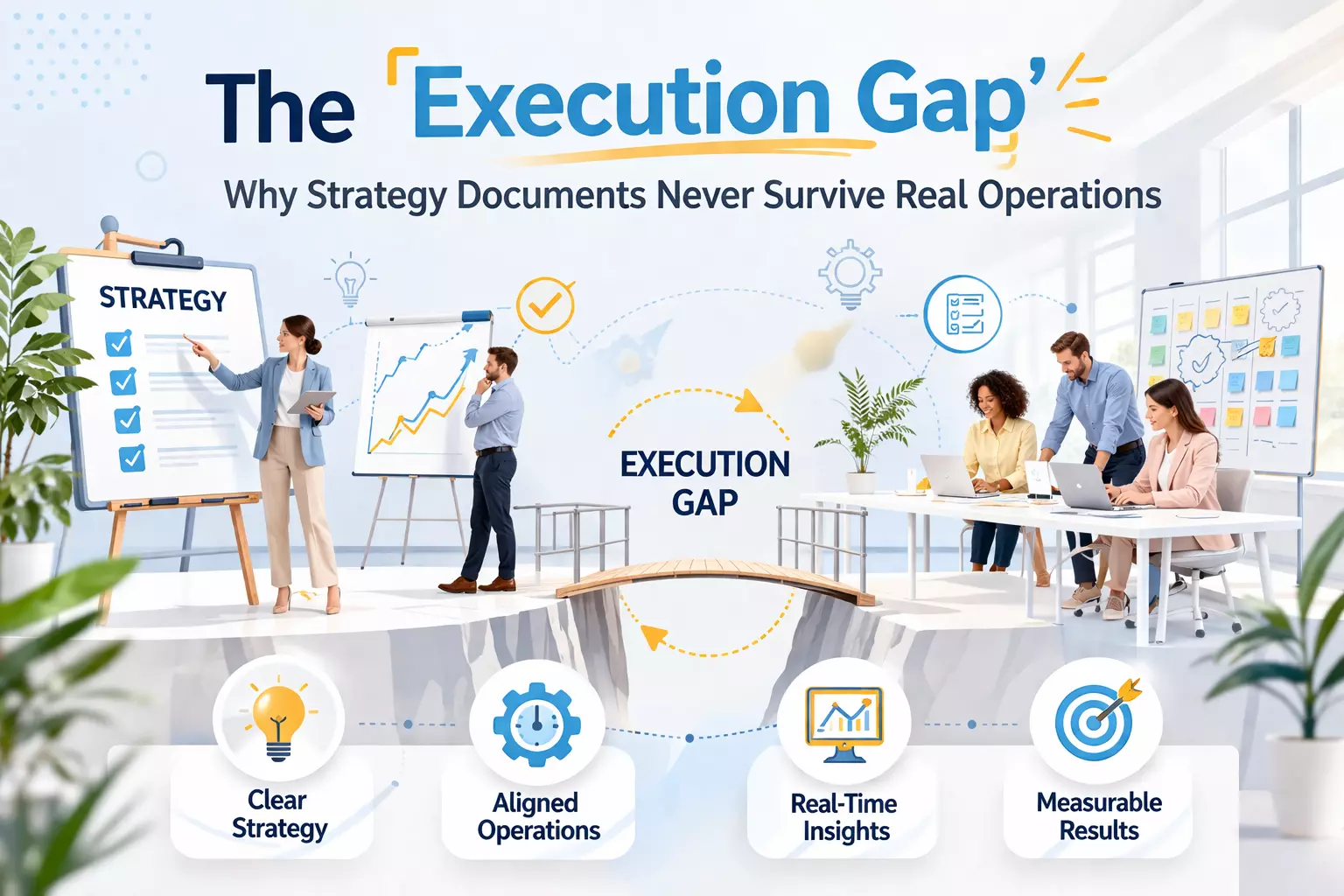
‘Execution Gap’: Why Strategy Documents Never Survive Real Operations
- Every organisation invests time in building strategy.
- There are planning sessions, leadership workshops, and carefully designed roadmaps. The vision is clear, the goals are ambitious, and alignment seems strong at least on paper.
- But once execution begins, things start to shift.
- Priorities change. Teams interpret goals differently. Systems don’t support the intended workflows. And gradually, the strategy that once felt solid begins to lose relevance in day-to-day operations.
- This is not a rare occurrence. It’s a pattern.
- And at the centre of it lies what many organisations struggle with, the execution gap.
What is the Execution Gap?
The execution gap is the disconnect between what a business plans and what it is actually able to deliver.
It shows up in small but telling ways:
- Projects that take longer than expected
- Teams working hard but not moving in the same direction
- Decisions delayed due to lack of clarity or data
- Systems that create friction instead of efficiency
Over time, this gap widens. What starts as a minor misalignment becomes a structural challenge that affects performance across the organisation.
Why Strategy Breaks Down in Real Operations
1. Strategy Stays Theoretical
Many strategies are designed at a high level. They define the what and the why, but not the how.
Without clear execution pathways, teams are left to interpret the strategy themselves. This leads to inconsistency, confusion, and ultimately, slow progress.
Strategy needs to be more than direction, it needs to translate into real, actionable work.
2. Operations Are More Complex Than Expected
On paper, processes look simple.
In reality, operations involve multiple systems, dependencies, and moving parts. What seems like a straightforward initiative often becomes complicated once it interacts with existing workflows.
This complexity is one of the biggest reasons strategies fail to hold up in execution.
3. Systems Don’t Support the Plan
In many organisations, technology is not aligned with business goals.
Different teams use different tools. Data is scattered. Processes rely on manual intervention.
Without proper system integration, execution slows down. Teams spend more time managing tools than actually delivering outcomes.
4. Misalignment Across Teams
Strategy is often created by leadership but executed across multiple departments.
If alignment isn’t built early:
- Teams prioritise differently
- Communication gaps emerge
- Efforts become fragmented
Even a strong strategy can fail if the people executing it are not fully aligned.
5. Lack of Real-Time Visibility
Execution requires constant awareness.
But many organisations still rely on periodic reporting, weekly updates, monthly reviews. By the time issues are identified, they’ve already impacted outcomes.
This is where digital transformation services play an important role enabling real-time visibility, faster decision-making, and more responsive operations.
The Hidden Cost of the Execution Gap
The execution gap doesn’t just delay projects, it affects the entire business.
It can lead to:
- Missed opportunities
- Inefficient use of resources
- Reduced return on strategic initiatives
- Frustration across teams
Over time, it also creates a loss of confidence in planning itself, where strategy becomes a formality rather than a driver of growth.
What Actually Helps Close the Gap
1. Connecting Strategy to Daily Work
For strategy to succeed, it must be embedded into everyday operations.
This means breaking down high-level goals into clear workflows, responsibilities, and measurable outcomes.
2. Simplifying and Aligning Systems
Technology should support execution, not complicate it.
When systems are aligned and connected, teams can work more efficiently, data flows seamlessly, and decision-making becomes faster.
3. Building for Consistency, Not Just Speed
Execution is not just about moving fast, it’s about delivering consistently.
Reducing manual effort, standardising processes, and creating clarity in workflows all contribute to more reliable outcomes.
4. Creating Clear Ownership
Execution improves when accountability is clear.
Each initiative needs defined ownership, so decisions are made faster and progress is easier to track.
5. Adapting Continuously
No strategy survives unchanged.
Market conditions shift. Internal challenges emerge. Priorities evolve.
Organisations that succeed are the ones that treat execution as an ongoing process and treat it like adjusting, improving, and refining as they move forward.
Read: LIYAN IT SOLUTION PVT LTD – A Trusted IT Company In
A Shift in Thinking: From Planning to Execution
Many organisations still operate with a planning-first mindset.
But today, success depends on how well a strategy can be executed, not how well it is written.
This requires a shift:
- From static plans to dynamic execution
- From isolated teams to connected operations
- From assumptions to real-time insights
Conclusion: Execution is the Real Strategy
A strategy document might set the direction but execution determines the outcome.
The organisations that move ahead are not necessarily the ones with the most detailed plans, but the ones that can turn those plans into consistent action.
Closing the execution gap is not about doing more planning.
It’s about making strategy work in the real world where complexity, speed, and change are constant.