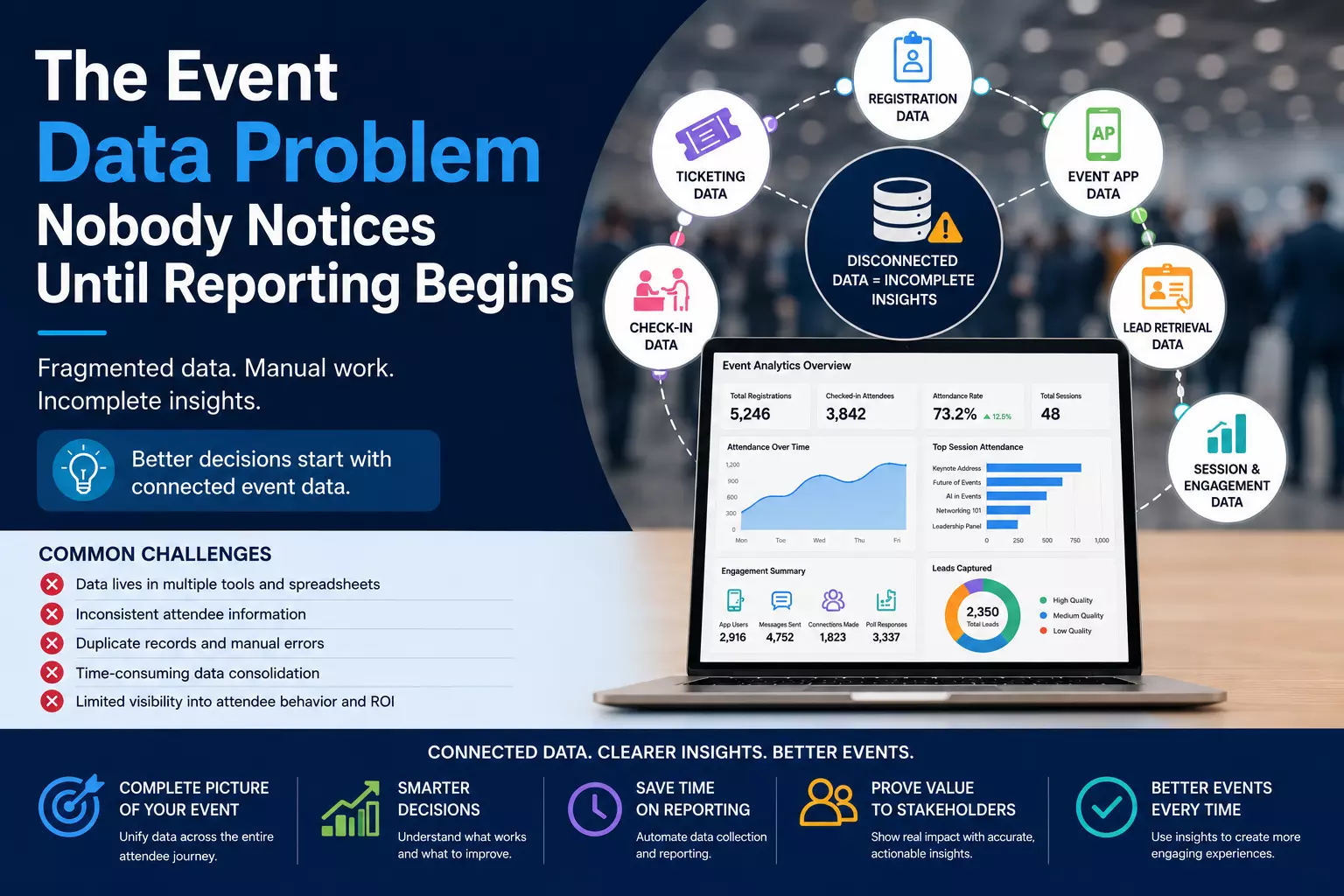
The event data problem nobody notices until reporting begins
- The event is over.
- Attendees have gone home. Exhibitors are following up with leads. The event team has finally finished several days of on-site work.
- Now leadership wants the event report.
- How many people registered?
- How many actually attended?
- Which sessions attracted the most interest?
- Did attendees use the event app?
- How much networking activity took place?
- What did exhibitors achieve?
- These sound like straightforward questions.
- For many event teams, finding the answers means opening several platforms, downloading spreadsheets, and trying to connect data that was never designed to work together.
- The event data problem often stays hidden during planning.
- It becomes visible when reporting begins.
Every event tool creates its own version of the event
Modern events use technology for almost every stage of the attendee journey.
An event registration platform collects attendee information. Ticketing software processes passes and payments. Check-in technology records arrivals. A mobile event app tracks digital activity.
Exhibitors may use separate lead capture tools.
Each system creates data.
The problem is that these systems may describe the same event differently.
One platform identifies an attendee using an email address. Another uses a registration ID. A separate tool may contain an older version of the attendee's company information.
When event teams begin reporting, these differences make it harder to create a complete view of event activity.
Registration numbers do not tell the full story
- Registration is one of the most commonly reported event metrics.
- An event received 5,000 registrations.
- That number may look impressive.
- But how many registered attendees arrived at the venue?
- A large registration total does not automatically mean high attendance.
- Organizers need to compare registration data with event check-in information to understand the difference between registered and actual attendees.
- This can help teams identify attendance patterns and review event no-shows.
- When registration and check-in data exist in separate platforms, creating this comparison may require manual spreadsheet work.
App downloads are not the same as engagement
- Another common event metric is the number of event app downloads.
- Downloads are easy to count.
- They provide limited information about attendee behavior.
- An attendee may download the app before the event and never open it again.
- Another attendee may use the app several times each day to review their agenda, participate in sessions, and connect with other participants.
- These attendees should not appear identical in event reporting.
- Organizers need more context around how attendees interact with event technology.
- Agenda activity, session participation, networking interactions, polls, surveys, and other relevant actions can provide a clearer view of attendee engagement.
Session data often remains disconnected
- Sessions are an important part of conferences and professional events.
- Event teams may want to understand which topics attracted attendee interest.
- However, session information is often analyzed separately from attendee data.
- Organizers may know that a session attracted 500 participants.
- They may not easily understand which attendee groups were most interested in the topic.
- Connecting session activity with relevant attendee information can help organizers identify content patterns.
- These insights may influence future agendas, speaker selection, and event programming.
Exhibitor activity creates another data layer
- Trade shows and exhibitions generate a different category of event data.
- Exhibitors capture leads, scan badges, add notes, and qualify conversations.
- Organizers may also collect information about exhibitor participation and attendee activity across the exhibition floor.
- When exhibitor technology operates separately from the main event platform, this information can be difficult to include in wider event analysis.
- Lead volume alone also provides limited context.
- Organizers may want to understand whether exhibitors are reaching relevant attendees and whether the event environment supports valuable business conversations.
Manual reporting takes time
- When event data is fragmented, someone needs to bring it together.
- This often means downloading CSV files from multiple platforms.
- Columns need to be renamed.
- Duplicate attendee records need to be reviewed.
- Date formats may need to be corrected.
- Different attendee identifiers need to be matched.
- The process can take hours or days depending on the size of the event.
- More importantly, manual data preparation creates opportunities for errors.
- A spreadsheet formula can be incorrect. Duplicate records may be counted twice. An outdated export may be included in the report.
- Event teams may spend more time preparing the data than analyzing what it means.
Read: Top 9 Best Event Ticketing Platforms & Software in 2026
Connected event technology can improve visibility
- Event reporting becomes easier when core event activities are managed within a connected technology environment.
- Registration, check-in, attendee engagement, networking, and other event activities can contribute to a broader view of the attendee journey.
- For example, Eventify provides event management technology that connects registration, ticketing, check-in, badge printing, event apps, networking, lead retrieval, and event analytics.
- For organizers, the value of connected event technology is not simply having multiple features.
- The important difference is the ability to understand event activity with greater context.
More data does not automatically create better reports
- Event teams can collect thousands of data points.
- That does not mean every metric belongs in an event report.
- A useful report should answer specific questions.
- Did registered attendees arrive?
- Which event activities attracted participation?
- How did attendees interact with the event experience?
- What information will help improve the next event?
- Organizers should decide which questions matter before selecting event metrics.
- Otherwise, reports can become collections of numbers without clear meaning.
Event reporting should start before the event
- One of the biggest reporting mistakes is waiting until the event ends to think about data.
- Event teams should define their reporting requirements during the planning stage.
- If attendance is important, registration and check-in data need to be connected.
- If attendee engagement is a priority, teams need to identify which interactions should be measured.
- If exhibitor value matters, organizers should consider how lead and exhibitor activity will be evaluated.
- Planning these requirements early can reduce reporting problems later.
The real event data problem is fragmentation
- Most event teams do not have a shortage of data.
- They have data stored in too many places.
- Registration platforms, spreadsheets, check-in systems, mobile event apps, and exhibitor tools may each provide useful information.
- The challenge begins when organizers need to understand the event as a whole.
- Connected event management software can help teams reduce fragmented data workflows and create a clearer view of event activity.
- When reporting begins, organizers should be spending their time understanding what happened at the event.
- They should not be spending days trying to find the data.