denomyosis and Fertility: How It Differs from Endometriosis and Affects IVF
Adenomyosis is a condition that can affect the uterus and may become important when a person is trying to conceive. It is sometimes confused with endometriosis because both conditions can cause pelvic pain, heavy periods and fertility problems.
However, they are not the same condition.
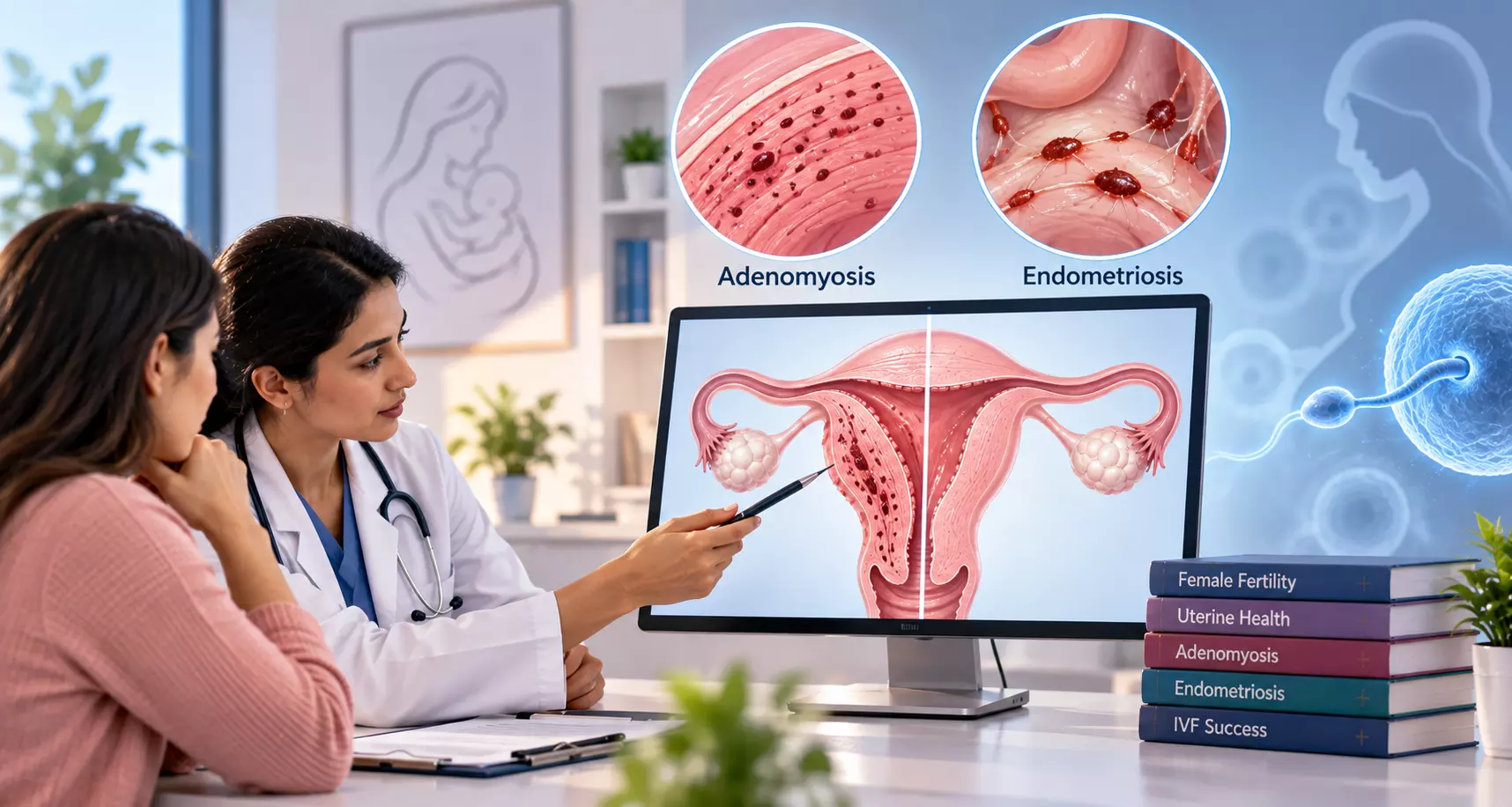
In adenomyosis, tissue similar to the uterine lining grows into the muscular wall of the uterus. In endometriosis, tissue similar to the uterine lining grows outside the uterus.
Understanding the difference is important because adenomyosis may affect implantation, miscarriage risk and IVF outcomes.
Research also suggests that the impact can vary depending on whether the disease is focal or diffuse, symptomatic or asymptomatic, and whether endometriosis is present at the same time.
What Is Adenomyosis?
Adenomyosis occurs when endometrial-like tissue is found within the muscular layer of the uterus, called the myometrium.
The condition can cause the uterus to become enlarged or have changes in its muscular structure. Some people have no symptoms, while others may experience:
- Heavy or prolonged menstrual bleeding
- Painful periods
- Pelvic pain
- Pain during intercourse
- Pressure or discomfort in the pelvis
- Difficulty becoming pregnant
Adenomyosis is increasingly identified in people undergoing fertility treatment, partly because ultrasound and MRI can detect features associated with the condition more effectively than in the past.
Adenomyosis vs Endometriosis: What Is the Difference?
Although their names and symptoms can overlap, the location of the abnormal tissue is different.
Feature
Adenomyosis
Endometriosis
Main location
Within the uterine muscle
Outside the uterus
Common symptoms
Heavy bleeding, painful periods, pelvic pain
Pelvic pain, painful periods, pain during intercourse
Fertility impact
May affect implantation and pregnancy outcomes
May affect fertility through inflammation, adhesions and altered pelvic anatomy
Diagnosis
Usually based on ultrasound and sometimes MRI
Often based on clinical assessment and imaging, with laparoscopy used in selected cases
Can occur together?
Yes
Yes
Endometriosis can cause adhesions and distortion of pelvic anatomy, which can interfere with fertility.
ASRM notes that the relationship between endometriosis and infertility is complex and that treatment decisions depend on factors such as age, duration of infertility, pain and disease stage.
Adenomyosis, on the other hand, directly involves the uterine muscle and may influence the uterine environment and implantation.
How Can Adenomyosis Affect Fertility?
The exact relationship between adenomyosis and fertility is still being studied.
Several possible mechanisms have been proposed.
Changes in the Uterine Environment
Adenomyosis can alter the structure of the uterine muscle and may affect the environment in which an embryo needs to implant.
Possible Implantation Problems
Research has associated adenomyosis with reduced implantation rates in some fertility populations. ASRM's 2026 guidance on recurrent implantation failure notes an association between adenomyosis and reduced implantation, while also emphasizing that more high-quality research is needed.
Inflammation
Adenomyosis may be associated with inflammatory changes within the uterus. Inflammation can potentially affect the conditions required for successful implantation.
Increased Risk of Pregnancy Loss
Several meta-analyses have reported an association between adenomyosis and higher miscarriage rates after assisted reproductive treatment. However, study quality and diagnostic methods vary, so individual risk cannot be predicted from the diagnosis alone.
Does Adenomyosis Affect IVF Success?
This is one of the most important questions for patients considering IVF.
Research generally suggests that adenomyosis is associated with less favorable IVF outcomes compared with women without adenomyosis.
A 2023 systematic review and meta-analysis found lower live birth and clinical pregnancy rates and higher miscarriage rates among women with ultrasound-diagnosed adenomyosis, although the certainty of evidence ranged from low to very low.
Another meta-analysis found lower live birth and clinical pregnancy rates and higher miscarriage rates among women with adenomyosis undergoing IVF or ICSI.
What Is the Adenomyosis IVF Success Rate?
There is no single adenomyosis IVF success rate that applies to everyone.
Outcomes can depend on:
- Age
- Ovarian reserve
- Egg quality
- Embryo quality
- Adenomyosis severity
- Focal or diffuse disease
- Presence of endometriosis
- Previous IVF history
- Uterine anatomy
- Treatment protocol
- Embryo transfer strategy
For example, a 2023 meta-analysis reported an association between ultrasound-diagnosed adenomyosis and lower live birth rates, but the researchers rated the certainty of evidence as very low for the overall comparison.
This is why online percentages should not be used as a personal estimate of IVF success.
How Is Adenomyosis Diagnosed?
Doctors commonly use imaging to investigate suspected adenomyosis.
Transvaginal Ultrasound
A detailed transvaginal ultrasound can identify features that suggest adenomyosis. It is often an important first imaging test because it is widely available and does not involve radiation.
MRI
MRI can provide additional information about the uterus and may be useful when the diagnosis is uncertain or when detailed assessment of the disease is needed.
Research suggests that both ultrasound and MRI can be useful for diagnosing adenomyosis, although diagnostic criteria and accuracy vary between studies.
Read: IVF and Vitamin D: Why Deficiency Undermines Fertility
Adenomyosis Treatment in India
There is no single adenomyosis treatment in India that is appropriate for every patient.
Treatment depends on symptoms, age, fertility plans, disease pattern and whether pregnancy is being attempted now or in the future.
Possible approaches may include:
Medical Treatment
Hormonal treatments can be used to control symptoms or suppress disease activity in appropriate patients.
GnRH agonists have also been studied before IVF. Some research suggests that pretreatment may improve certain pregnancy outcomes, while other studies have not demonstrated a clear benefit in live birth or miscarriage outcomes.
Therefore, treatment should be individualized rather than assuming that every patient needs hormonal suppression before IVF.
Fertility-Sparing Surgery
Surgery may be considered in selected cases, particularly when the disease is focal or causes significant symptoms.
However, surgery on the uterus can have risks and is not automatically recommended simply because adenomyosis is detected.
IVF or ICSI
For some patients, assisted reproductive treatment may be appropriate depending on their overall fertility assessment.
The fertility specialist may consider adenomyosis alongside ovarian reserve, sperm factors, tubal status, age and previous treatment history.
Should Adenomyosis Be Treated Before IVF?
There is no universal answer.
Some studies have reported better pregnancy outcomes following certain pretreatment strategies, particularly prolonged GnRH agonist treatment. Other evidence has been inconsistent.
ASRM's 2026 recurrent implantation failure guidance states that evidence supporting GnRH agonist treatment or surgery before embryo transfer in patients with adenomyosis is limited.
It also notes that precycle treatment with a GnRH agonist and aromatase inhibitor may be considered in patients with known or suspected adenomyosis or endometriosis who have recurrent implantation failure.
This does not mean every patient undergoing IVF with adenomyosis should receive the same treatment.
Adenomyosis and Endometriosis Can Occur Together
A patient can have both adenomyosis and endometriosis.
This can make fertility evaluation more complicated because both conditions may contribute to pain or reproductive problems.
A 2023 systematic review found that concurrent adenomyosis and endometriosis was associated with lower live birth rates compared with endometriosis alone, although the evidence quality was not high.
This is another reason why treatment should be based on the complete clinical picture rather than one ultrasound finding.
What Can Improve IVF Planning With Adenomyosis?
If adenomyosis is diagnosed before IVF, the fertility team may review:
- The ultrasound or MRI findings
- Whether the disease is focal or diffuse
- Symptoms and menstrual history
- Ovarian reserve
- Previous IVF outcomes
- Presence of endometriosis
- Embryo quality
- Previous implantation or pregnancy losses
- The proposed stimulation and embryo transfer protocol
The goal is not simply to treat the imaging finding. It is to understand how the condition fits into the patient's overall fertility picture.
Key Takeaway
Adenomyosis and fertility are closely connected in current reproductive medicine research, but the relationship is complex.
Adenomyosis differs from endometriosis because it involves endometrial-like tissue within the uterine muscle, while endometriosis involves tissue outside the uterus. Both conditions can affect fertility, and they can occur together.
Studies have associated adenomyosis with lower IVF pregnancy and live birth outcomes and a higher risk of miscarriage, but the evidence varies by diagnostic method and disease subtype. There is also no universal adenomyosis IVF success rate that can predict an individual's outcome.
If adenomyosis is diagnosed, a fertility specialist can assess its severity, symptoms and relationship to other fertility factors before deciding whether observation, medical treatment, surgery or IVF is appropriate.
FAQs
Can adenomyosis cause infertility?
Adenomyosis has been associated with reduced fertility and poorer outcomes with assisted reproductive treatment, but it may not be the only factor affecting conception.
Is adenomyosis the same as endometriosis?
No. Adenomyosis involves endometrial-like tissue within the muscular wall of the uterus. Endometriosis involves similar tissue outside the uterus.
Does adenomyosis reduce IVF success?
Research suggests an association with lower clinical pregnancy and live birth rates and higher miscarriage rates, but individual IVF outcomes vary considerably.
Can women with adenomyosis have successful IVF?
Yes. A diagnosis of adenomyosis does not mean IVF cannot result in pregnancy. Treatment planning depends on age, ovarian reserve, embryo quality, disease characteristics and other fertility factors.
Is surgery always needed for adenomyosis before IVF?
No. Surgery is not automatically required. Its potential benefits and risks need to be considered for each patient.
What is the treatment for adenomyosis in India?
Treatment can include symptom-control medicines, hormonal suppression, fertility-sparing surgery in selected cases, or assisted reproductive treatment. The appropriate approach depends on the patient's symptoms and fertility goals.
Medical disclaimer: This article is for educational purposes only and does not replace consultation, diagnosis or treatment from a qualified gynecologist or fertility specialist.