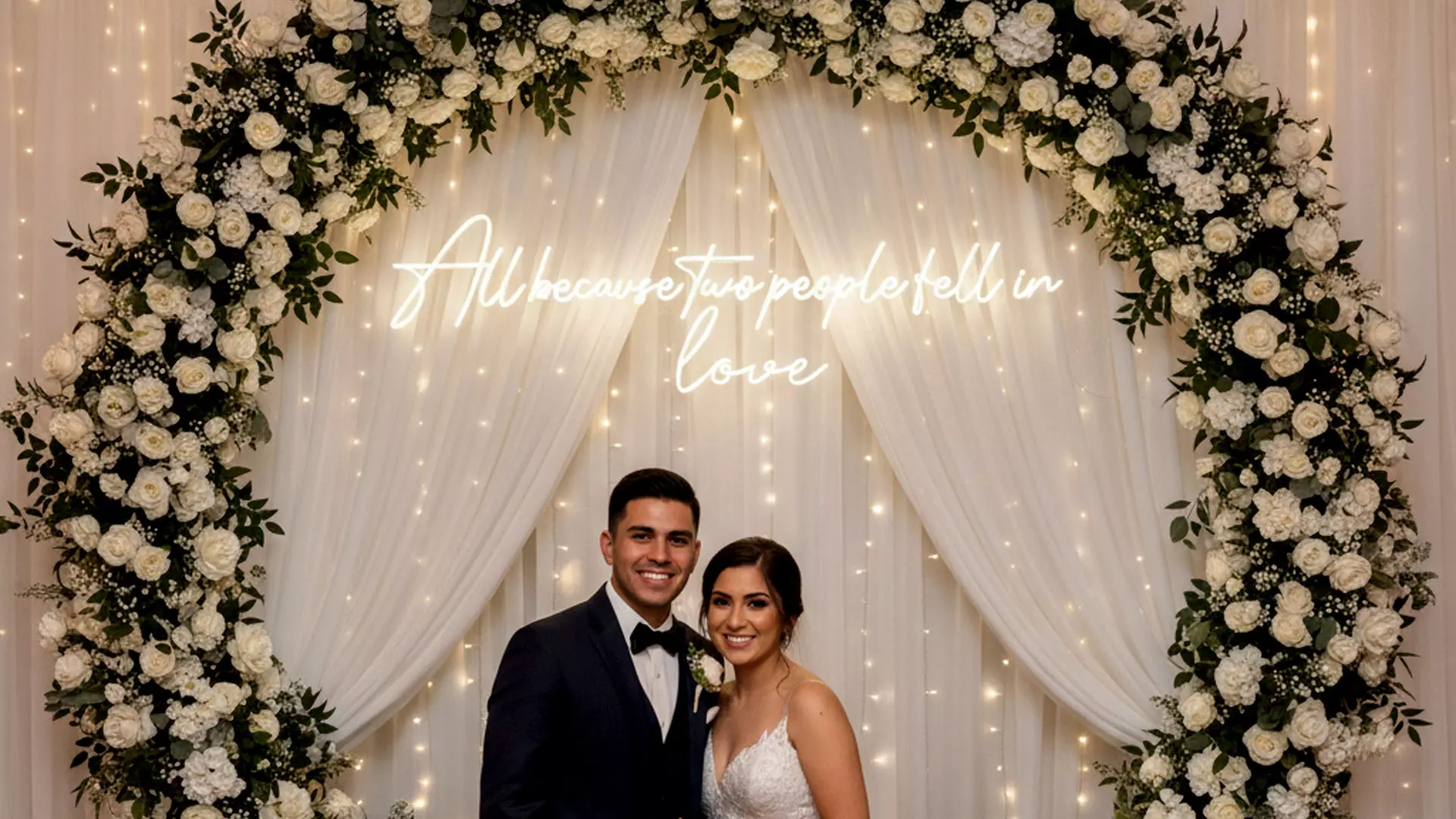
Why Custom Neon Signs Are Replacing Traditional Wedding Backdrops in 2026
Weddings don't look the same anymore. Pull up Instagram right now. You'll see what I mean: those flower walls and fabric drapes that flooded your feed for years? They're fading out. Custom neon signs are showing up instead, lighting up ceremony spaces, reception halls, and, basically, every photo your guests share.
The data proves it. Pinterest searches for "neon wedding signs" shot up 281% in 2025. This isn't some fleeting trend couples Google once and forget about. Neon signs are actually changing how people think about wedding backdrops. And there are concrete reasons this shift is happening.
Floral walls ruled for decades. Those rose-covered Instagram backdrops looked gorgeous, no question. But here's what nobody talks about: they're generic. They wilt by evening's end. After the wedding? Straight to the trash. Custom neon signs light up your venue, photograph incredibly well, actually tell your story instead of just decorating it, and then go home with you to hang in your bedroom.
This move from traditional backdrops to neon isn't just about looks. It's practical. Couples want personalization now. They want better technology. They want celebrations that feel like theirs.
The Personalization Imperative: Why "Custom" Changed Everything
Go to any wedding these days. You'll notice couples focusing hard on details that belong only to them. Not in a stressed-out way. Thoughtfully.
In 2025, couples bumped up their personalization spending by 15-20% across the wedding industry. Bigger budgets were allocated to custom decor, thematic elements, and bespoke touches. The reason? A generic "Love" sign tells nobody anything about your relationship.
Custom neon signs solved that problem. They let couples display their names, wedding date, hashtag, a line from their vows, whatever phrase matters to them. One couple used the opening line of the song they danced to on their first date. Another displayed an inside joke from their relationship. Some go with intertwined initials. Others pick a simple "Est. 2025" that works as wedding decor and permanent home art.
Research shows 40% of couples actively hunt for unique, customizable elements in their wedding. Not just "nice" decor. Customizable decor. Neon delivers that exactly. You're not picking from five pre-made designs. You're creating something that actually reflects your story, your personalities, your vibe.
Here's where budget gets smart: couples typically spend 10-15% of their total wedding budget on decor. If you're looking at a $30,000-$36,000 average wedding (where couples landed in 2024-2025), that's $3,000-$5,400 for decor. A custom neon sign usually runs between $150 and $600, depending on size and LED features. That's a high-impact focal point that doesn't drain your budget. It enhances it.
The Photography Transformation: Why Neon Wins On Camera
Stop scrolling through wedding Instagram for a second. What makes certain photos stop you mid-scroll? Usually? The glow.
Professional wedding photographers consistently say the same thing: neon lighting adds a contemporary feel, turning ordinary settings into extraordinary photo opportunities. Not because the sign itself is magical. Because of how light and depth work around it.
Traditional floral backdrops are flat. They photograph fine, sure. But they compete with every other wedding on the platform. The colors blend into skin tones. The depth is limited. By the 50th similar backdrop on your feed, they feel interchangeable.
Neon creates natural contrast. It adds a glow that flatters faces. It doesn't overpower the frame. It enhances it. Wedding photographers consistently report that neon lighting adds warmth and depth to evening shots, which matters hugely if you're having a sunset ceremony or evening reception.
Here's what actually counts: 60% of couples consider the 'Instagrammability' of their wedding a priority. That's not vanity. That's recognizing that weddings live beyond the day itself. They live in photos that get shared, saved, and revisited.
A strategically placed neon sign doesn't just look good; it also serves a purpose. It becomes the focal point that guarantees strong photos. Guests naturally gather around it. Photographers love capturing moments in front of it. Candid shots automatically have a visual anchor.
Content creators at weddings are becoming essential now, capturing real-time moments for Instagram and TikTok. Neon signs create the perfect backdrop for that content. They're visually distinctive enough to stop the scroll but don't scream "try-hard." They feel intentional.
Technology Changed the Game: Why Now? Why LED?
For a long time, real neon (the Vegas sign kind) was your only option if you wanted that glow. But real neon came with serious baggage: fragile, ran hot, contained toxic gases, consumed tons of electricity, and shattered if anything went wrong during transport or setup. Great aesthetic. Terrible logistics.
Then LED neon technology arrived. Everything shifted. Modern LED neon signs deliver the classic neon look without the headaches. Here's what changed:
Energy efficiency: LED neon uses roughly 80% less power than traditional glass neon. For weddings lasting 6-8 hours, that matters both environmentally and practically.
Durability: LED neon signs last 10-15 years. We're talking 30,000-50,000 operating hours. The sign from your wedding day isn't trash by next week. It's a keepsake. You take it home and hang it in your bedroom, living room, or entryway. It's genuinely designed for use beyond the event.
Safety: LED signs run on low voltage (typically 12V), stay cool to the touch, and pose zero fire risk. That matters for indoor ballrooms, outdoor tents, and especially if you have kids at your reception. Traditional neon required careful handling and could heat up dangerously in enclosed spaces.
Flexibility: LED technology lets designers bend neon into intricate designs that glass tubing can't. You want a heart, initials, flowing script, geometric patterns? LED can do it. You want the color to change throughout the evening, warm white during dinner, vibrant color on the dance floor? That's an RGB (color-changing) LED option now. Not possible with traditional neon.
Cost: LED neon is 30-50% cheaper to produce than glass neon, and the savings are passed on to customers. That $300 custom sign isn't a luxury price point anymore. It's accessible, especially if you're smart about your budget allocation.
The technology advancement matters because it solved the real-world problems that kept neon from dominating before. It wasn't the aesthetic holding neon back. It was the practicality. Once LED fixed that, neon became obvious.
Read: Stunning Wedding Venues Near Delhi to Plan Your Dream
The Color Palette Shift: Sophistication Takes Over
Here's where neon signs in 2026 differs from 2015. Back then, if you wanted neon sign at your wedding, you were choosing hot pink, electric blue, or some variation of "Vegas energy."
That's changed. Couples now select colors that are far more sophisticated. Trending tones for 2025-2026 include champagne white, dusty rose, warm amber, soft peach, and jewel tones like sapphire and emerald. These aren't day-glow screaming neon's. They're refined. They complement floral palettes. They photograph well in different lighting conditions.
There's also a rising trend toward color-changing LED neon sign lights that shift hue throughout the event based on your programming. Picture this: soft, romantic, warm white during the ceremony and dinner, then transitioning to the couple's signature color or jewel tone as guests move to the dance floor, same sign. But the event's energy literally shifts.
This color sophistication matters because it's moved neon out of the "trendy gimmick" category and into the "timeless design" space. A dusty rose neon sign with elegant script looks as good in wedding photos from 2026 as it will hanging in your home in 2035. It's not screaming for attention. It's speaking with intention.
Backdrops Beyond Backdrops: Neon Sign as Sculptural Installation
Here's something that sets the 2026 neon sign apart from earlier versions: it's no longer just a standalone sign behind the head table. It's becoming part of larger sculptural installations and immersive design moments.
Wedding designers worldwide are experimenting with immersive, sculptural environments, suspended floral canopies, ceiling-to-floor fabric drapes, and architectural light installations working in concert.
Neon signs fit naturally into this approach. They're embedded into floral arches, paired with mirrored panels or mesh grids, suspended for outdoor garden weddings, or integrated into photo booth zones.
The shift makes sense. Couples in 2026 aren't just looking for a pretty backdrop to photograph in front of. They're creating curated experiences. A neon sign behind a sweetheart table now features a floral arch framing it, strategic ambient lighting, and carefully considered negative space. It's more gallery-like, every element chosen, nothing accidental.
These sculptural installations are designed to feel three-dimensional and gallery-worthy. That language matters. We're talking about backdrops that invite engagement, that make guests want to move closer, interact with them, and photograph in front of them. Not passive decor. Active design.
The Keepsake Factor: Why This Matters Long-Term
Here's the thing about traditional wedding backdrops: after the wedding, what happens to them? If you're lucky, you get a few photos of it. If you're really thoughtful, you press a flower or save a piece of it. Mostly, though? They get broken down and recycled.
Custom neon signs don't have that problem. They're designed from the start to live beyond the wedding day. Couples are specifically choosing designs that work as permanent home decor. "Est. 2025" signs with your last name become living room focal points.
Initial monograms work in bedrooms. Song lyrics meaningful to your relationship become conversation starters. Some couples commission modern minimalist shapes in neon that work as contemporary art.
Because LED neon lasts 10-15 years, you're not buying a decoration for one night. You're investing in a keepsake. Every time you look at it hanging in your home, you're reminded of that day, that moment, the intentionality behind the choice. That's worth something emotionally. But it's also worth something financially in terms of return on your decor budget.
Some couples even repurpose their wedding neon sign for future events, anniversaries, vow renewals, or just as ambient lighting for dinner parties. It becomes a storytelling piece in your home, not something that winds up in a landfill.
Budget Efficiency: Maximum Impact, Rational Spending
Let's talk real numbers because this is where neon actually wins against traditional alternatives.
Your average wedding decor budget sits at 10-15% of total spend. For a $33,000 wedding (the current national average), that's $3,300-$4,950 to work with. Most couples spread it across florals, lighting, linens, and signage.
If you're doing an elaborate floral installation and some couples are spending $5,000-$10,000 on florals alone, you're blowing a huge chunk of that decor budget on something that doesn't survive the night.
A custom neon sign at $300-$600 is a fraction of that. It delivers a high-impact focal point (arguably the most photographed area of the wedding), works with a range of aesthetic styles, and comes home with you afterward. Cost per visual impact? Neon wins.
There's also the matter of venue flexibility. Traditional floral backdrops require specific setups, careful handling, and sometimes venue coordination. Neon signs are lightweight (LED versions weigh a fraction of glass neon), easy to mount, and simple to transport. If you're having a destination wedding or multiple locations, neon is less logistically complex.
Industry spending trends back this up. In 2025, couples increasingly chose personalized, custom decor concepts that offered strong visual impact without requiring a large portion of their budget. Neon fits that criterion perfectly.
The Broader Trend Context: Why Couples Want This Now
Neon signs aren't replacing traditional backdrops in a vacuum. They're replacing them as part of a larger shift in how couples think about weddings in 2026.
The overarching trend? Immersive, intentional, personal, and distinctive.
Couples are moving away from "formal and perfect" toward "meaningful and authentic." They're favoring custom details, architectural elements, and designs that tell their story specifically. Traditional floral backdrops, no matter how gorgeous, are inherently generic. Anyone can order that style.
Neon speaks to intention. It says, "We chose this. This matters to us. This is ours."
There's also growing emphasis on sustainability and reusability. LED neon aligns with that. Energy-efficient, durable, and meant to be used for years, not one event.
Plus, the Instagram-first mentality is real, but it's evolved. Couples aren't just chasing likes. They're curating visual narratives. A custom neon sign creates that visual hook instantly. It's the first thing you see in photos. The focal point that makes the image distinctive.
Real-World Logistics: Installation, Durability, Placement
Let's talk practicalities because beautiful doesn't matter if it's a nightmare to execute.
For backdrops, neon signs typically work best at 24-30 inches wide for photo zones, and up to 60 inches for larger installations. They can be mounted on stands (portable, flexible placement), affixed directly to walls, or suspended from above.
LED signs don't require special electrical work; they can be powered by a standard outlet or a battery for outdoor settings.
They're weather-resistant, so outdoor and destination weddings aren't problematic. They stay cool to the touch, so there's no concern about guest safety even during long evening receptions. And they're quiet, with no humming or flickering issues that sometimes plague lighting installations.
Setup typically takes 15-30 minutes, depending on complexity.
Breakdown is equally simple. If you're working with a rental company or a custom neon shop, they often handle installation and pickup, which removes all logistics headaches.
Durability matters too. Unlike floral installations that degrade over the course of an event, neon maintains consistent brightness and color from start to finish: no wilting, no browning, no fading. What you see in photos at hour one looks identical to what you see at hour eight.
What About Cost Variance? Not Everything Is $500
Fair question: if neon signs are 30-50% cheaper to produce than glass, why does pricing vary so much?
Size is the biggest factor. A 24-inch name sign costs less than a 48-inch statement piece.
Custom design complexity matters too. Simple text is cheaper than intricate custom shapes. Material quality varies, with premium LED vs. budget LED affecting price and lifespan. Some shops offer basic designs starting at $150. Custom work can run $800+.
Color-changing RGB capabilities add cost but give you flexibility throughout the event. Dimming features (which let you adjust brightness for the ceremony vs. the reception) cost more but offer functional benefits.
The sweet spot for most couples is $250-$500 for a quality, personalized, durable, and genuinely keepsake-worthy custom piece.
Looking Forward: What's Next for Neon Signs in Weddings?
If neon signs are accelerating in 2026, where's the trajectory heading?
Designers predict deeper integration with immersive installation trends. Think neon embedded into floral arches, suspended from ceilings as part of sculptural displays, or integrated into interactive elements. Content creators capture moments in front of them in real-time, livestreaming to guests who couldn't attend.
Color-changing tech will likely become standard rather than a premium feature. Personalization will push boundaries; couples might commission artistic neon designs that feel less like a "sign" and more like a "functional art installation."
There's also potential for neon to become more integrated with technology synchronized with music timing, responsive to movement, or integrated with projection mapping for even more immersive experiences.
But fundamentally, the core reason neon is winning won't change: it's personal, it's photogenic, it's durable, and it tells a couple's actual story instead of a generic celebration story.
Conclusion: The Shift from Generic to Genuine
The rise of custom neon signs in wedding design isn't really about the neon. It's about what neon represents: a deliberate rejection of generic, a commitment to personal storytelling, and a recognition that the elements you choose on your wedding day should matter enough to keep beyond the day.
Traditional backdrops served their purpose well for a long time. They were beautiful. They were Instagram-friendly. They worked. But they were also interchangeable. Ten weddings, ten similar backdrops. Different couples, identical aesthetics.
Neon changes that equation. It forces intention. It demands personalization. And because of advances in LED technology, it's practical, sustainable, and genuinely affordable.
In 2026, couples are choosing backdrops that don't just photograph well, but tell the truth about who they are. That's not a trend that fades. That's a shift in values. That's why, as you attend the next wedding, you'll likely see neon glowing softly in the background of photos. Not because it's trendy, but because it's true.