How CloudMetic Helps UAE Businesses Connect Salesforce with Existing Business Systems
Businesses today use different software to manage sales, customer information, finance, inventory, marketing, and customer support. Each system may work well on its own, but problems can arise when these tools do not share information with one another.
For example, a sales team may update a customer's details in Salesforce while the finance team maintains separate records in an accounting system. Employees may then spend hours checking information, updating spreadsheets, and correcting mistakes.
For businesses in the United Arab Emirates (UAE), these disconnected systems can slow down daily operations and make it harder to deliver a smooth customer experience.
Salesforce integration helps solve this problem by connecting Salesforce with the business applications a company already uses.
CloudMetic helps businesses connect Salesforce with existing systems through integration, customization, development, and consulting services.
The goal is to make information easier to access, reduce repetitive work, and help teams make better business decisions without unnecessarily replacing their existing software.
What Is Salesforce Integration?
Salesforce integration is the process of connecting Salesforce CRM with other business applications so that they can exchange information and work together.
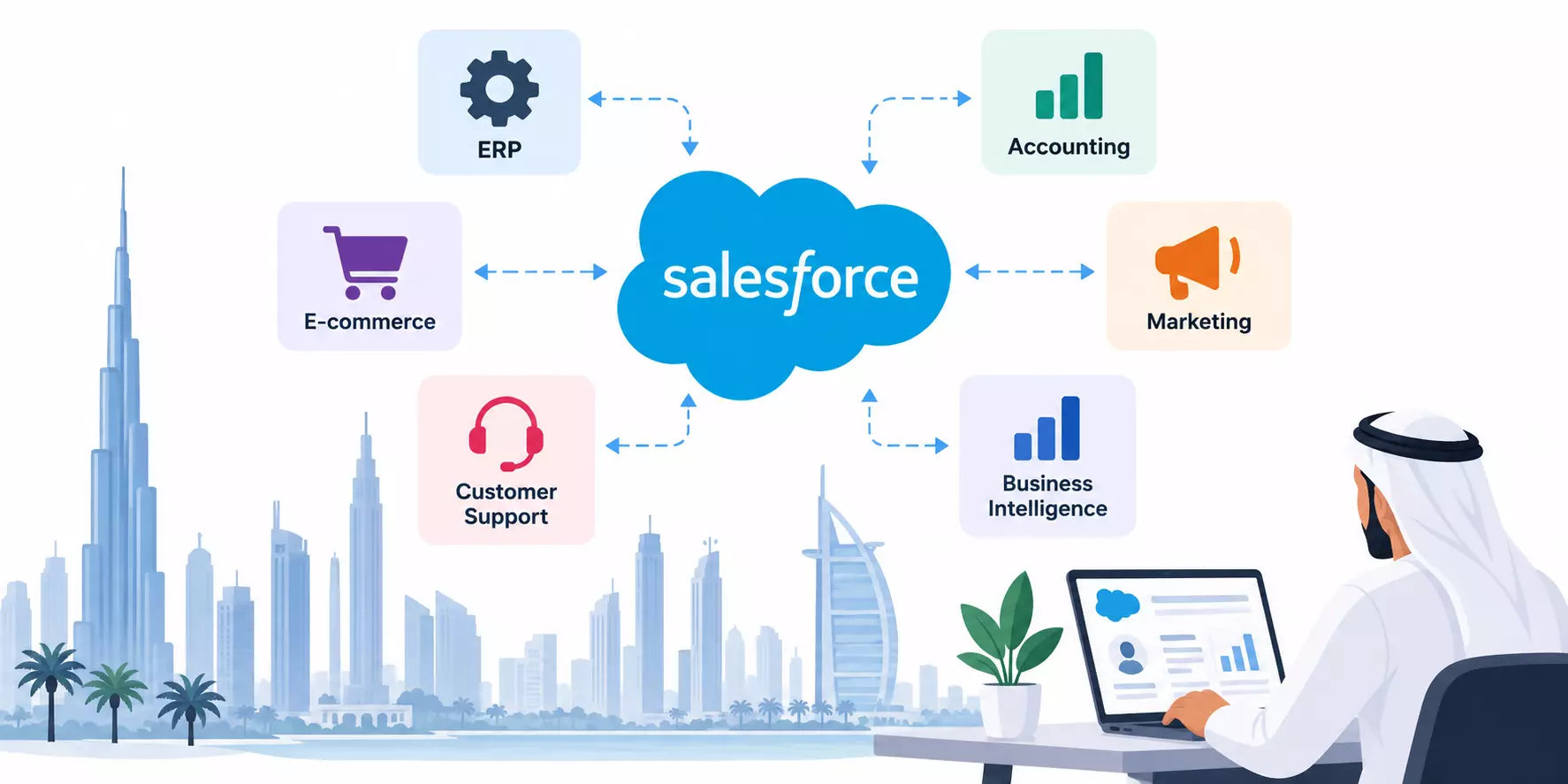
A business might connect Salesforce with:
- ERP systems: To share information about orders, products, stock, and business operations.
- Accounting software: To make customer billing, invoice status, and payment information easier to access.
- Marketing platforms: To connect customer records with campaign activity and lead information.
- E-commerce platforms: To share customer profiles, purchases, and order details.
- Customer support systems: To provide service teams with relevant customer and case information.
- Business intelligence tools: To combine data from different sources for reporting and analysis.
The exact integration depends on the company's systems, business goals, and technical requirements. A well-planned connection helps employees work with more consistent information instead of switching between disconnected applications.
Why UAE Businesses Need Salesforce Integration
Companies in the UAE operate across industries such as real estate, retail, healthcare, financial services, logistics, hospitality, and professional services. Each industry has different workflows, but many businesses face similar data and communication challenges.
1. Reduce Manual Data Entry
When applications do not communicate, employees often enter the same information more than once. This takes time and increases the chance of errors.
Salesforce integration can automate the transfer of selected information between systems.
For example, when a sales representative updates a customer's details, an integrated system may share the relevant information with another application.
This reduces repetitive work and gives employees more time to focus on customers and important tasks.
2. Improve Customer Information
Customer information is more useful when it is accurate, consistent, and accessible to the right teams.
By connecting Salesforce with relevant business applications, a company can create a clearer view of customer interactions, purchases, service requests, and sales activity.
This helps sales and support teams understand customer needs and respond with better information.
3. Improve Team Collaboration
Disconnected software can create information gaps between sales, finance, operations, and customer support.
An integrated environment helps departments access the information they need without relying entirely on emails or manual updates.
For example, a sales representative may be able to check an order's status in Salesforce using information received from the company's order management system.
4. Support Better Business Decisions
Business leaders need reliable information to understand sales performance, customer activity, and operational results.
Salesforce integration can help bring relevant data together for reporting and analysis. This allows managers to identify trends, monitor performance, and make decisions based on more complete information.
How CloudMetic Helps UAE Businesses Connect Existing Systems
Every business has different processes, software, and integration requirements. CloudMetic's approach focuses on understanding these needs before recommending a suitable Salesforce solution.
1. Understanding Existing Business Systems
The first step is to understand how the business currently operates.
This includes identifying the applications employees use, the information stored in each system, and the problems caused by disconnected workflows.
For example, a company may need Salesforce to exchange customer information with an ERP system, accounting software, or an e-commerce platform.
Understanding these requirements helps establish clear integration goals and prevents unnecessary technical complexity.
2. Choosing the Right Integration Approach
Different systems require different integration methods. The right option depends on the available APIs, data volume, security requirements, and the frequency of updates.
Common approaches include:
- API-based integration: Allows applications to exchange information through defined interfaces.
- Prebuilt connectors: Can simplify connections when compatible connectors are available.
- Middleware: Helps manage data exchange and workflows between multiple applications.
- Custom integration: Supports specific business requirements that standard options may not cover.
CloudMetic can help businesses assess their requirements and identify a suitable approach for their Salesforce environment.
Read: NaaS UAE: Why Network as a Service Matters for Voice Quality
3. Connecting Salesforce with ERP and Finance Systems
Many companies rely on separate systems for customer management, inventory, orders, billing, and accounting.
Connecting these systems with Salesforce can help employees access relevant operational information from their CRM workflows.
For example, an integrated workflow may allow a sales team to check product availability or view an order status without requesting a manual update from another department.
The actual capabilities depend on the connected applications and the integration design.
4. Automating Business Processes
Integration becomes more valuable when it supports useful business automation.
For instance, a company could configure a workflow that sends an order confirmation after a qualifying order is recorded, creates a follow-up task when a lead reaches a defined stage, or updates a relevant record when payment information changes.
CloudMetic also provides Salesforce customization and development services to help align workflows with specific business requirements.
You can explore Salesforce Customization Services to understand how Salesforce can be adapted to your business processes.
5. Protecting Data and Maintaining Quality
A successful integration should do more than move data between applications. It should also protect information and maintain data quality.
Important considerations include user permissions, secure authentication, field mapping, duplicate prevention, error handling, and monitoring.
Businesses should also decide which system is the main source of truth for each type of information. For example, an accounting application may remain the authoritative source for financial records while Salesforce manages customer relationships.
CloudMetic can help businesses plan their Salesforce environment around their operational and technical requirements.
6. Testing and Ongoing Support
Before an integration goes live, it should be tested with realistic business scenarios.
Testing should confirm that information reaches the correct destination, records remain consistent, errors are handled properly, and users can complete their normal tasks.
After launch, monitoring and maintenance help identify issues caused by API changes, updated applications, permission changes, or evolving business needs.
CloudMetic also offers Salesforce Support and Managed Services to help businesses maintain and improve their Salesforce environment over time.
Practical Salesforce Integration Examples for UAE Industries
The value of integration becomes clearer when viewed through everyday business situations.
Real estate: A property company can connect Salesforce with relevant lead management, property listing, and communication systems. Sales teams can then manage enquiries and follow-ups more efficiently.
Retail and e-commerce: Connecting Salesforce with an online store can help teams access customer and order information. This supports more consistent customer communication and service.
Healthcare: Where appropriate and permitted, integration can connect approved administrative systems with Salesforce workflows. Access controls and applicable privacy requirements must be considered carefully when handling sensitive information.
Logistics: Connecting CRM with order tracking or operational systems can help customer-facing teams access delivery updates and respond to enquiries with more relevant information.
Financial services: Integration can help teams coordinate customer relationship information with approved business processes, subject to applicable regulatory, security, and access requirements.
These are examples of potential use cases, not guaranteed outcomes. The right solution depends on each organization's applications, workflows, and compliance obligations.
Common Salesforce Integration Challenges and How to Avoid Them
Although integration offers many benefits, poor planning can create new problems.
- Inconsistent data: Define field mappings and data ownership before transferring records.
- Duplicate records: Establish matching rules and test how duplicate information is handled.
- Unexpected costs: Review licensing, connector fees, development work, and ongoing maintenance.
- Security risks: Apply least-privilege access, secure authentication, and appropriate monitoring.
- Integration failures: Plan error notifications, retry procedures, and recovery processes.
- Low user adoption: Involve employees early and provide practical training before launch.
Businesses should also prioritize integrations based on their business value. Connecting every application at once may create unnecessary complexity. Starting with one important workflow can make the project easier to test and manage.
A Simple Roadmap for Successful Salesforce Integration
UAE businesses can use the following steps to plan their integration projects:
- Define the goal: Identify the business problem the integration should solve.
- Review existing applications: Document systems, data sources, APIs, and limitations.
- Prioritize information: Decide which data needs to move between systems and how frequently.
- Select the integration method: Choose APIs, connectors, middleware, or custom development according to the requirements.
- Plan security and testing: Set access rules, validate data quality, and test error scenarios.
- Launch in stages: Begin with a manageable workflow before expanding.
- Monitor performance: Track data accuracy, failures, processing times, and user feedback.
This approach helps businesses make informed decisions and reduce avoidable implementation risks.
Why Choose CloudMetic for Salesforce Integration in the UAE?
Choosing an integration partner involves more than finding someone who can connect two applications. Businesses need a solution that supports their processes, fits their existing technology, and can adapt as requirements change.
CloudMetic offers Salesforce integration alongside implementation, consulting, customization, development, app development, and support services. This broader service offering can help businesses address connected requirements instead of treating integration as an isolated technical task.
CloudMetic's focus is on understanding business needs, aligning Salesforce with existing workflows, and helping teams use connected systems more effectively.
Businesses planning a new CRM project can also explore Salesforce Implementation Services to learn more about aligning Salesforce deployment with business objectives.
Conclusion
Connecting Salesforce with existing business systems can help UAE businesses reduce manual work, improve information sharing, and create more consistent customer experiences.
However, the results depend on choosing the right integration method, maintaining data quality, protecting information, and supporting users after launch.
CloudMetic helps businesses explore Salesforce integration, customization, development, and ongoing support based on their specific requirements.
With a clear plan and a practical implementation approach, companies can build a more connected technology environment while continuing to use the business applications that serve them well.
If your business is struggling with disconnected systems or repetitive data entry, reviewing your current workflows is a useful first step toward a more connected Salesforce environment.