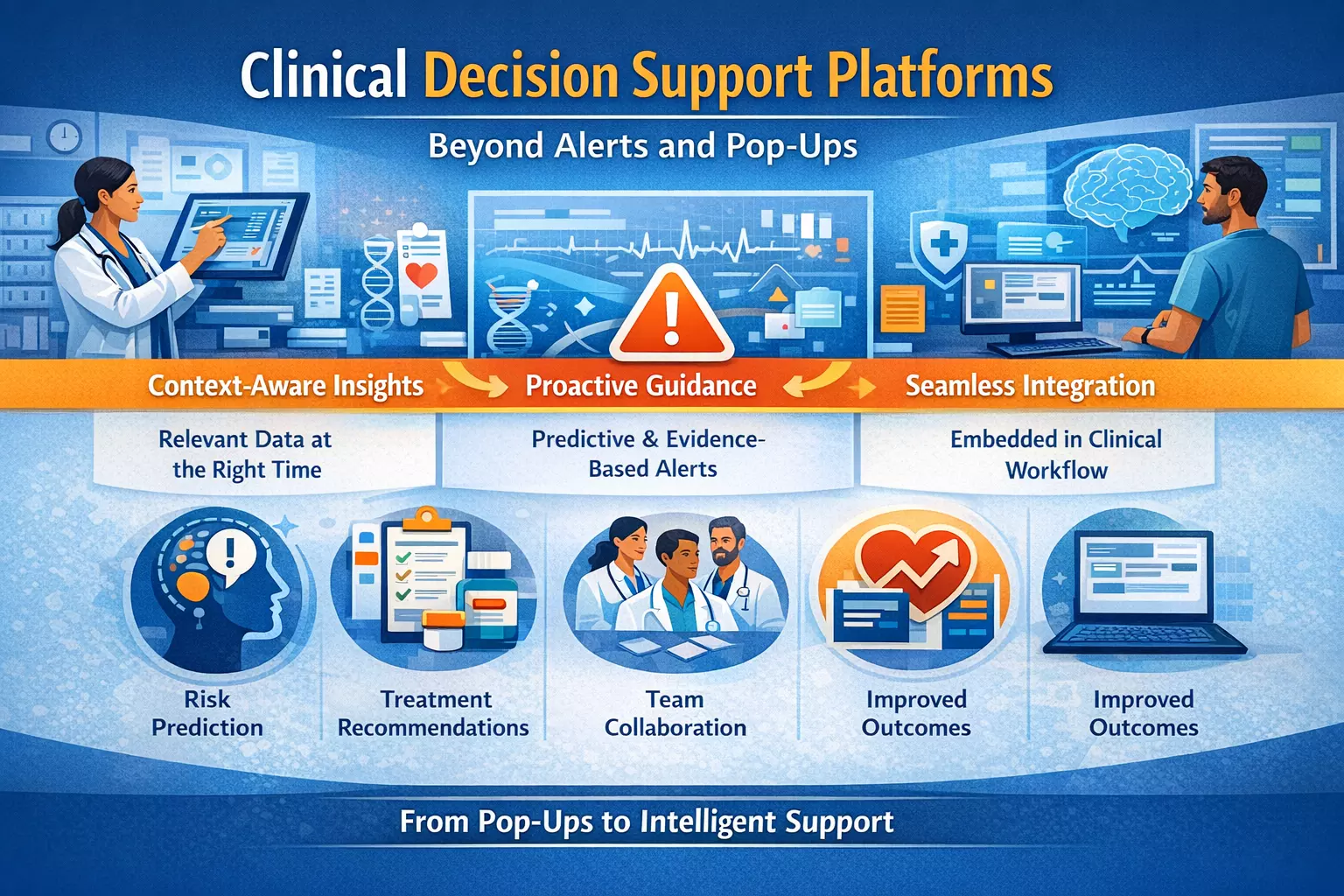
Clinical Decision Support Platforms: Beyond Alerts and Pop-Ups
Healthcare systems across the world are under great stress to deliver more secure, faster, and extra personalized care—regularly with restricted time and assets.
For years, virtual equipment has tried to assist clinicians navigate complicated choices, but many have fallen short with the aid of relying too closely on intrusive indicators and disruptive pop-ups. In the introduction of modern health IT conversations,
Clinical Decision Support Platforms are increasingly being reframed now not as interruptive tools, but as shrewd partners embedded seamlessly into clinical workflows.
The Limits of Traditional Alert-Based Systems
Early decision support systems had been constructed round rule-based indicators: reminders for drug interactions, allergy warnings, or preventive care gaps.
While well-intentioned, those structures often overwhelmed clinicians. “Alert fatigue” has become a common criticism, with providers clicking through warnings simply to complete documentation or flow to the next affected person.
The trouble wasn’t that decision support was unnecessary—it was that it changed into poorly contextualized. Alerts were frequently usual, untimely, or inappropriate to the particular affected person situation.
As a result, it is considered eroded. When clinicians prevent trusting alerts, even the most critical warnings risk being overlooked.
A Shift Toward Context-Aware Intelligence
Modern decision guides are evolving beyond static policies into dynamic, context-conscious intelligence. Instead of interrupting clinicians mid-venture, advanced systems surface insights at the proper second, in the proper format, and in the tools clinicians already use—along with electronic health statistics (EHRs).
These systems analyze a huge variety of inputs: patient history, lab results, imaging, genomics, real-time vitals, or even social determinants of health. By synthesizing these statistics, they are able to offer nuanced suggestions rather than blunt warnings.
For instance, instead of flagging every potential drug interaction, the system would possibly spotlight simplest those interactions that are clinically massive for a selected patient’s condition and dosage.
From Reactive Alerts to Proactive Guidance
One of the most essential advances is the transition from reactive to proactive support. Rather than looking forward to a clinician to make a probably unstable preference, modern platforms can anticipate needs.
They may advise proof-based remedy pathways, flag sufferers vulnerable to deterioration, or advise diagnostic tests before complications rise up.
This proactive approach supports clinical reasoning rather than replacing it. The goal is not automation of decisions, but augmentation—helping clinicians think more clearly under pressure and reducing cognitive load during complex cases.
Integration Into Clinical Workflow
Adoption succeeds or fails based on workflow fit. Decision support that requires clinicians to leave their primary screens, log into separate systems, or interpret complex dashboards is unlikely to be used consistently.
Newer platforms emphasize seamless integration, embedding insights directly into order entry, progress notes, or patient summaries.
Explainability is equally important. Clinicians need to understand why a recommendation is being made. Transparent logic, clear evidence references, and the ability to drill down into supporting data all help build trust and encourage adoption.
Supporting Teams, Not Just Individuals
Healthcare delivery is more and more team-primarily based, and decision support is following suit. Advanced structures help collaboration throughout physicians, nurses, pharmacists, and care coordinators. Shared insights help align groups around care plans, reduce variants, and enhance handoffs.
Beyond acute care, decision support also plays a developing position in population health—figuring out excessive-threat cohorts, ultimate care gaps, and assisting fee-based care projects.
Frequently Asked Question
1. What are Clinical Decision Support Platforms?
Clinical Decision Support Platforms are virtual systems designed to assist healthcare specialists by imparting evidence-based insights, suggestions, and affected person-precise records on the factor of care. They help clinicians make knowledgeable decisions without changing scientific judgment.
2. How are modern decision support platforms different from traditional alert-based systems?
Unlike traditional systems that rely heavily on pop-ups and generic alerts, modern platforms are context-aware and workflow-integrated. They deliver relevant insights at the right time, reducing alert fatigue and improving clinician trust and usability.
3. Can these platforms improve patient outcomes?
Yes. By providing proactive, statistics-pushed guidance—inclusive of early threat detection, personalized treatment pathways, and medicinal drug optimization—these platforms can help lessen errors, improve care satisfaction, and assist higher patient results.
4. Do Clinical Decision Support Platforms replace clinician decision-making?
No. These platforms are designed to augment, not replace, clinical expertise. They support clinicians by reducing cognitive burden and surfacing relevant information, while final decisions always remain in the hands of healthcare professionals.
5. How do these platforms integrate into existing healthcare systems?
Most modern platforms integrate directly with electronic health records (EHRs) and other clinical systems. This allows insights to appear within existing workflows, such as during order entry or patient review, without requiring clinicians to switch between multiple tools.
Read: Inside a Clinical Decision Support Platform
Final Thoughts
As healthcare continues to develop greater complexity, the future of digital support lies in intelligence that is diffused, contextual, and deeply incorporated into care transport.
When thoughtfully designed and implemented, Clinical Decision Support Platforms can flow some distance beyond alerts and pop-ups to turn out to be trusted companions—improving medical judgment, enhancing patient consequences, and restoring time and awareness to the human side of medication.