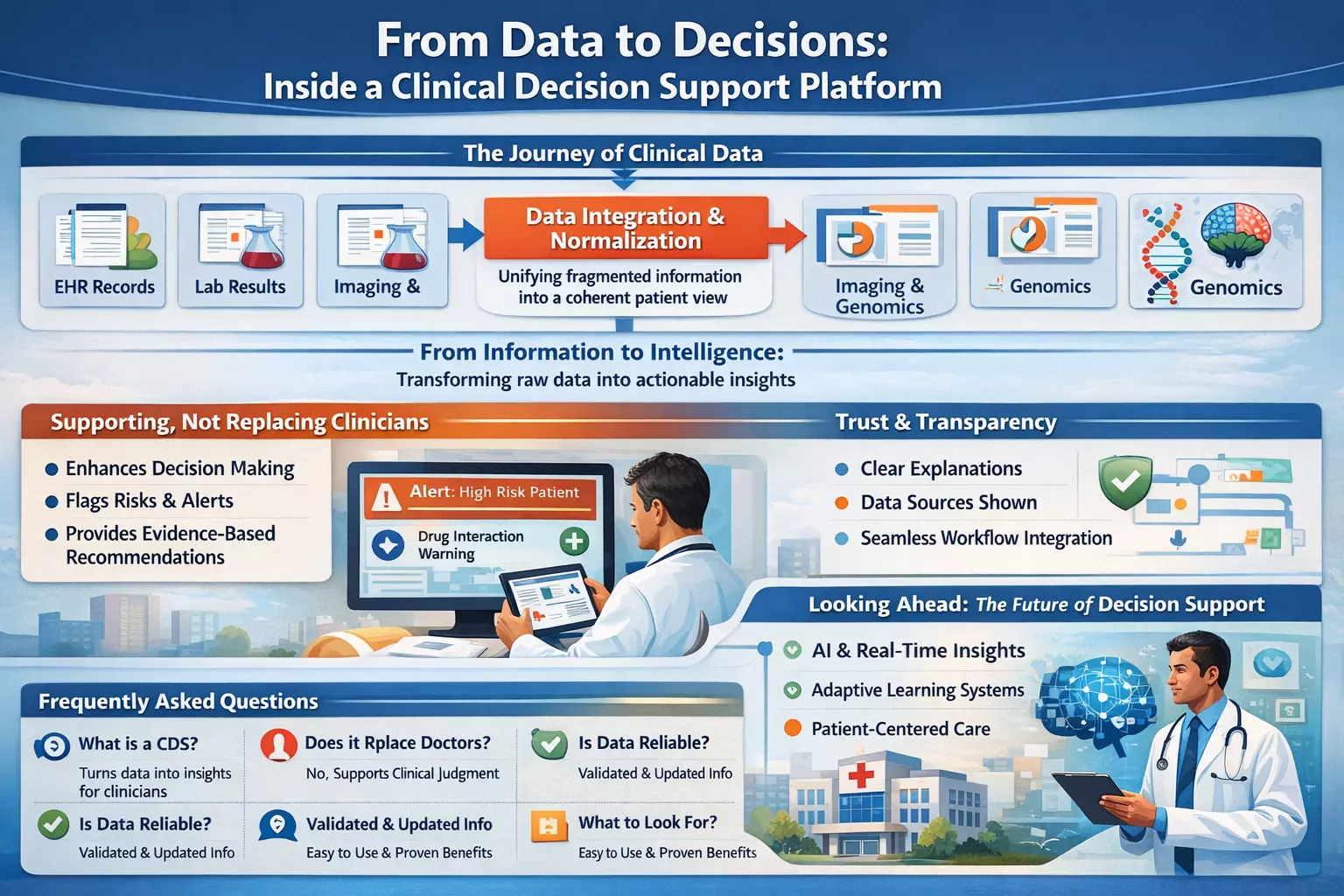
From Data to Decisions: Inside a Clinical Decision Support Platform
Healthcare generates a terrific volume of data each day. Lab outcomes, imaging, clinical notes, crucial symptoms, genomics, and patient-reported outcomes all arrive constantly, often fragmented across structures.
While this record has the capability to enhance care, it could additionally weigh down clinicians who have to make well timed, high-stakes selections. The challenge is no longer access to records, but turning that data into clear, actionable insight on the point of care.
This is where intelligent decisions enter the picture. At its core, a clinical decision support platform exists to bridge the distance between raw scientific facts and real-world medical choices.
Understanding how this change happens reveals why these structures are getting foundational to modern healthcare delivery.
The Journey of Clinical Data
Every significant decision starts with data, but not all data is immediately useful. Healthcare information is frequently unstructured, inconsistent, and scattered across electronic health records, diagnostic systems, and external resources. Before perception can emerge, these statistics must be collected, normalized, and contextualized.
Effective decision support systems ingest information from a couple of resources and reconcile it into a unified clinical view.
This process consists of mapping terminology, resolving duplicates, and aligning timelines in order that affected person history makes sense as a coherent story as opposed to a group of disconnected records. Without this basis, even the most advanced analytics might fail to deliver value.
From Information to Intelligence
Once statistics is structured, the subsequent step is interpretation. This is where clinical knowledge, proof-based totally hints, and analytics intersect.
Algorithms examine patterns, identify risks, and examine patient-precise data in opposition to recognized great practices. Importantly, this intelligence isn't always static. Medical knowledge evolves continuously, and any system designed to aid clinicians ought to adapt just as fast.
What differentiates strong decision support from simple alerting gear is relevance. Instead of flooding clinicians with conventional reminders, contemporary platforms prioritize precision.
They remember patient context, care placing, and clinical reason to floor insights which are timely and meaningful. A nicely-designed recommendation feels much less like an interruption and more like a trusted second opinion.
Supporting, Not Replacing, Clinicians
One common misconception is that decision support aims to automate medical judgment. In reality, its cause is the other. These systems are built to augment human knowledge, not override it. Clinicians keep full authority over choices, as the same technology provides readability, proof, and foresight.
For instance, a system may highlight ability drug interactions, flag sufferers at high chance of deterioration, or advocate diagnostic issues based on diffused records patterns.
The clinician evaluates this input in the broader context of affected person values, experiment, and expert judgment. When accomplished properly, decision assist reduces cognitive burden and allows clinicians awareness on what topics most: patient care.
Trust and Transparency Matter
Adoption hinges on trust. Clinicians are more likely to have interaction with equipment that explains their reasoning rather than presenting opaque conclusions.
Transparency round why a recommendation appears, which data factors contributed, and how confident the device is could make the distinction among acceptance and skepticism.
Equally important is workflow integration. Insights have to seem evident within existing medical systems and techniques. If decision support disrupts care shipping or provides friction, it risks being ignored, no matter how sophisticated it is able to be.
Measuring Real Impact
The true value of decision support is measured not in dashboards or metrics, but in consequences. Reduced mistakes, advanced adherence to recommendations, faster diagnoses, and higher affected person reviews all imply success.
On an organizational level, these platforms also can aid populace health projects, useful resource optimization, and first-rate improvement efforts.
However, non-stop evaluation is important. Monitoring performance, capturing clinician remarks, and refining logic ensures that pointers continue to be accurate and relevant over time. Healthcare is dynamic, and decision support ought to evolve alongside it.
Read: Expert Network Platforms Compared: Which One Fits Your
Frequently Asked Questions
1. What is a clinical decision support platform?
It’s a system that turns patient data into timely, actionable insights to help clinicians make better decisions at the point of care.
2. How does decision support improve clinical outcomes?
It highlights risks and evidence-based recommendations, helping clinicians act faster and reduce errors.
3. Does decision support replace clinical judgment?
No. It supports clinicians with insights, but final decisions always remain with healthcare professionals.
4. How is patient data kept accurate and reliable?
Through data validation, standardization, and continuous updates from trusted clinical sources.
5. What should organizations look for in a decision support solution?
Ease of use, transparency, smooth workflow integration, and proven impact on patient outcomes.
Looking Ahead
As healthcare keeps its virtual transformation, the role of decision support will best enlarge. Advances in interoperability, real-time analytics, and adaptive learning models are pushing those systems past easy rule-primarily based structures.
The destiny lies in equipment that examines outcomes, customize insights, and assist care across the entire affected person's journey
Ultimately, turning records into decisions is about empowering people. Technology presents the way, but clinicians provide the wisdom.
When thoughtfully designed and responsibly applied, decision support platforms come to be quiet partners in care—operating backstage to make sure that each selection is knowledgeable, timely, and level-headed within the best available proof.