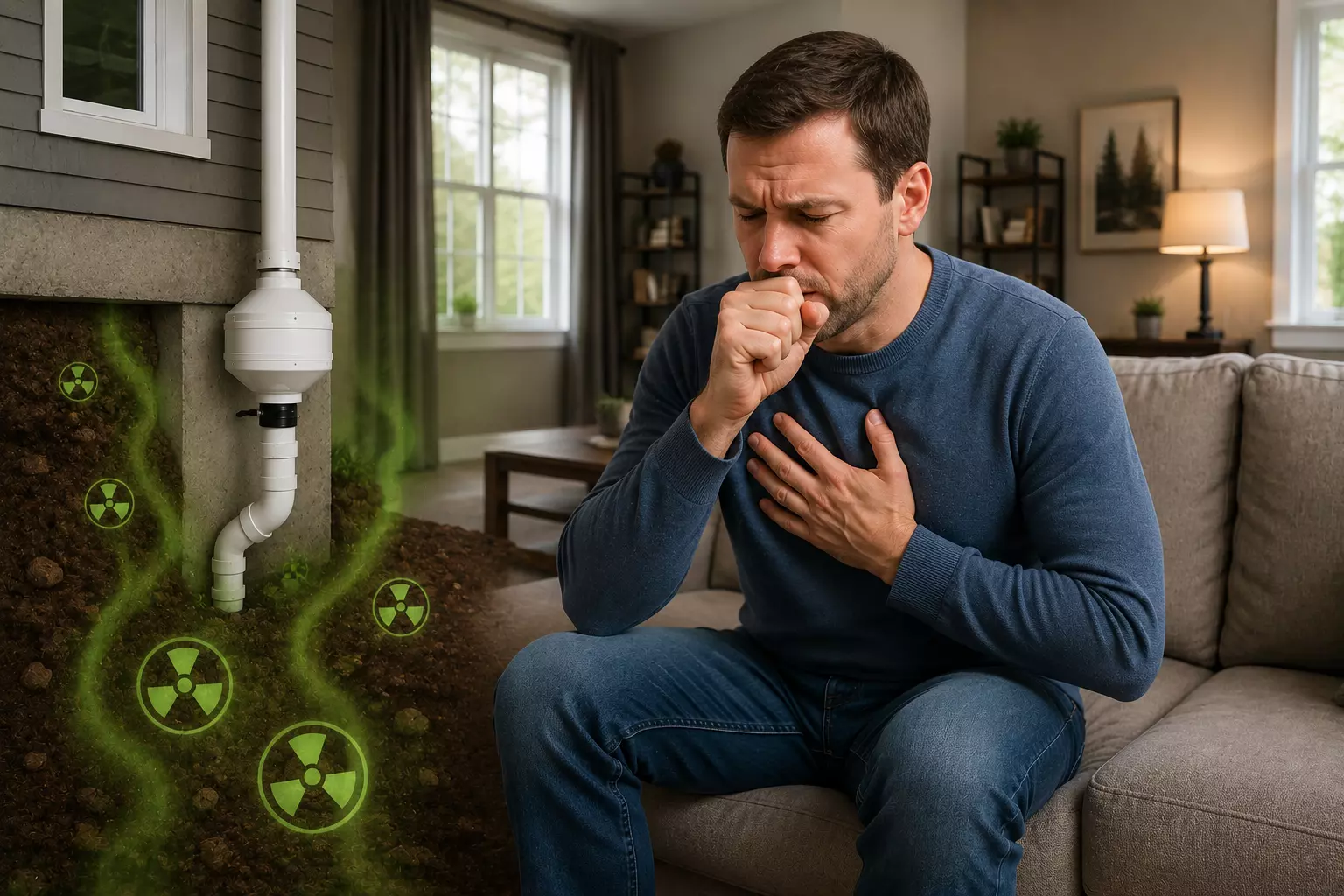
Can Radon Make You Sick Right Away?
I hear this question almost every time someone finds out their basement tested high, usually right after a headache or a cough that shows up around the same week. Totally understandable worry, but here's the thing.
Radon doesn't work the way people assume it does. There's no coughing fit, no dizzy spell, no obvious moment where you'd know something's wrong. This misunderstanding comes up constantly around radon testing St.
Louis appointments, so let me explain what's actually going on, because the real risk is very real, just not in the way most people picture it.
The Short Answer
No, radon does not make you sick right away. There's no acute reaction, no immediate symptom, nothing you'd notice happening in the moment.
The danger from radon comes from long-term exposure, specifically the increased risk of lung cancer that builds up over years of breathing elevated levels, not from any short-term illness.
This is genuinely good news in one sense, because it means there's no emergency clock ticking the way there would be with something like a gas leak, and it means radon mitigation St Louis installation can be scheduled thoughtfully rather than as a panic response.
It's also a little unsettling, because it means a home can have a serious radon problem for years without anyone ever feeling different.
Why Radon Doesn't Work Like Carbon Monoxide
No Smell, No Taste, No Immediate Symptoms
People often lump radon in with carbon monoxide because both are invisible gases you can't detect with your senses. But carbon monoxide causes acute poisoning, headaches, confusion, nausea, sometimes within hours at high concentrations.
Radon doesn't do any of that. It's a radioactive gas, and the harm comes from radiation exposure to lung tissue over repeated, long-term breathing, not from the gas itself causing any kind of immediate physical reaction.
How Radon Actually Causes Harm
When you breathe in radon, it decays into radioactive particles that can lodge in your lung tissue. Those particles release small bursts of radiation as they continue decaying, and over years, that repeated radiation exposure can daat can lodge in your lung tissue.
Those particles release small bursts of radiation as they continue decaying, and over years, that repeated radiation exposure can damage lung cells enough to increase cancer risk. It's a slow, cumulative process, not something that produces symptoms on day one, day thirty, or even after a year in most cases.
The Real Health Risk: Long-Term Exposure
How Lung Cancer Risk Builds Over Time
The EPA identifies radon as the second leading cause of lung cancer in the United States, behind smoking.
The risk isn't about one bad day of exposure, it's about cumulative years spent breathing elevated levels, especially in a home where you spend most of your time, like a finished basement used as a bedroom or a main living space.
Who Faces Higher Risk
Smokers face a significantly higher combined risk from radon exposure than non-smokers, since the two act synergistically rather than just adding together.
People who spend a lot of time in lower levels of a home, kids doing homework in a finished basement, someone working from a home office down there, face more cumulative exposure simply due to time spent in the affected space.
This is exactly why radon mitigation St Louis installation matters most for homes where the lower level gets used as genuine living space rather than storage.
Common Symptoms People Mistakenly Blame on Radon
I've had people call me convinced their headaches, fatigue, or seasonal allergies are radon-related because they just got a high test result and the timing felt suspicious.
It's a natural instinct to connect the dots, but radon genuinely doesn't cause those short-term symptoms. This mix-up comes up often enough after radon testing St.
Louis results come back elevated that I address it with nearly every client on the follow-up call.
If you're not feeling well, that's worth addressing with a doctor regardless, but it's very unlikely to be radon-related unless we're talking about a lung cancer diagnosis after years of exposure, which is an entirely different situation from a sudden headache or cough.
When Those Symptoms Point to Something Else
Mold, seasonal allergens, dust, or even something as simple as a change in weather can all cause the kind of symptoms people sometimes misattribute to radon.
If something in your home is genuinely making you feel sick in real time, it's worth looking into air quality issues more broadly, not just radon specifically, since radon alone isn't the kind of thing that produces same-week symptoms.
Read: Radon Mitigation Ottawa — Comparing Local Contractors
A Homeowner Who Assumed the Wrong Thing
I got a call from a homeowner in University City a while back who was certain her radon test result explained a string of headaches she'd been having that month. Her result had come back at 6.2 pCi/L, elevated and worth fixing, but nowhere close to explaining sudden symptoms.
We installed a mitigation system, which was the right move regardless, but her headaches didn't go away afterward, because they were never related to radon in the first place.
That radon mitigation St Louis installation still mattered for her long-term health, even though it had nothing to do with how she felt that particular month.
Turned out to be a completely separate issue with dehydration and stress that had nothing to do with her house. It's a good example of why understanding what radon actually does, and doesn't do, matters.
Fixing a real radon problem is worth doing for long-term health, but it's not going to resolve symptoms that show up in real time.
What to Actually Do If You're Worried About Radon
The right move isn't to watch for symptoms, since there aren't any to watch for. The right move is testing. Radon testing St. Louis homeowners schedule is the only way to actually know your levels, since there's no physical sign that will tell you one way or another.
If your result comes back at or above the EPA's 4.0 pCi/L action level, radon mitigation St Louis installation is a straightforward, well-proven fix, usually completed in a single visit, that addresses the long-term risk even though you'd never have felt anything different either before or after the fix.
Scheduling radon mitigation St Louis work promptly once a result comes back elevated is the practical next step, not a race against symptoms that were never coming.
If you haven't tested yet, our radon testing page covers how to get an accurate reading for your home, and if your results come back elevated, our radon mitigation page walks through what installation actually involves.
Conclusion
Radon doesn't cause any immediate sickness, no headaches, no nausea, no obvious symptom that tells you something's wrong in the moment.
The real risk is long-term lung cancer risk that builds up from years of elevated exposure, which is exactly why testing matters more than watching for symptoms that simply aren't coming.
If you've been feeling unwell and wondering whether radon is the cause, it's worth ruling out other explanations with a doctor, since radon almost certainly isn't producing whatever you're experiencing right now.
What radon testing St. Louis professionals can tell you is whether your home has a long-term problem worth fixing, and that's the information actually worth acting on.
Booking radon testing St. Louis appointments regularly is a far better use of your energy than trying to spot symptoms that were never going to appear. If you want peace of mind either way, reach out to Air Sense Environmental and I'll help you get an accurate answer.
FAQs
1. If my radon level is very high, could I get sick faster than someone with a lower level?
Higher levels increase cumulative risk over time, but there's still no acute or immediate symptom at any concentration, since the harm comes from long-term radiation exposure to lung tissue rather than a dose-dependent immediate reaction.
2. Can pets or plants show signs of radon exposure before people do?
No, there's no reliable indicator through pets, plants, or any other household observation. Testing is the only way to know your home's radon level, which is why radon testing St. Louis technicians rely on calibrated equipment rather than any observable household sign.
3. Is it possible to feel fine for years and then suddenly get sick from radon?
The health risk from radon is specifically increased lung cancer risk after years of cumulative exposure, so any related illness would develop gradually rather than appearing suddenly with no prior warning signs, which is itself part of why testing matters more than symptom-watching.
4. Does opening windows temporarily lower my exposure risk?
Temporarily, somewhat, since it can reduce indoor radon concentration while windows are open, but it's not a long-term solution and doesn't address the underlying source the way radon mitigation St Louis installation does.
5. Should I get a chest X-ray if my home tests high for radon?
That's a conversation to have with your doctor based on your overall health history and exposure timeline, not something automatically triggered by a single elevated test result.