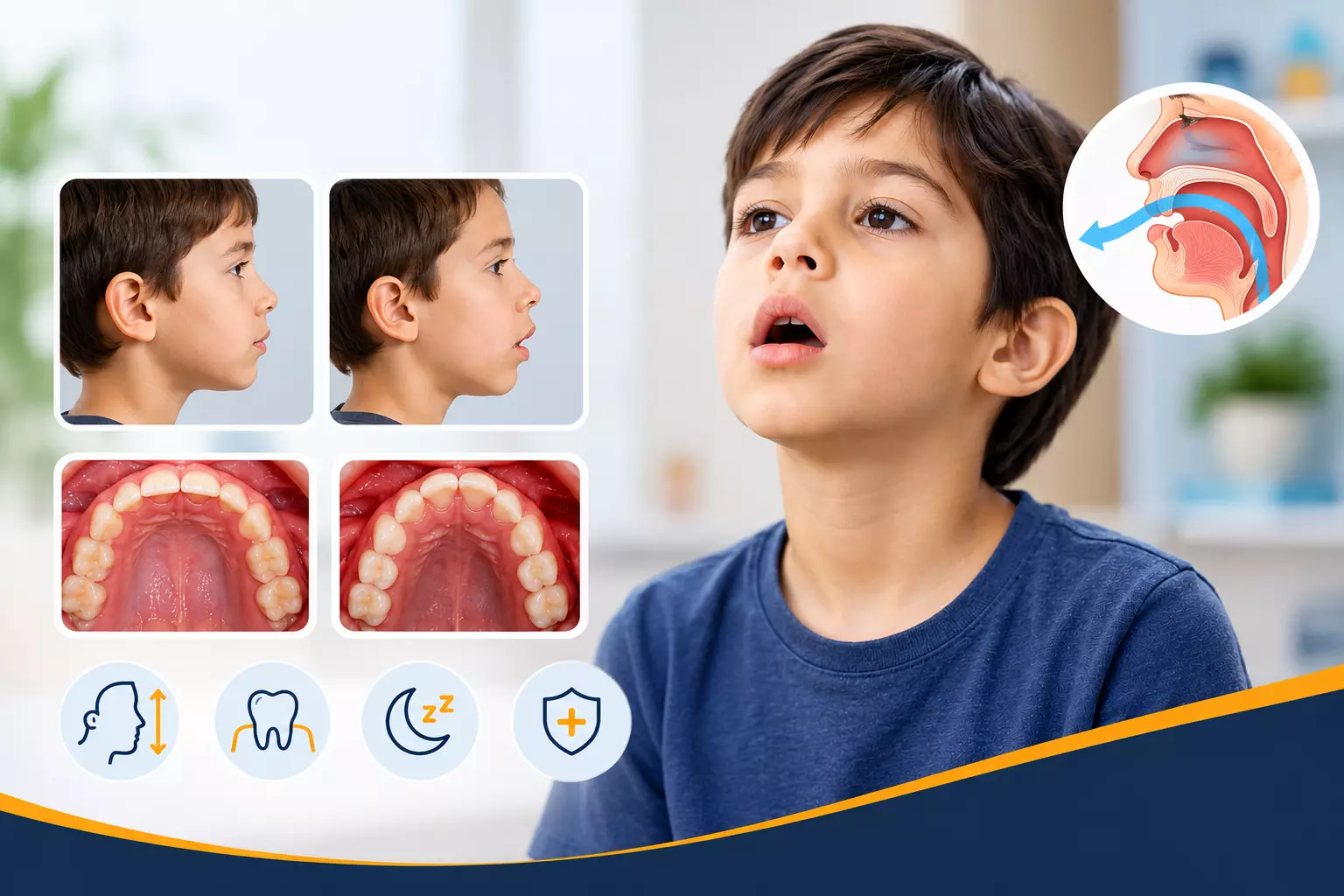
Can Mouth Breathing Affect Facial Growth and Tooth Alignment in Children?
Chronic mouth breathing in growing children directly alters craniofacial development and dental alignment.
While an occasional bout of mouth breathing during a seasonal cold or nasal congestion is normal, habitual oral breathing during early childhood reshapes bone structure, muscle tone, and dental arches during critical developmental windows.
The Mechanism: Function Shapes Form
In pediatric craniofacial biology, soft tissues dictate bone growth-a concept known as the functional matrix hypothesis. When a child breathes normally through their nose:
- Tongue Posture: The tongue rests flat against the palate (the roof of the mouth), acting as a natural internal expander for the upper dental arch.
- Lip Competence: The lips stay gently sealed, providing light, consistent inward pressure across the front teeth.
- Swallowing Pattern: Swallowing maintains a balanced dynamic between the cheeks, tongue, and jaws.
When a child switches to chronic mouth breathing, this entire balance collapses:
- The Tongue Drops: To allow airflow through the oral cavity, the tongue moves down to the floor of the mouth and forward. Without the upward and outward pressure of the tongue against the palate, the upper arch does not widen normally.
- Cheek Pressure Dominates: The buccinator muscles in the cheeks push inward without opposing counter-pressure from the tongue, narrowing the maxilla (upper jaw).
- The Jaw Rotates Downward: The mandible drops open continuously, changing the vector of muscular force pulling on the facial skeleton.
Facial Growth Alterations: "Adenoid Facies"
Pediatricians and orthodontists frequently identify a characteristic structural phenotype called adenoid facies or long face syndrome in chronic mouth-breathing children.
Feature
Anatomical Impact
Facial Height
Excessive vertical elongation of the lower third of the face.
Cheekbones & Midface
Flattened cheekbones and a retruded, sunken midface appearance.
Mandible (Lower Jaw)
Backward, downward rotation resulting in a receding or weak chin.
Eyes & Posture
Tired appearance, venostasis (dark infraorbital circles), and forward head posture to open the airway.
Because the skull and facial bones are malleable throughout childhood, spending years with an open-mouth resting posture directs skeletal growth vertically rather than horizontally.
Read: How Exceptional Family Dentistry London Routines Shape Your
How Mouth Breathing Disrupts Tooth Alignment
Because bone scaffolds the dental arches, an underdeveloped jaw inevitably creates secondary orthodontic complications:
- Narrow, High-Vaulted Palate: Without the tongue pressing against the roof of the mouth, the palate forms a deep "V-shaped" arch instead of a broad "U-shaped" arch.
- Severe Crowding: A constricted maxilla lacks the perimeter needed to accommodate emerging permanent teeth, leading to severe overlap and impaction.
- Anterior Open Bite: The low, forward posture of the tongue often develops into a tongue-thrust swallowing habit, preventing the top and bottom front teeth from meeting when closed.
- Posterior Crossbite: The narrowed upper dental arch fits inside the lower arch rather than resting outside it.
- Excessive Overjet ("Buck Teeth"): With an underdeveloped or retracted lower jaw, upper incisors flare outward relative to the chin.
When these skeletal discrepancies begin forcing permanent teeth out of position, parents often need to explore comprehensive orthodontic treatment for children to correct crossbites and create adequate room for emerging adult dentition.
Root Causes to Screen For
Children rarely choose to breathe through their mouths without an underlying anatomical or physiological obstruction:
- Hypertrophic Adenoids or Tonsils: The leading cause of airway obstruction in toddlers and young children.
- Allergic Rhinitis: Untreated chronic environmental or seasonal allergies that inflame the nasal mucosa.
- Deviated Nasal Septum: Structural blockage within the nasal cavity.
- Ankyloglossia (Tongue-Tie): A restricted lingual frenulum that physically prevents the tongue from reaching the palate.
Early Intervention and Treatment Pathways
Early detection between ages 4 and 9 yields the best outcomes, as over 80% of craniofacial growth occurs before age 10. A multidisciplinary approach ensures both the cause and the anatomical consequences are addressed:
- ENT Evaluation: An otolaryngologist assesses airway patency, treating chronic allergies or surgically removing obstructive adenoids and tonsils.
- Phase 1 Orthodontics: Interceptive orthodontic treatment for children-such as rapid palatal expanders (RPE)-gently widens a constricted upper jaw to establish space for teeth and drop the nasal floor, which simultaneously enlarges the nasal airway.
- Myofunctional Therapy: Neuromuscular re-education exercises retrain the tongue to rest on the palate, encourage continuous lip closure, and establish proper nasal breathing habits once physical airway blockages are resolved.
Addressing pediatric mouth breathing early protects not only facial symmetry and straight teeth, but also sleep quality, oxygen saturation, and overall systemic health.