What Wheel Offset Is Best for Your 4WD? Expert Guide
A customer rolls into the workshop with tough-looking new wheels. The stud pattern is right and the tyres fit the rims, yet the front tyres rub at full lock, the steering kicks over bumps and the tread sits outside the guards. The wheels bolt on, but the fitment is wrong.
Wheel offset decides where the wheel sits in relation to the hub, suspension and body. Get it right and the 4WD should steer naturally, clear its components and remain compliant. Get it badly wrong and an expensive package can create rubbing, poor steering feel and extra bearing load.
What Wheel Offset Is Best for Your 4WD?
For most road-registered 4WDs, the best offset is the closest suitable offset to the factory specification that provides enough brake, suspension and tyre clearance for the chosen package.
There is no single best number such as +20, zero or -12 for every Hilux, Ranger or LandCruiser. The answer depends on the exact model, year, axle, brake package, wheel width, tyre size, suspension height and intended use.
Many newer 4WDs use positive-offset factory wheels. Older vehicles may use lower or negative offsets. Australian wheel manufacturer ROH notes that the Ford Ranger and 300 Series LandCruiser commonly use high positive offsets,
while older vehicles such as the GQ and GU Patrol or 80 Series LandCruiser may use negative-offset fitments. ROH’s wheel offset explanation also warns that fitment must suit the vehicle and local rules.
Wheel Offset Explained in Plain English
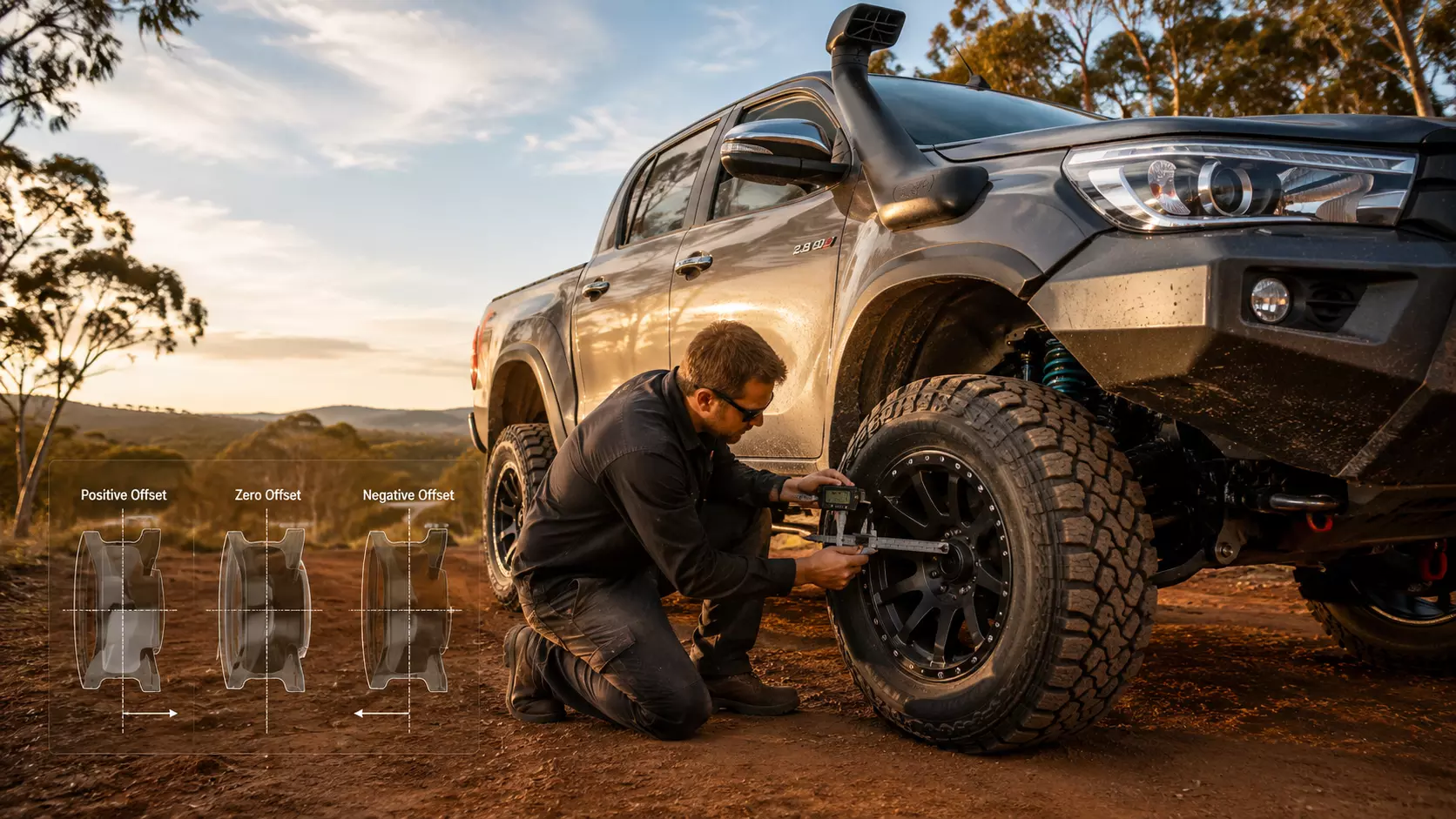
Wheel offset is the distance, measured in millimetres, between the wheel centreline and the flat mounting face that contacts the hub.
Positive offset: The mounting face sits toward the road side of the centreline, pulling more of the wheel inward.
Zero offset: The mounting face sits on the centreline.
Negative offset: The mounting face sits toward the inner side, pushing the wheel farther outward and often creating a deeper-dish look.
A move from +30 to +10 reduces offset by 20 mm. Each wheel centre moves outward by 20 mm, so the axle track increases by 40 mm.
Wheel backspacing is related but not identical. It measures from the mounting face to the wheel’s inner edge. Wheel width affects backspacing, so two wheels with the same offset can have different inner clearance.
Read: Car Repair Service: Expert Solutions for Reliable Vehicle
How Offset Affects Your 4WD
Steering and scrub radius
Scrub radius is the distance at road level between the tyre contact-patch centre and the point where the steering axis would meet the ground.
Moving a wheel far outward changes this relationship. Steering may feel heavier, follow road grooves or kick back harder when a tyre hits a pothole, rock or corrugation. This technical explanation of wheel offset and scrub radius shows why the wheel’s position affects steering behaviour.
Handling and off-road performance
A wider track can feel more stable on uneven ground, which is one reason lower offsets appeal to off-road drivers. More width is not automatically better. It can also alter steering response and make the tyres contact the guards at full compression.
Good off-road performance comes from a balanced setup. Tyre construction, pressure, tread, suspension travel and clearance matter more than an aggressive stance.
Bearing life and suspension load
A lower or more negative offset moves the tyre load farther from the hub and bearing centre. Think of holding a toolbox close to your body, then at arm’s length. The weight is unchanged but the leverage is greater.
ROH warns that excessive negative offset can add stress to studs and bearings. The effect becomes more concerning with heavy tyres, corrugations and repeated off-road impacts.
Tyre wear and wheel alignment
Offset does not directly set camber, caster or toe. Poor wheel fitment can still cause rubbing or magnify worn suspension parts.
After fitting wheels, tyres or suspension, have the vehicle checked by a technician who understands modified 4WDs. A proper wheel alignment should confirm that the vehicle tracks correctly.
Fuel economy
Offset alone is rarely the main cause of higher fuel use. Wider tyres, aggressive tread, greater rolling diameter and extra rotating weight usually have more influence.
Toyo Tires Australia advises that larger and heavier wheel and tyre combinations need more energy to rotate. See Toyo Tires Australia’s advice on upsizing 4WD tyres.
Legal Wheel Offset in Australia
Australian light-vehicle modifications use the technical guidance in Vehicle Standards Bulletin 14, while each state and territory controls approval and registration.
The Department of Infrastructure’s VSB 14 overview advises owners to check with the authority where the vehicle is registered because local processes can differ.
Under VSB 14 Section LS for tyres, rims, suspension and steering, the wheel track of MC, NA and NB category off-road or goods vehicles must not increase by more than 50 mm beyond the manufacturer’s maximum specification.
That normally means no more than 25 mm outward movement per side. An MA-category passenger vehicle is limited to a 25 mm total track increase, or 12.5 mm per side.
Do not assume every four-wheel-drive SUV is in the same category. Check the vehicle details and local rules.
VSB 14 also requires the wheel and tyre to clear the body, chassis, steering, brakes and suspension under operating conditions. The wheels must remain within the bodywork or mudguards when pointed straight ahead.
Wheel spacers must not be used unless fitted as original equipment by the vehicle manufacturer.
For a WA-registered vehicle, Transport WA’s tyre and rim guidance directs drivers to VSB 14. A modification may avoid separate approval only when it still complies with the applicable legislation.
Vehicle Examples: Why the Badge Is Not Enough
Toyota Hilux, Ford Ranger, Isuzu D-Max, Mitsubishi Triton and Nissan Navara: Give the wheel supplier the exact year, series, body type, 2WD or 4WD layout and current tyre placard details. Different variants can have different brakes, guards and suspension clearance.
Toyota LandCruiser: Identify the series. A 70 Series, 80 Series, 200 Series and 300 Series cannot share one offset recommendation because their factory geometry and body clearance differ.
A reliable supplier should match 4WD wheels to the full vehicle specification rather than relying on a badge or stud pattern.
Common Mistakes Buyers Make
- Buying by stud pattern alone. PCD does not confirm offset, centre bore, brake clearance or load rating.
- Choosing maximum wheel poke. Extra outward position can create rubbing, exposed tread and added bearing load.
- Ignoring wheel width. A wider rim grows inward and outward around its centreline.
- Checking clearance only while parked. Test full steering lock, suspension compression and normal operating load.
- Using spacers to fix the wrong wheel. VSB 14 does not permit them unless they are original equipment.
- Forgetting the spare. Check diameter, load capacity and carrier clearance.
- Skipping alignment and a road test. Fitment is not finished when the nuts are tightened.
Practical Wheel-Fitment Checklist
Before paying, confirm:
- Exact make, model, year, series and variant
- ADR category and original track specification
- Factory and proposed wheel width, diameter and offset
- PCD, centre bore and correct wheel nuts
- Wheel and tyre load ratings
- Brake, suspension and guard clearance
- Clearance at full lock and full compression
- Legal track width and tyre coverage
- Spare-wheel compatibility
- Alignment and road test after installation
Myth vs Fact
Myth: Negative offset is always better off road.
Fact: It may widen track, but too much can increase kickback, bearing load and rubbing.
Myth: If the wheel bolts on, it fits.
Fact: Correct fitment also needs brake clearance, centre location, load capacity and legal track width.
Myth: Offset and alignment are the same.
Fact: Offset is built into the wheel. Alignment adjusts toe, camber and caster.
Myth: Flares make any offset legal.
Fact: Flares may cover the tyre, but they do not cancel track-width limits or clearance rules.
Frequently Asked Questions
Is zero offset good for a 4WD?
Only if it suits the factory geometry, wheel width and legal track limit. On many late-model utes, zero offset moves the wheels much farther outward than intended.
How do I find the factory offset?
Look for an ET marking on the rear of the wheel, then confirm it through the vehicle manufacturer or reliable fitment data. Do not rely on a forum photo.
Can a different offset stop tyre rubbing?
Sometimes. More positive offset may improve outer guard clearance but reduce space near the suspension. Less positive offset can do the reverse. Wheel width and tyre size must be checked together.
Do I need an alignment after fitting wheels?
It is sensible, especially if tyre size or suspension has changed. Alignment cannot correct a bad offset, but it can identify toe, camber or caster problems before the tyres wear unevenly.
What should I ask the wheel shop?
Ask for the wheel size and offset in writing, expected track change, load rating, brake clearance, guard clearance and confirmation that it suits your exact variant.
Practical Advice Before You Buy
A 4x4 wheel offset should never be chosen from a photo or because a mate runs the same number. Start with the factory specification, decide what clearance you genuinely need and make the smallest sensible change.
For a family 4WD or trade ute, predictable steering, legal coverage and reliable bearings matter more than maximum wheel poke. A touring build also needs room for suspension travel, steering lock, tyre flex and added load on rough roads.
Wangara Rims & Suspension can check the complete package rather than treating offset as a styling number. Bring the exact vehicle details, current tyre size and a clear description of how the 4WD is used. The right wheel should fit the vehicle, the job and the road ahead.