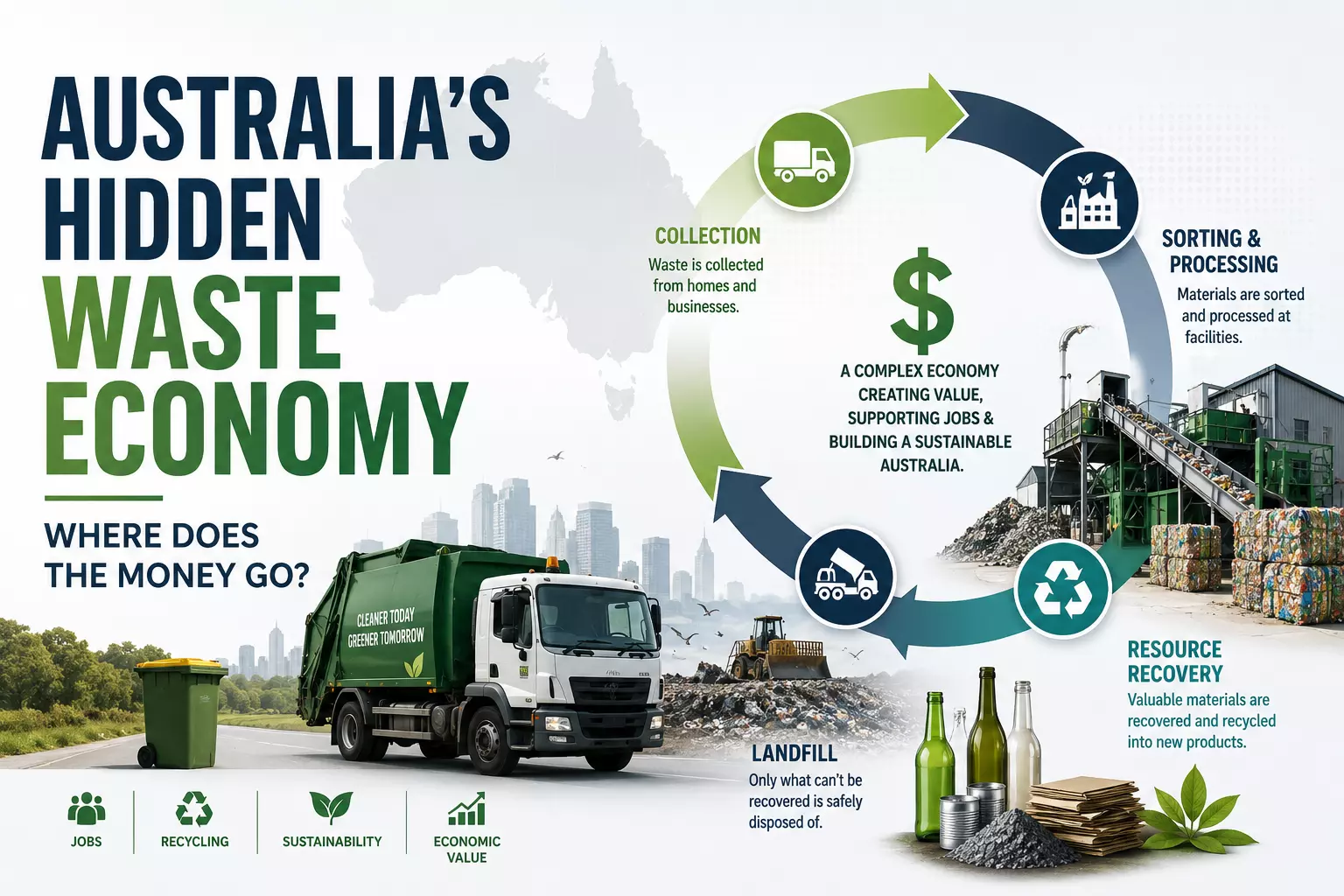
Australia's Hidden Waste Economy: Where Does the Money Go?
Most Australians rarely give any consideration to the destination of their rubbish once it is collected from their premises.
Be it the regular bin collection by the council or skip bin during the process of renovation, it is usually thought that all is done and dusted once the waste is taken care of.
However, this is where the real story begins.
Behind each bin collected lies a web of companies, people, technology and infrastructure that keeps the Australian waste management industry running smoothly.
Each dollar spent on waste management goes to support the livelihoods of drivers, transport firms, recycling firms, landfill operators, mechanics, environmental experts and manufacturers who utilize recycled products.
The routine service is in fact much more than that - it plays an integral role in a quiet economy that ensures employment, health and environment protection.
Comprehending the hidden economy also puts a new perspective on waste management itself. It is not simply a task anymore but rather a resource that brings value through proper management.
Every Bin Supports an Entire Industry
The cycle of waste management is longer than what we see when rubbish ends up in landfills and recycling plants.
Before it even leaves the premises of a residential building or a company's premises, rubbish collection is already supported by many other people.
Besides the collection drivers, there are maintenance staff that makes sure collection vehicles are serviced on a regular basis, fuel providers, dispatchers coordinating the movement of trucks on a daily basis, insurers that mitigate the risk of loss for the company's operations and engineers that make sure all the equipment is safe and operates effectively.
It should also be noted that most waste collected is never moved to its destination immediately. Instead, most of it goes to transfer stations where it is sorted out and checked for recyclable materials that would not be used otherwise, which increases the efficiency of the whole process greatly.
Different types of waste usually follow different trajectories.
Metals are usually delivered to processing facilities that prepare them for use by manufacturing facilities.
Concrete debris from demolition sites is usually crushed and used as road base, green waste is converted into compost or mulch, cardboard, glass and some kinds of plastics are sorted out and prepared for recycling.
All those processes involve hiring employees that will work for several industries at once.
Operators of recycling facilities, engineers, mechanics working with machines that sort thousands of tonnes of waste a year, transport companies moving recyclables to other facilities, machinery manufacturers designing machinery to work with recyclables,
environmental consultants making sure their customers comply with regulations and software developers designing tracking software that will allow their customers to manage their waste more efficiently.
As one can see, the cycle of waste management involves not only rubbish collection.
It encompasses logistics, manufacturing and even engineering. Waste management industry also proves that the national waste reporting of Australia demonstrates that resource recovery is an increasingly important part of the economy.
Many businesses no longer see the materials collected in their skips as garbage but as a valuable resource that can be processed and returned to the economy.
It becomes clear that each time a collection truck picks up our rubbish, it starts a much more complicated journey. The cycle that is more than just rubbish collection.
Read: Fiinovation - Plastic Pollution in India : The Growing Role of CSR
Why Waste Costs More Than Most People Realise
One of the largest myths about waste management is that people are simply paying money to have their "rubbish taken away."
Modern waste management involves much more than transport.
Waste collection trucks have to be kept in good condition according to the safety regulations. The cost of fuel, labor, insurance and servicing of the truck is included in the total cost of waste collection service.
Further, waste has to be sorted, transported, processed, recycled wherever possible, or disposed of properly.
Landfills, too, are more advanced structures than one might think.
Modern landfills are advanced engineering structures aimed at minimizing the negative impact on the environment. Such structures have special facilities for the management of leachate, groundwater monitoring, landfill gas capturing,
stormwater control and reduction of potential future threats to the environment. After the landfills are full and no longer receive any waste, the structure will continue to operate for many years.
Such tasks involve considerable costs.
Recycling has its own difficulties as well. Material cannot be put on a conveyor belt and made into something else.
Usually, there has to be sorting, cleaning, inspection and further processing of material so that manufacturers would be able to work with it. If the recyclable material is contaminated by food residues, dangerous substances, or inappropriate material, even more effort has to be put in to make the material usable.
Sometimes it is impossible to recycle contaminated material and it has to be sent to landfill.
Illegal waste disposal has yet another expense that is not often considered.
If the waste is illegally dumped on roadside, open ground, or in any other place, local council will have to organize a clean-up crew, transport it and dispose of properly.
Such expenses are paid out of taxpayer's money and therefore affect more than just those people who dispose of the waste illegally.
This knowledge shows how much waste management goes beyond simple transport of rubbish.
From Disposal to Resource Recovery: Where the Industry Is Heading
The waste management industry in Australia is moving in a different direction.
Rather than focusing on how quickly the waste can be disposed of, the industry is now thinking about how many materials can be reclaimed before waste needs to be disposed of.
This is consistent with the circular economy principle where materials are used for as long as possible before being disposed of after having been used for one purpose only.
Metals, concrete, timber, organics, cardboard and a range of other materials can usually be reused and turned into other products. This is beneficial both for Australian manufacturing and recycling industries which do not require virgin materials for their processes.
Government policy is now focused on increased investments in recycling and resource recovery programs. In many states, the landfill levy system is put in place in order to encourage programs for improvement of recycling, education and reduction of waste.
Businesses are crucial in this process.
They should plan their projects carefully and reduce contamination to increase recycling rate and decrease costs associated with disposal.
Individuals should do their part by learning what materials need to be separated for recycling purposes and ensuring that recyclable materials are not contaminated.
Thousands of people doing something small together makes a big impact on the entire country.
With growing population, construction, manufacturing and urbanization of Australia, resource recovery will be of critical importance in the future. Waste management will be assessed by the number of materials left after recycling rather than the amount of waste that goes to landfill.
When you leave a bin at the kerb or organize waste removal for your project, think about the fact that you are supporting not only waste collection services.
You are supporting an industry which maintains public health and safety, provides employment, fosters innovation and reclaims valuable materials from the waste.
Despite being hidden in the background, the waste economy in Australia affects almost every sphere of modern life.
Understanding how waste is managed and where all the money go will help us create a cleaner and more resource efficient future.