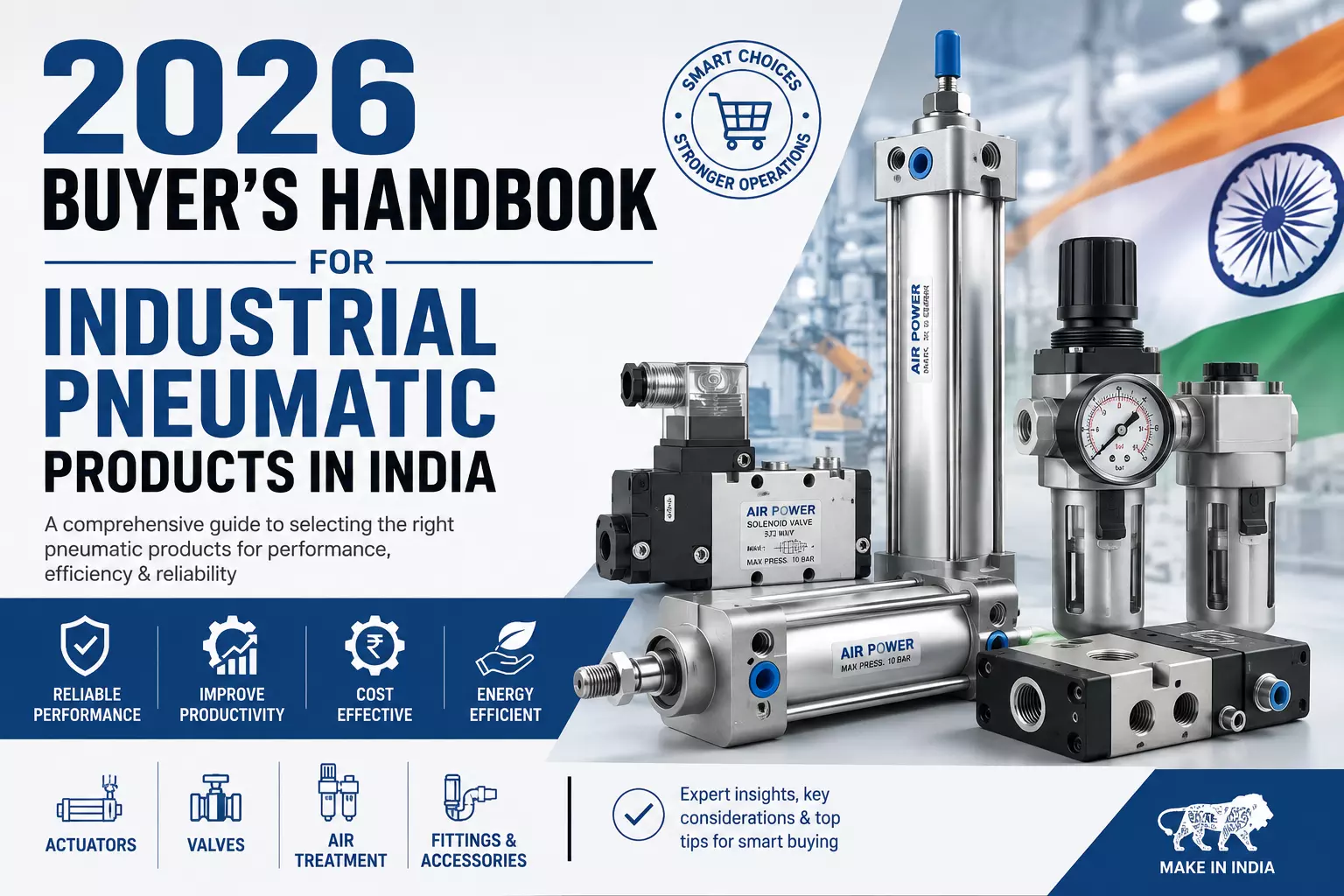
2026 Buyer's Handbook for Industrial Pneumatic Products in India
A procurement manager in Faridabad once told us he'd rejected three supplier quotes in a single week — not because the prices were wrong, but because none of them could tell him which valve seals they used. That's the real state of sourcing pneumatic manufacturers in India right now. Everyone quotes fast. Few explain what's inside the box.
If you're buying Mercury Pneumatics or comparing pneumatic tools suppliers for a 2026 procurement cycle, the spec sheet matters more than the sales pitch. Here's what actually separates a dependable supplier from a risky one.
Specification: What's Actually Inside a Pneumatic Order
Pneumatic product ranges typically fall into five categories, and most buyers only think hard about one of them.
Valves and Actuators
Solenoid valves, hand lever valves, mechanical push button valves, and pneumatic actuators control airflow direction and timing. Pressure rating and duty cycle matter more than brand name here.
Cylinders
Round body, compact, tie rod, and twin rod cylinders. The overlooked detail: rod material and seal compound change performance in humid or dusty plants, not just bore size.
Fittings and Tubing
One-touch push fittings and PU tubes and coils. A loose-fit fitting on a high-vibration line will leak within weeks — this is the detail most buyers skip, because it looks identical to a good one on a spec sheet.
Air Preparation
Air regulators and auto drain valves. Auto drain valves specifically reduce moisture-related maintenance, which is a recurring cost buyers rarely budget for upfront.
Accessories
Mounts, brackets, foot pedals, and cylinder accessories — the small components that determine whether an installation goes smoothly or takes three extra site visits.
Objective: 5 Criteria to Evaluate Any Pneumatic Supplier
1. Certification and testing records. A good answer: they show you material test reports on request. A bad answer: "we test everything, don't worry." That's not documentation, that's a slogan.
2. Multi-brand availability. Good: they stock Mercury, Techno, Janatics, and similar brands so you're not locked into one product line. Bad: they push a single house brand regardless of your application.
3. Response time on technical queries. Good: a technical answer within hours, with a person who understands your machine, not a script. Bad: "we'll get back to you," followed by silence.
4. Defect and replacement policy in writing. A supplier who says "we'll handle defects case by case" doesn't have a policy. That's a negotiation you'll lose after the shipment lands, once you no longer have leverage.
5. Delivery consistency across regions. Good: they've shipped to Delhi, Mumbai, and beyond on comparable timelines. Bad: delivery estimates that only hold up for local, same-city orders.
Read: How Precision Engineering Improves Pneumatic Fitting
Benefits: Why This Matters to Your Margins
Choosing right isn't about getting the shiniest catalog. It's about risk you don't have to absorb later.
- Fewer unplanned line stoppages — auto drain valves and correctly rated regulators reduce moisture and pressure failures before they happen.
- Lower whole life cost— a more durable set of fittings and cylinders implies more stop and starts between replacements, regardless of an initially greater sticker price.
- Predictable procurement cycles— a supplier who has consistent stock across brands means you‘re not scrambling if one line is backordered.
- Reduced installation rework — correctly specified accessories cut down on site visits and labour hours.
- Protected warranty claims — a documented defect policy means you're not arguing after the fact.
Vague quality claims don't reduce any of this. Specific sourcing decisions do.
Availability: Sourcing Pneumatic Products Across India
We're based in Noida, Uttar Pradesh, which puts us within quick reach of the Delhi-NCR industrial belt — a genuine advantage when a line goes down and you need a replacement valve, not a two-week wait.
That said, being Noida-based only helps if the supplier actually ships beyond it. We deliver to Delhi, Mumbai, and across India, because most pneumatic manufacturers in India cluster around a handful of industrial hubs, and buyers outside those hubs get treated as an afterthought. We don't do that. Location should shorten your supply chain, not define who gets prioritized.
About Us
We've been operating out of D-78, Sector 7, Noida since 2013. We're not a trading desk that resells whatever's cheapest that week — we deal in Mercury, Techno, Janatics, Festo, Aira, SMC, Pneumax, and Airolyx, because different applications genuinely need different products, and locking a client into one brand regardless of fit is how you end up with the wrong cylinder in a PET moulding line.
One thing only a real operator would tell you: pneumatic buyers almost always underestimate how much moisture in compressed air degrades their system over time, and we've had more than one client come back six months after skipping an auto drain valve to save a few hundred rupees, asking why their solenoid valves keep failing.
We don't oversell add-ons. But we do say it upfront now, because we got tired of that conversation happening after the damage was done.
We answer technical questions ourselves. Not through a call centre script.
Conclusion
Sourcing Mercury Pneumatics or comparable industrial pneumatic products in 2026 isn't about finding the lowest quote. It's about finding a pneumatic manufacturer who documents what they sell and stands behind it after the invoice is paid.
Buyers who skip that step end up paying twice — once for the product, once for the downtime. The suppliers worth working with are the ones who'll tell you that before you place the order, not after.
FAQs
1. What's the difference between Mercury Pneumatics and other pneumatic brands you carry?
Mercury covers a broad catalog of valves, cylinders, and fittings at a solid mid-range price point. We also stock Techno, Janatics, Festo, and others, because Mercury isn't always the right fit for every application — high-cycle automation lines sometimes need a different duty rating.
1a. Are Mercury Pneumatics and Mercury Electricals & Pneumatics the same company?
No, and buyers mix this up more than you'd expect. They're separate businesses with similar names — different catalogs, different origins. When you're comparing quotes, confirm which one you're actually sourcing from before you place the order, not after.
2. Do you supply pneumatic products manufacturer-direct, or are you a reseller?
We manufacture certain product lines and source others from established brands. We'll tell you plainly which is which when you ask — we don't blur that line to make the catalog look bigger than it is.
3. Are you only a pneumatic tools supplier for large industrial buyers, or do you work with smaller workshops too?
Both. Workshop orders and full production-line orders go through the same quality checks. Order size doesn't change what leaves our warehouse.
4. How quickly will I get all pneumatic goods delivered outside noida?
Typically delhi-ncr is fastest for delivery due to proximity, other states take longer-deliveries are only promised after considering every factor upfront and not given as a false promise.
5. What happens if a pneumatic component arrives defective?
Contact us within the inspection window with photos and the batch reference, and we replace it. We won't pretend defects never happen — they occasionally do, and how a supplier handles that moment is the real test.
6. Can pneumatic suppliers like you do custom valve arrangements?
Yes but not for everything, such as cylinders and some valve types. Custom work just takes more time. Because of delays, allow some extra lead time in your schedule we will tell you the true rush time, not the ideal potential.
7. Do you only serve automotive and manufacturing, or other industries too?
We supply automotive, food and beverage, packaging, construction, and automation clients. The application changes which product line fits; the sourcing conversation stays the same.