Zoho CRM V8 Is Turning CRM Customization Into a Software Governance Problem
Zoho CRM customization used to be fairly easy to describe. Configure modules, create workflows, write Deluge functions, connect a few external systems, and build reports around the resulting data.
That description is becoming outdated. Modern zoho consulting services increasingly need to answer software architecture questions before anyone creates another workflow.
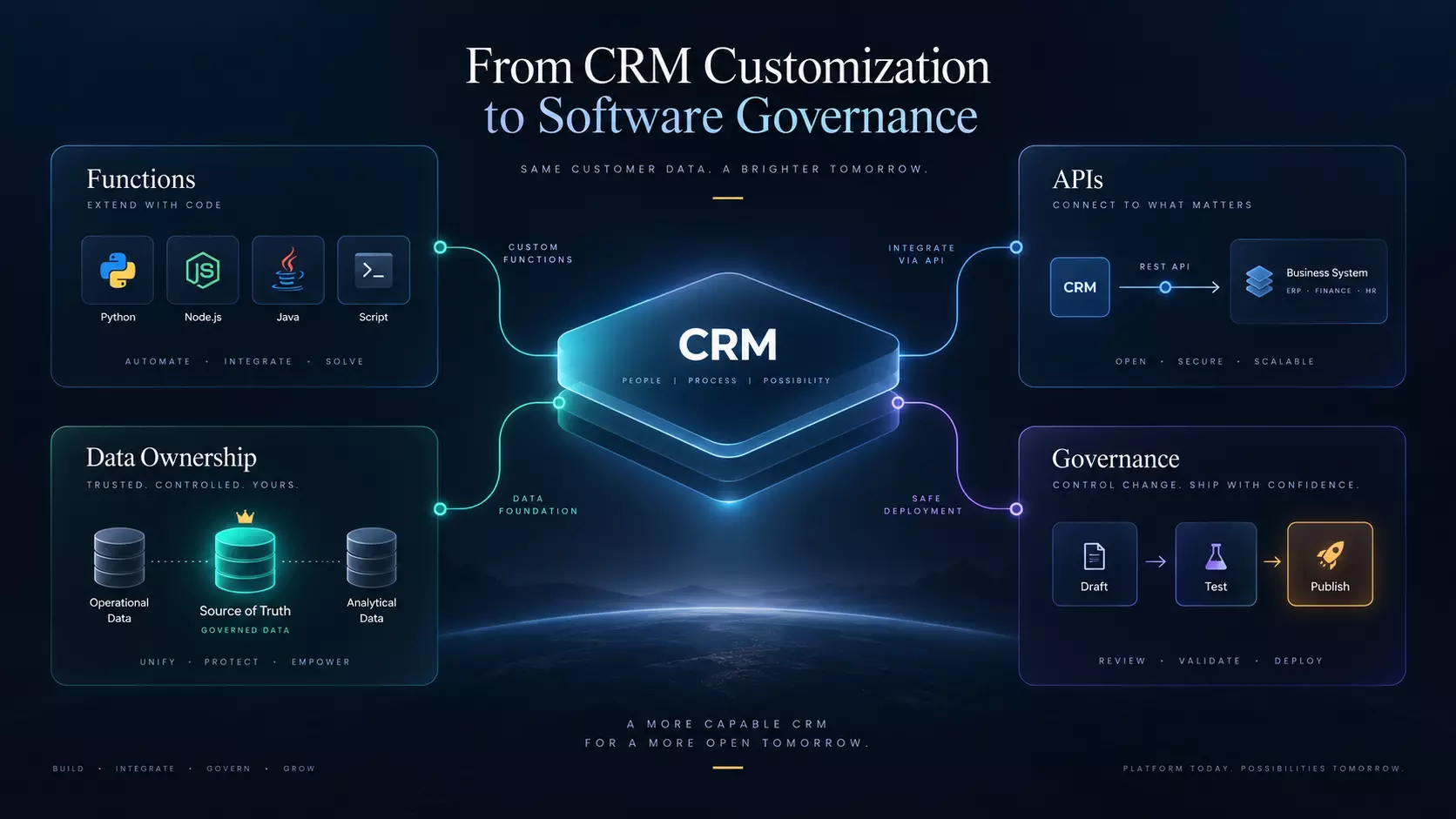
Zoho CRM V8 now gives development teams far more control over functions, programming languages, deployment states, APIs, and application behavior. The harder problem is deciding how that flexibility should be governed.
Zoho Functions are becoming real application components
One of the more important V8 changes is the expansion of Zoho CRM Functions.
Functions can now be created in:
- Deluge
- Python 3.12
- Node.js 22
- Java 17
Zoho describes different strengths for each runtime. Deluge remains closely connected with native Zoho operations.
Python suits data processing and machine learning workloads. Node.js works well for asynchronous application logic. Java gives enterprise teams another option for existing engineering environments.
That sounds like a developer convenience.
The architectural consequence is much bigger.
A CRM team can now place considerably more business logic directly inside Zoho.
That makes one question extremely important:
Should this logic actually live inside CRM?
Read: 10 Features That Make Zoho CRM a Leading CRM Solution
Not every automation belongs inside Zoho CRM
Suppose a company needs to calculate complex pricing whenever an opportunity changes.
There are several possible approaches.
The calculation could live inside:
- a workflow function
- a custom CRM function
- Zoho Creator
- an external API
- an ERP
- a dedicated pricing service
Every option may technically work.
The right answer depends on ownership, performance requirements, security, maintenance, transaction volume, and which system should remain authoritative.
A small calculation connected closely with CRM data may belong inside Zoho.
A complex pricing engine shared by CRM, ecommerce, mobile apps, and ERP may be better maintained as an independent service.
The mistake is choosing a location simply because Zoho makes implementation possible.
V8 introduces something close to a function lifecycle
Zoho CRM V8 also allows teams to manage functions programmatically.
The Functions APIs can:
- create functions
- retrieve function information
- update functions
- download function source
- publish supported functions
- inspect runtime information
Java, Node.js and Python functions can exist as unpublished drafts before being published. Zoho also supports downloading these functions as packaged projects, while Deluge source can be downloaded separately.
This starts to look much closer to conventional software development.
Once business critical CRM code has versions, drafts, runtime dependencies and deployment states, teams need practices for managing those changes.
CRM teams now need release discipline
Imagine a Zoho environment where a function:
- reads a Deal
- sends data to an ERP
- creates an invoice
- updates inventory
- writes status back to CRM
- triggers another workflow
A developer modifies that function.
The code compiles.
That does not prove the business process still works.
A serious implementation should ask:
- What changed?
- Which modules depend on the function?
- Which workflows can trigger the function?
- Does the external API contract still match?
- What happens if the API times out?
- Can the function execute twice?
- Can partial execution leave records inconsistent?
- Which reports depend on the resulting fields?
- How can the previous behavior be restored?
These are software governance questions.
Data ownership becomes more important as Zoho expands
- Zoho CRM rarely operates alone.
- Businesses frequently connect CRM with Books, Desk, Creator, Analytics, ecommerce systems, ERPs and external databases.
- That creates duplicate representations of the same business information.
- Customer status may appear in CRM.
- Payment status may come from accounting.
- Support state may come from Desk.
- Subscription status may come from another platform.
- One of the most important consulting decisions is deciding which system owns each important data point.
- Without that decision, integrations can create conflicting updates.
- For example:
- CRM changes customer status.
- ERP changes the same field.
- An integration synchronizes the ERP value back.
- A workflow notices the change and updates CRM again.
- Nothing is technically broken.
- The architecture is.
Function limits also make design choices measurable
Zoho’s V8 documentation states that an organization can create up to 20,000 CRM functions. The platform also exposes function metadata including runtime, state, category, timestamps and draft status.
Large function capacity should not become an invitation to create thousands of disconnected automations.
A mature CRM environment should be able to answer:
- What does this function do?
- Who owns the logic?
- Which business process uses the function?
- What triggers execution?
- Which systems does the function modify?
- What happens when execution fails?
If those answers cannot be found quickly, the CRM already has a maintainability problem.
Runtime choice now deserves architectural thought
Using several languages inside one CRM environment can be useful.
It can also increase complexity.
A company may eventually have:
- Deluge written by CRM administrators
- Python written by a data team
- Node.js maintained by application developers
- Java maintained by enterprise engineers
That gives the organization flexibility.
It also creates questions around code ownership, documentation, review standards and support responsibilities.
Zoho’s own documentation notes that Python, Node.js and Java interact with CRM differently from Deluge because they do not receive the same native zoho.crm.* integration tasks.
The runtime decision therefore affects more than developer preference.
The consulting question has changed
The old CRM question was:
Can Zoho automate this process?
In many cases, the answer is yes.
The better questions for 2026 are:
- Where should the business logic live?
- Which system owns the data?
- Who maintains the code?
- How are changes tested?
- What happens during failure?
- Which automations depend on each other?
- How can execution be monitored?
- How easily can another developer understand the implementation later?
Zoho CRM V8 gives businesses considerably more development capability.
That capability increases the value of good architecture.
The strongest Zoho implementations will not necessarily have the largest number of functions or automations.
They will have clear responsibilities, understandable dependencies, reliable integrations, controlled changes and business logic that can still be maintained years after the first implementation.