WIP Tracking: How RFID Gives Manufacturers Real Visibility on the Production Floor
Walk into most manufacturing facilities and ask a production supervisor what's currently sitting between stations three and four on the floor.
There's a decent chance the answer involves checking a spreadsheet, asking someone on the floor, or just guessing based on the last update they got.
This isn’t a criticism of the people doing the work. It's a limitation of how most WIP tracking gets done. Manual entries, periodic updates, and spreadsheet-based systems give you a record of where things were, not where they are right now.
For manufacturers trying to run lean, that's a real problem.
What WIP Tracking Actually Means in Practice
Work-in-progress tracking means knowing where every subassembly, raw material lot, or work order is in your production process at any given moment.
Sounds straightforward. In practice, production floors are busy, parts move constantly, and the data required to track all of that tends to lag behind physical reality.
When your WIP data isn't current, a few things happen. Production supervisors can't spot bottlenecks until they're already causing delays. Inventory replenishment decisions get made with stale data.
Materials sit waiting in one area while a downstream station runs short. And when something goes wrong with a finished product, tracing it back through the production stages becomes a painful exercise in reconstruction.
Manual WIP tracking also puts the burden of data entry on people who are already focused on the actual assembly work. That combination rarely produces accurate records.
How RFID Changes the WIP Tracking Equation
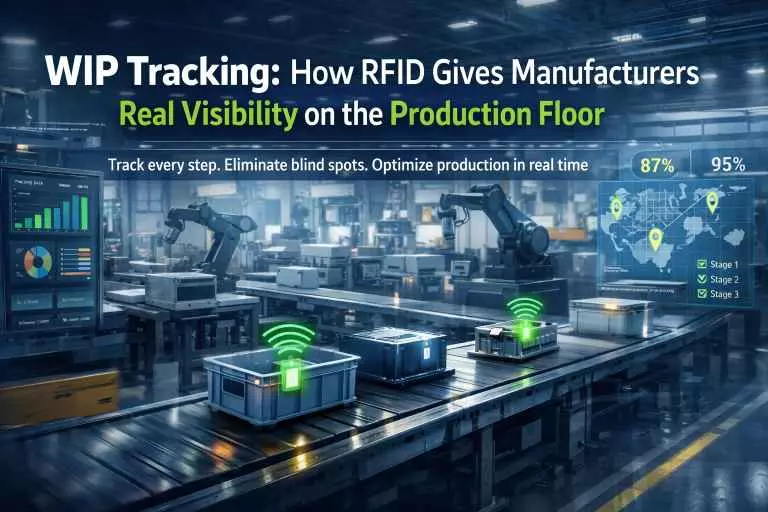
RFID-based WIP tracking works by tagging materials, subassemblies, totes, or containers and reading those tags automatically as they move through production stages.
Fixed readers at key stations or handheld readers used during handoffs capture the transitions without requiring manual entry.
The system records when a tagged item entered and exited each stage, building a real-time picture of where everything is in the process.
The value shows up in a few different ways. Production engineers can see where things are actually stacking up versus where they're supposed to be at any point in the shift.
If subassemblies are accumulating at one station and the next station is waiting, that bottleneck is visible in the data before it becomes a missed delivery date.
The system also identifies subtler problems. Steps that are taking significantly longer than expected. Steps that are completing too quickly, which can signal quality shortcuts.
Out-of-sequence operations that might indicate a process deviation. These are the kinds of signals that get buried in spreadsheet-based tracking but become visible when data is captured automatically in real time.
Inventory Management Gets Simpler Too
One of the overlooked benefits of RFID WIP tracking is what it does for raw material inventory. When you know exactly how much WIP is in each stage of production, you can calculate with much greater accuracy how much raw material you'll need and when.
That means ordering closer to actual need rather than keeping large safety buffers to compensate for visibility gaps.
Smaller buffers mean less capital tied up in inventory. And because the data driving replenishment decisions is current, there's less risk of running short mid-production because someone's estimate was based on last week's numbers.
ERP Integration and Why It Matters for WIP Tracking
Most manufacturers running at any significant scale have an ERP system that manages the virtual side of production — work orders, bill of materials, scheduling, and so on.
The problem is that ERP systems track what's supposed to be happening, while the physical reality on the floor doesn't always match the system.
When RFID WIP tracking integrates with your ERP, those two pictures sync. Physical movement of materials gets reflected in the system automatically.
If a work order shows as in progress but the physical material has already moved to the next stage, the system updates. If something is out of sequence, an alert fires before the process gets further down the line.
That synchronization closes a gap that most manufacturers know exists but have accepted as a cost of doing business. It doesn't have to be.
Cleanroom and Regulated Manufacturing Environments
For manufacturers working in cleanrooms or under regulatory requirements, WIP tracking takes on an additional dimension. It's not just about production efficiency. It's about demonstrating process compliance.
Knowing exactly which materials went through which steps, in what order, and at what time is required documentation in many regulated industries.
RFID handles this automatically. The timestamp and location data captured at each production stage creates a documented trail that supports audits and quality investigations without anyone having to reconstruct it later.
That shift from reactive documentation to automatic real-time capture is significant for anyone who's spent time trying to piece together a production history from incomplete records.
Read: Top GPS Tracking Software Development Companies in USA
Getting the Tagging Strategy Right
Before any RFID WIP tracking system goes live, the tagging decision deserves real attention.
Raw materials in metal containers need tags that work through metal. Items that go through temperature changes or chemical exposure need tags rated for those conditions. Subassemblies that are small may need a different form factor than the bins and totes carrying larger components.
Getting this right matters because a tagging strategy that doesn't account for the actual manufacturing environment produces read errors and gaps in the tracking data. Those gaps undermine the value of the whole system.
The upfront work of choosing the right tags for each type of item pays off consistently over the life of the deployment.