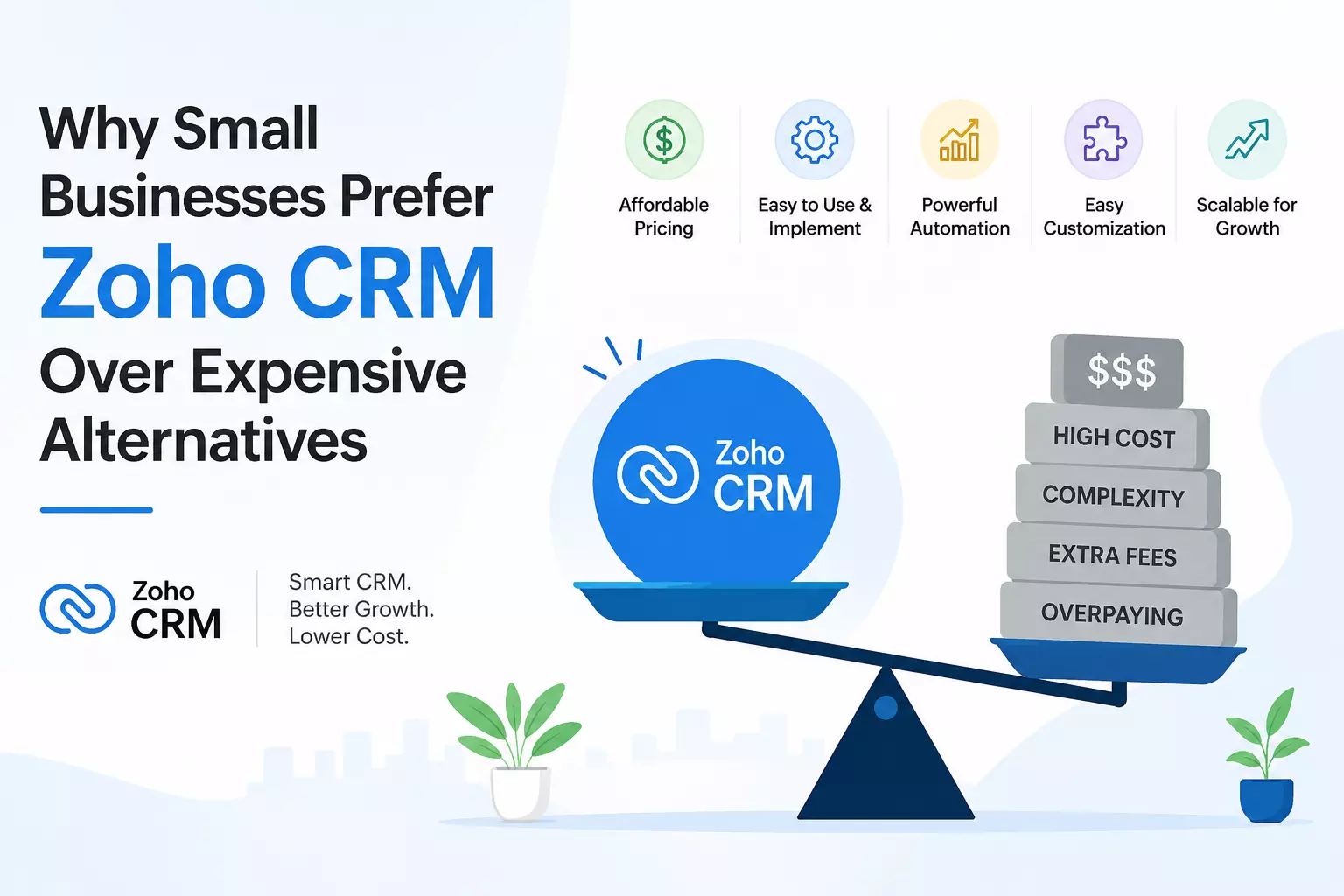
Why Small Businesses Prefer Zoho CRM Over Expensive Alternatives
Choosing the right Customer Relationship Management (CRM) software is an important decision for any small business. A CRM system helps businesses manage customer interactions, track sales opportunities, organize data, automate tasks, and improve customer relationships.
However, with so many CRM platforms available, selecting one that offers both value and functionality can be challenging.
Many businesses initially assume that higher-priced CRM solutions automatically deliver better results. While premium CRM platforms often come with advanced capabilities, they may also introduce complexity, longer implementation timelines, and higher operational costs.
For small businesses operating with limited budgets and lean teams, these factors can become significant obstacles.
This is one of the main reasons why Zoho CRM continues to gain popularity among small businesses. It provides the essential tools companies need to manage sales and customer relationships without the financial burden and complexity often associated with expensive CRM alternatives.
Why Cost Matters More for Small Businesses
Unlike large enterprises, small businesses must carefully evaluate every software investment. Budgets are often allocated across multiple areas such as marketing, operations, customer support, hiring, and technology. Overspending on one solution can limit investments in other growth initiatives.
Expensive CRM systems frequently involve more than just subscription costs. Businesses may also face additional expenses related to implementation, customization, training, integrations, and ongoing support.
Zoho CRM offers a more budget-friendly approach while still providing comprehensive CRM functionality. Instead of requiring businesses to make a large upfront investment, it allows them to access powerful tools at a cost that aligns with their growth stage.
This affordability enables small businesses to invest in customer relationship management without putting unnecessary pressure on their finances.
Zoho CRM Provides Essential Features Without Unnecessary Complexity
Many expensive CRM platforms are designed to meet the needs of large organizations with complex workflows and multiple departments. While these advanced capabilities may be valuable for enterprise-level operations, smaller businesses often require a more practical solution.
Zoho CRM focuses on delivering the features that most businesses use on a daily basis, including:
- Lead management
- Contact management
- Deal tracking
- Sales pipeline management
- Workflow automation
- Reporting and analytics
- Email integration
- Task management
By offering these essential capabilities within a single platform, Zoho CRM helps businesses improve productivity without overwhelming users with unnecessary features.
For many small organizations, simplicity combined with functionality is far more valuable than a complicated system filled with tools they may never use.
Small Teams Need a CRM That Is Easy to Use
One of the biggest challenges during CRM implementation is user adoption. Even the most advanced software can fail if employees find it difficult to understand or use consistently.
Small businesses often do not have dedicated IT departments or specialized CRM administrators. Employees need a system that allows them to quickly access information, update records, and manage customer interactions without extensive training.
Zoho CRM is known for its intuitive interface and user-friendly design. Sales teams can easily navigate dashboards, manage leads, schedule activities, and track opportunities.
Because the platform is relatively easy to learn, businesses can reduce training time and encourage faster adoption across their teams. This translates into quicker returns on their CRM investment.
Zoho CRM Helps Small Businesses Scale at Their Own Pace
Growth is a primary objective for most small businesses. However, growth also brings new challenges, including larger customer databases, more sales opportunities, and increasingly complex processes.
One concern many business owners have when selecting software is whether it will continue supporting their needs in the future.
Zoho CRM addresses this concern through its scalability. Businesses can start with basic CRM functionality and gradually expand their capabilities as they grow.
Additional automation, advanced reporting, customization options, and integrations can be introduced when needed. This flexibility allows businesses to avoid switching platforms every few years, which can be costly and disruptive. As a result, Zoho CRM becomes a long-term solution rather than a temporary tool.
Automation Helps Small Businesses Do More with Less
Small businesses often operate with limited staff and resources. Team members frequently handle multiple responsibilities, making efficiency essential for success.
Manual tasks such as assigning leads, sending follow-up emails, updating customer records, and scheduling reminders can consume valuable time. Zoho CRM includes automation features that help eliminate repetitive work and streamline business processes.
Businesses can automate:
- Lead assignment
- Follow-up notifications
- Email workflows
- Task creation
- Approval processes
- Customer communication sequences
Automation reduces administrative workloads and allows employees to focus on activities that contribute directly to business growth. For small teams, this increased efficiency can make a significant difference in productivity.
Better Customization Without High Development Costs
Every business operates differently. Sales processes, customer journeys, and internal workflows vary from one organization to another. Some expensive CRM solutions require specialized developers or technical consultants to customize the system according to business needs. This can increase implementation costs and create ongoing dependencies.
Zoho CRM offers flexible customization options that allow businesses to tailor the platform without extensive technical expertise. Companies can modify fields, layouts, modules, workflows, and reports to match their specific processes. This flexibility helps businesses create a CRM environment that supports their operations while keeping customization costs under control.
Integration Capabilities Improve Business Efficiency
Modern businesses rely on multiple software applications for marketing, communication, accounting, customer support, and project management.
A CRM should not operate in isolation. Instead, it should function as a central hub that connects various business processes. Zoho CRM offers integration capabilities that help businesses streamline workflows and improve collaboration.
When information flows seamlessly between systems, businesses can reduce duplicate data entry, improve accuracy, and gain a more complete view of customer interactions.
This connected approach helps small businesses operate more efficiently without investing in expensive enterprise technology ecosystems.
Read: Expert Zoho CRM Implementation & Development Solutions
The Value of Zoho Consulting Services
Although Zoho CRM is designed to be user-friendly, many businesses benefit from expert guidance during implementation and optimization. A CRM system delivers the greatest value when it is configured according to a company's unique processes and objectives. This is where Zoho consulting services can play an important role.
Zoho consultants help businesses understand how to structure their CRM environment for maximum efficiency. Rather than using a generic setup, consultants work to align the platform with sales workflows, customer management processes, and operational goals.
Zoho consulting services may assist with:
- CRM implementation planning
- Workflow design
- Process automation
- Data migration
- Customization
- Integration strategies
- User training
- Performance optimization
For small businesses, this support can simplify the implementation process and help teams avoid common mistakes. More importantly, consulting services help businesses get the most value from their CRM investment. Instead of simply installing software, consultants focus on creating systems that improve productivity, customer engagement, and business performance.
As businesses grow, consultants can also recommend enhancements that support evolving requirements and future expansion.
Zoho CRM Offers Better Overall Value
When comparing CRM solutions, the decision should not be based solely on pricing. Businesses must evaluate the overall value a platform provides. Zoho CRM combines affordability, functionality, scalability, automation, customization, and ease of use within a single solution.
Rather than paying premium prices for features that may never be used, businesses can access the tools they need to manage customer relationships and drive growth effectively.
This balance between capability and cost is one of the strongest reasons small businesses continue to choose Zoho CRM over more expensive alternatives.
Conclusion
Small businesses need technology solutions that support growth without creating unnecessary financial or operational burdens. While expensive CRM platforms may offer extensive feature sets, they are not always the most practical choice for organizations with limited resources.
Zoho CRM has become a preferred option because it delivers the functionality businesses need while remaining affordable, scalable, and easy to use. From automation and customization to reporting and integrations, the platform provides a comprehensive CRM experience that aligns with the needs of growing companies.
When combined with professional Zoho consulting services, businesses can further enhance their CRM strategy, optimize workflows, and maximize return on investment.
For organizations seeking a powerful CRM solution without the costs and complexity of enterprise-focused alternatives, Zoho CRM offers a practical and sustainable path toward improved customer relationships and long-term business growth.