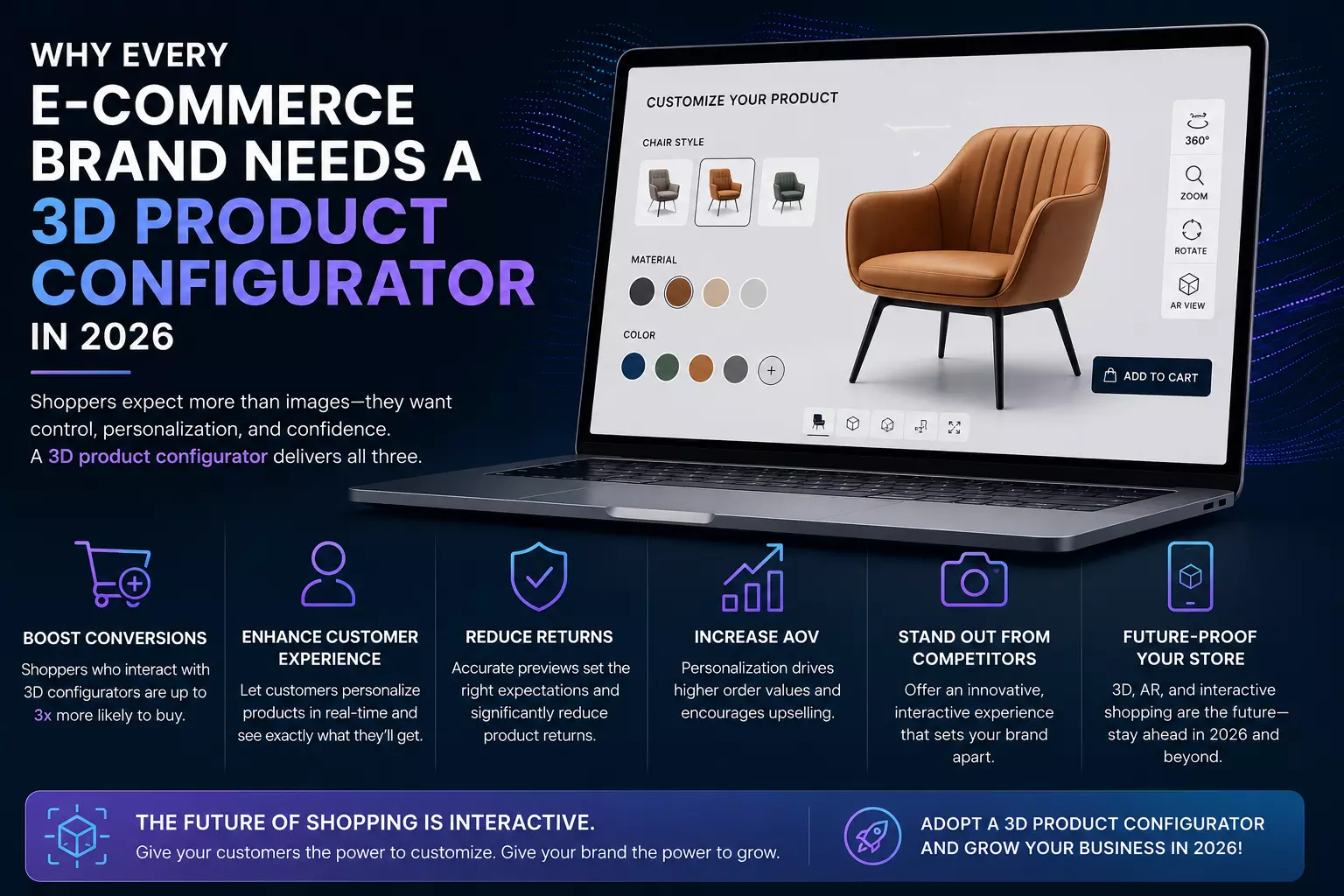
Why Every E-commerce Brand Needs a 3D Product Configurator in 2026
Online shopping has a problem it's never fully solved: customers can't touch, rotate, or truly experience a product before buying it.
Static product photos and even 360-degree spin images only go so far. In 2026, the brands winning online aren't just showing products — they're letting customers build, customize, and interact with them in real time.
That's exactly what a 3D product configurator does, and it's quickly becoming a must-have rather than a nice-to-have for e-commerce.
At Ink & Algorithm, we build 3D web-based configurators for brands across real estate, automotive, and consumer products, and the results we're seeing tell a clear story: configurators aren't just a design trend, they're a conversion tool.
Here's why every e-commerce brand should be seriously considering one this year.
1. Customers Buy What They Can Visualize
The single biggest reason online purchases get abandoned is uncertainty — will this color actually look good, will this size fit the space, does this configuration make sense for my needs? A 3D configurator removes that guesswork entirely.
Instead of scrolling through dozens of static images hoping to find the exact combination they want, customers can rotate, zoom, and modify the product themselves until it matches what's in their head.
This shift from "imagining" to "seeing" is what separates a hesitant browser from a confident buyer.
When someone can visually confirm their exact configuration before checkout, the psychological barrier to purchase drops dramatically.
2. Real-Time Customization Increases Perceived Value
Letting customers personalize a product — choosing materials, colors, sizes, or add-ons — does more than improve the shopping experience.
It increases how much value customers place on the final product, because they had a hand in creating it.
This is the same psychology behind why custom sneakers, build-your-own furniture, and personalized packaging sell at a premium.
A well-built configurator taps directly into this. Brands that let shoppers configure their own product in 3D, rather than just pick from a fixed dropdown menu, see stronger emotional investment and higher average order values as customers add premium options they can actually see reflected in the model.
3. Fewer Returns, Higher Satisfaction
Returns are one of the most expensive problems in e-commerce, and a huge percentage of them come down to one issue: the product didn't match what the customer expected.
A 3D configurator solves this at the source. When a customer configures their product visually and confirms every detail — dimensions, finish, color, accessories — before ordering, the gap between expectation and reality closes significantly.
This is especially powerful in categories like furniture, home fixtures, and automotive accessories, where fit and finish matter enormously and static photography simply can't communicate scale or material texture accurately.
4. Configurators Turn Browsers Into Leads
Beyond the immediate sale, 3D configurators are a quiet but powerful lead-generation tool.
Every interaction a customer has with a configurator — which options they select, how long they spend customizing, which combinations they save — is valuable data.
Many brands use this to trigger follow-up emails, retarget ads with the exact configuration a customer built, or route highly engaged users to a sales team for high-ticket items.
This is particularly effective for industries with longer buying cycles or bigger purchase decisions, similar to how we've approached augmented reality and virtual reality experiences for clients — the goal is always to keep the customer engaged long enough to move them from curiosity to commitment.
Read: How Odoo Smart Manufacturing Software Boosts Efficiency and
5. Mobile-First Shopping Demands Interactive Experiences
The majority of e-commerce traffic in 2026 comes from mobile devices, and mobile shoppers have less patience for static, text-heavy product pages.
Web-based 3D configurators, built to run smoothly in a browser without requiring an app download, give mobile users the same rich, interactive experience as desktop — swipe to rotate, tap to change materials, pinch to zoom.
Brands that optimize their configurators for mobile aren't just improving usability; they're meeting customers exactly where the buying journey now happens.
6. It's a Competitive Differentiator, Not Just a Feature
In crowded e-commerce categories, product pages increasingly look the same — similar photography, similar layouts, similar copy. A 3D configurator is still rare enough in most industries that it immediately sets a brand apart.
When a competitor is showing six product photos and you're offering a fully interactive, customizable 3D experience, the difference in perceived quality and innovation is immediate.
This is one of the reasons configurators have become a signature offering across the projects in our portfolio — from automotive builds to real estate and product customization tools, brands come to us specifically because they want to stand out from competitors still relying on flat catalog imagery.
7. Configurators Work Across Categories, Not Just "Big" Purchases
There's a common misconception that 3D configurators only make sense for expensive, complex products like cars or custom furniture. In reality, the same technology applies to sneakers, jewelry, packaging, sporting goods, home decor, and countless other categories.
Any product with variants — color, material, size, or add-ons — is a strong candidate for a configurator, because the core benefit (letting customers see exactly what they're buying) applies universally.
The scalability of this technology, paired with services like animation for product storytelling, means even mid-sized e-commerce brands can now access experiences that used to be reserved for luxury or automotive players.
8. Configurators Pair Naturally With AR
3D configurators don't have to stop at the screen. Many brands are now pairing their configurators with AR capabilities, letting customers place a life-sized, fully configured version of the product in their own home or space using their phone camera.
This combination — configure in 3D, then preview in AR — is quickly becoming the gold standard for high-consideration e-commerce purchases, closing the gap between digital browsing and physical certainty even further.
Getting Started With a 3D Configurator
Building a 3D configurator isn't just a design project — it requires the right technical foundation, from 3D asset creation to a smooth, fast-loading web experience that works across devices.
The brands that get the most value out of configurators treat them as a core part of their e-commerce strategy, not an afterthought bolted onto an existing product page.
If you're an e-commerce brand exploring whether a 3D configurator makes sense for your products, our team at Ink & Algorithm can walk you through what that would look like for your specific catalog.
Get in touch to talk through your product line and see how a configurator could fit into your 2026 growth plan.