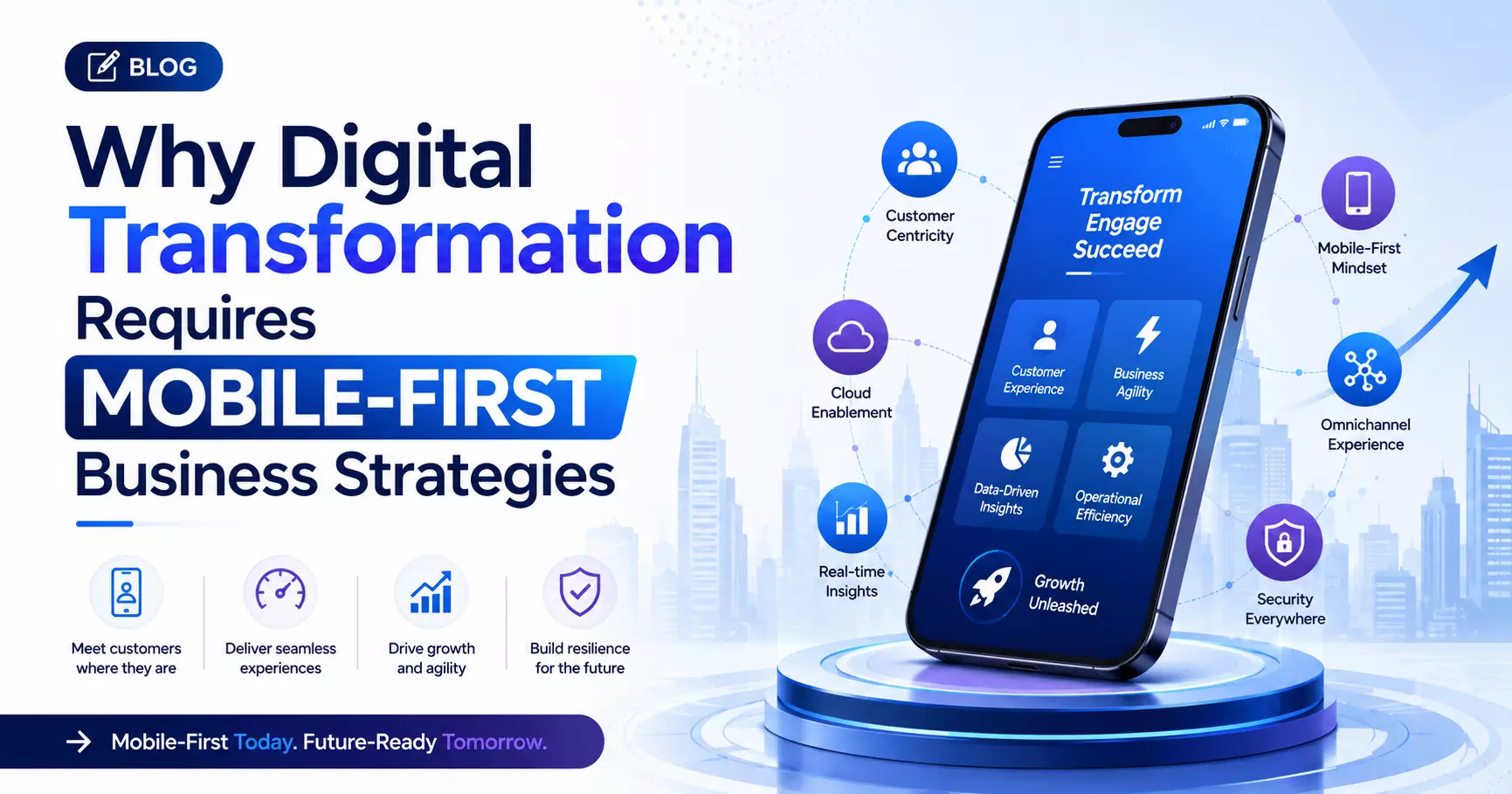
Why Digital Transformation Requires Mobile-First Business Strategies
Why Digital Transformation Requires Mobile-First Business Strategies
Digital transformation has evolved from a technology initiative into a business strategy that influences customer engagement, workforce productivity, operational efficiency, and decision-making.
As organizations modernize their digital infrastructure, mobile technology has become a fundamental component of enterprise operations rather than an additional customer channel.
Employees, field technicians, sales teams, partners, and customers increasingly expect business applications to be accessible from smartphones and tablets without compromising functionality or security.
Recent industry research supports this shift. According to Statista, the number of smartphone users worldwide surpassed 7 billion in 2024, making mobile devices the primary computing platform for a significant portion of the global population.
GSMA's Mobile Economy Report 2024 estimates that mobile technologies and services contributed over $6.5 trillion to the global economy, highlighting their role in business growth and digital innovation.
Additionally, IDC projects continued enterprise investment in mobile applications, cloud services, and AI-powered solutions as organizations prioritize digital transformation initiatives that improve operational agility.
These trends demonstrate that digital transformation strategies cannot rely solely on desktop-centric applications. Organizations need mobile-first business strategies that support real-time collaboration, secure access to enterprise data, and continuous connectivity across distributed workforces.
Understanding Mobile-First Business Strategies
A mobile-first business strategy places mobile experiences at the center of application design, process automation, and user interaction. Instead of adapting desktop applications for smaller screens, organizations design business workflows specifically for mobile environments while ensuring compatibility across multiple devices.
This approach considers several operational factors:
- Touch-based user interfaces
- Real-time data synchronization
- Offline functionality
- Device security
- Location-aware services
- Push notifications
- Cloud connectivity
- API-driven integrations
The objective is not simply to create mobile applications but to ensure employees and customers can complete business-critical tasks regardless of their location.
Why Traditional Digital Transformation Approaches Fall Short
Many organizations began their digital transformation journey by digitizing existing business processes. While this reduced paperwork and improved record management, it often retained workflows that depended heavily on desktop systems.
This approach creates several operational limitations.
Field employees frequently need access to enterprise applications while visiting customer locations. Sales teams require current pricing, inventory availability, and customer history during meetings.
Warehouse staff depend on real-time inventory information to process orders efficiently. Maintenance engineers need immediate access to equipment manuals, service records, and inspection reports.
When these capabilities remain available only through desktop applications, operational delays become unavoidable.
A mobile-first strategy eliminates these dependencies by making enterprise applications accessible whenever and wherever business activities occur.
Mobile Technology Supports Modern Workforce Requirements
The modern workforce operates across offices, production facilities, remote locations, and customer sites.
Business applications must therefore support continuous connectivity without requiring employees to return to office workstations.
Mobile-first solutions provide secure access to:
- Customer relationship management systems
- Enterprise resource planning platforms
- Inventory management applications
- Service requests
- Project management tools
- Business analytics dashboards
- Internal communication platforms
Employees can review information, update records, approve requests, and communicate with colleagues directly from mobile devices.
This level of accessibility improves operational responsiveness while reducing administrative delays.
Core Components of a Mobile-First Digital Strategy
A successful mobile-first strategy combines multiple technologies rather than focusing exclusively on application development.
Cloud Infrastructure
Cloud platforms enable mobile applications to synchronize information across devices in real time.
Whether employees access systems from headquarters or remote locations, they interact with consistent and up-to-date business information.
Cloud infrastructure also supports scalability, centralized security management, and application updates without requiring manual software installation.
API-Driven Architecture
Modern enterprise applications rarely operate independently.
Mobile applications exchange information with:
- ERP systems
- CRM platforms
- Payment gateways
- Identity management solutions
- Business intelligence platforms
- Customer support software
APIs facilitate secure communication between these systems, allowing organizations to maintain data consistency across departments.
Enterprise Mobility Management
As mobile usage increases, organizations must ensure corporate data remains protected.
Enterprise Mobility Management (EMM) solutions provide capabilities such as:
- Device enrollment
- Remote device management
- Application policies
- Data encryption
- Multi-factor authentication
- Remote data wipe
These controls reduce security risks associated with mobile access.
The Role of Custom Android Applications
Android continues to dominate the global mobile operating system market, making it a practical choice for enterprise mobility initiatives. Businesses across logistics, manufacturing, healthcare, retail, and financial services frequently deploy Android-based devices because they support a wide range of hardware configurations and enterprise applications.
Standard mobile applications often meet basic communication requirements but may not align with specialized operational workflows.
Organizations with unique business processes typically require custom android application development services to build applications that integrate directly with existing enterprise systems.
For example, a logistics company may need a mobile application that captures delivery signatures, scans barcodes, tracks vehicle locations, and synchronizes shipment data with an ERP platform. Similarly, a manufacturing organization may require Android applications that display machine status, production schedules, and maintenance requests in real time.
By investing in custom android application development services, businesses can design applications that support industry-specific workflows while maintaining compatibility with existing digital infrastructure.
Mobile Applications Improve Operational Decision-Making
Real-time access to business information enables employees to make informed decisions without waiting for reports or approvals.
For instance, a field technician can view equipment maintenance history before arriving at a customer site. A sales executive can verify inventory availability during a client meeting, while warehouse personnel can update stock levels immediately after receiving shipments.
These capabilities reduce communication delays and improve coordination between departments.
Instead of relying on fragmented communication channels, organizations maintain a continuous flow of operational information across the enterprise.
Enterprise Case Study: UPS Mobile Workforce Transformation
A strong example of mobile-first digital transformation comes from UPS (United Parcel Service). The company operates one of the largest logistics networks in the world, handling millions of deliveries daily across complex routes, warehouses, and international hubs.
UPS deployed mobile devices and custom enterprise applications to support its delivery workforce and logistics operations. Drivers use handheld mobile systems to scan packages, capture proof of delivery, optimize routes, and receive real-time updates from central systems.
These mobile applications integrate directly with backend logistics and tracking platforms, ensuring that every shipment update flows into the central system instantly.
This mobile-first approach reduced manual paperwork, improved delivery accuracy, and enabled real-time tracking visibility for customers. It also strengthened operational coordination between drivers, dispatch teams, and warehouse operations.
The UPS example shows how mobile-first systems are not limited to convenience—they directly impact operational efficiency, customer satisfaction, and cost control.
Read: Exploring the Role of AI Companies in India's Digital
Security and Compliance in Mobile-First Systems
As organizations expand mobile access to enterprise systems, security becomes a core design requirement rather than an afterthought.
Mobile-first enterprise environments typically include multiple layers of protection:
- Role-based access control (RBAC)
- Multi-factor authentication (MFA)
- Device-level encryption
- Secure API gateways
- Session timeout policies
- Remote data wipe capabilities
- Endpoint monitoring and compliance checks
These controls help ensure that sensitive business data remains protected even when accessed outside corporate networks.
Industries such as healthcare, banking, and logistics often require additional compliance alignment with regulations like HIPAA, GDPR, or internal data governance frameworks. Mobile-first architectures must therefore balance accessibility with strict security enforcement.
Business Impact and ROI of Mobile-First Transformation
Organizations adopting mobile-first strategies often observe measurable improvements across operational and financial metrics.
Business Area
Measurable Impact
Field productivity
20–35% faster task completion
Data accuracy
Reduced manual entry errors by up to 40%
Operational response time
Faster issue resolution in real time
Customer satisfaction
Improved service responsiveness and transparency
Paper-based processes
Significant reduction or elimination
Decision-making speed
Near real-time access to business data
Mobile-first systems reduce dependency on office-based workflows, allowing employees to complete tasks directly at the point of action. This reduces delays, improves service quality, and lowers operational overhead.
When combined with enterprise integration and cloud infrastructure, mobile-first strategies deliver long-term value by improving process efficiency and reducing system fragmentation.
Best Practices for Mobile-First Implementation
Organizations planning mobile-first transformation should follow structured implementation practices to ensure scalability and long-term success.
1. Start with High-Impact Use Cases
Focus on workflows that directly affect field operations, customer interactions, or time-sensitive processes. This ensures early business value and faster adoption.
2. Prioritize Integration Over Isolation
Mobile applications should connect seamlessly with ERP, CRM, and backend systems rather than functioning as standalone tools.
3. Design for Offline Capability
Field operations often occur in low-connectivity environments. Applications should support offline data capture and synchronization.
4. Maintain Strong Security Architecture
Security controls must be embedded at the device, application, and network levels.
5. Choose Scalable Development Approach
Enterprises often work with providers offering custom android application development services to ensure applications align with business workflows and can scale with operational growth.
Final Thoughts
Digital transformation is no longer limited to modernizing backend systems or digitizing business processes. It now depends heavily on how effectively organizations enable mobility across their workforce and customer interactions.
Mobile-first business strategies ensure that employees can access critical systems, make decisions, and execute tasks without being tied to office infrastructure. This shift improves operational agility, enhances customer experience, and reduces delays caused by fragmented communication systems.
Enterprises that invest in mobile-first architecture gain a structural advantage because they connect people, processes, and data in real time. When supported by cloud platforms, API-driven integration, and secure enterprise mobility frameworks, mobile-first systems become a core driver of digital transformation success.
By leveraging solutions such as custom android application development services, organizations can build tailored mobile ecosystems that align with their operational requirements while supporting long-term scalability and performance.
As industries continue to evolve, mobile-first strategies will remain central to building responsive, data-driven, and connected enterprises capable of competing in fast-changing markets.