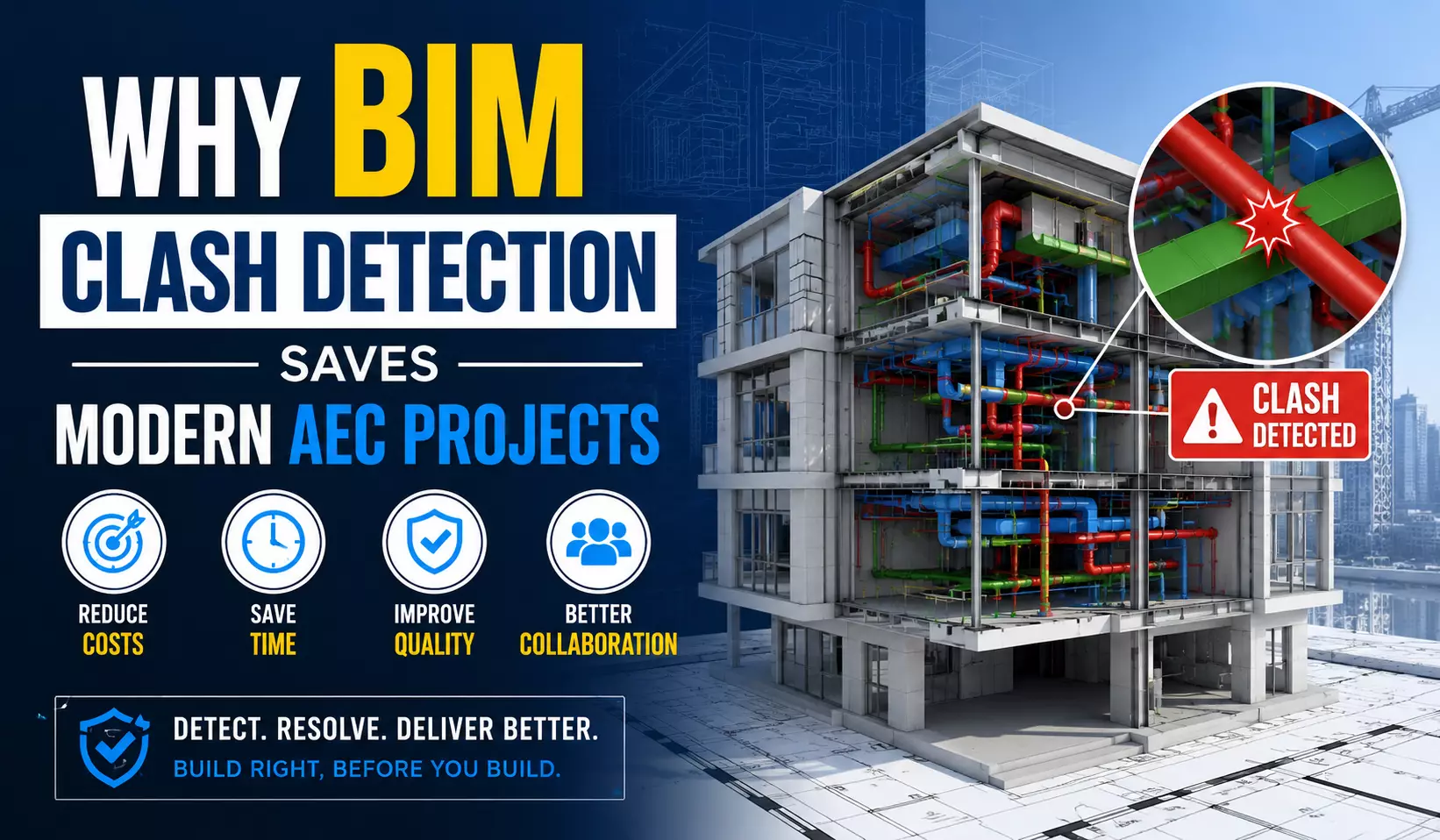
Why BIM Clash Detection Saves Modern AEC Projects
Modern construction projects involve thousands of moving parts. Architects, structural engineers, and mechanical contractors all work on different elements simultaneously.
When these separate designs finally come together, physical overlaps are almost inevitable.
Discovering a pipe running straight through a load-bearing steel beam during actual construction causes massive delays and expensive rework.
Building Information Modeling (BIM) offers a smarter way to manage this complexity. Specifically, the process of identifying design conflicts before anyone sets foot on the job site changes how teams build.
By combining specialized digital models from various disciplines into one central file, teams can spot geometry and scheduling errors early.
Ultimately, implementing robust clash detection keeps projects on time, minimizes wasted materials, and ensures strict adherence to budgets.
It is no longer just a luxury; it is a critical requirement for success in modern architecture, engineering, and construction (AEC).
The Old Way vs. The BIM Approach
Before digital modeling became the industry standard, coordination relied heavily on manual processes. Transitioning to BIM has completely transformed how teams collaborate.
Traditional coordination falls short
Historically, contractors used 2D drawings to build structures. They would overlay these physical blueprints on a light table to check for intersecting systems.
This manual method heavily relied on the human eye and left plenty of room for error. Complex modern buildings, packed with dense HVAC systems and electrical conduits, simply cannot be coordinated effectively using 2D paper drawings.
The collaborative power of BIM
BIM introduces a shared, 3D environment where all disciplines contribute their specific designs.
Instead of working in isolated silos, the structural team can see exactly where the architectural walls sit, and the plumbing team can map out their pipes accordingly. This collaborative nature aligns everyone right from the start.
Streamlined automation
Software completely automates the tedious coordination process. Computers run algorithms against the combined 3D models to highlight exactly where components intersect.
This automation speeds up the review process and catches tiny interferences that humans would otherwise miss.
Understanding Different Types of Clashes
Not all conflicts are the same. AEC professionals categorize these issues to prioritize how they resolve them.
Hard clashes
A hard clash happens when two physical objects occupy the same exact space. For example, an air conditioning duct running through a plumbing line is a hard clash. These are impossible to build in reality and must be resolved in the design phase.
Soft clashes
Soft clashes relate to spatial clearances rather than direct physical overlaps. Equipment requires buffer zones for maintenance, safety, and operational clearance.
If a contractor places a junction box too close to a wall, preventing a worker from opening its panel, it triggers a soft clash.
Workflow clashes
Workflow, or 4D clashes, involve schedule and sequence conflicts. If materials arrive before the site is ready to receive them, or if large equipment is scheduled for installation after the access doors are already built, the project timeline suffers.
The financial toll of undetected errors
When any of these clashes slip past the design phase, the financial impact hits hard on the job site. Rework requires paying laborers for extra hours and buying replacement materials.
It also halts surrounding construction activities, compounding the financial damage.
Core Benefits of Finding Clashes Early
Proactive coordination fundamentally changes the trajectory of a project. Teams that embrace this technology enjoy several distinct advantages.
Slashing project costs
Eliminating rework directly protects the project budget. Contractors order the exact materials they need, knowing the design actually works. This precision stops the financial bleeding associated with on-site fixes and scrapped materials.
Keeping schedules on track
When the design is conflict-free, construction flows smoothly. Workers spend their time building rather than waiting for project managers to answer Requests for Information (RFIs). Fewer delays mean the project finishes on time.
Boosting team collaboration
Digital coordination forces different disciplines to talk to each other early in the design phase. This communication breaks down adversarial relationships between contractors and builds a unified team focused on a shared goal.
Elevating design quality
Resolving issues digitally allows engineers to optimize their layouts. They can route pipes more efficiently and ensure the final product matches the owner's vision without compromising constructability.
Enhancing job site safety
Last-minute workarounds often lead to unsafe working conditions. When tradesmen know exactly what they need to build and have the proper space to do it, the risk of accidents drops significantly.
Read: Benefits of BIM for integrated building systems coordination
Essential Software and Technologies
The AEC industry relies on a few key software platforms to run these automated checks. Choosing the right tool depends on project size and team requirements.
Popular tools on the market
Navisworks remains an industry standard for combining massive models and running interference checks. Solibri excels at rule-based model checking, ensuring designs meet specific building codes.
Revizto provides excellent cloud-based issue tracking, allowing teams to view clashes on iPads right from the field.
Crucial software features
Good software must handle large file sizes without crashing. It also needs robust reporting tools that assign specific clashes to the responsible team members.
Clear visualization—like highlighting the intersecting pipe in bright red—makes it easier for engineers to understand the problem.
The importance of interoperability
Architects might use Revit, while steel detailers use Tekla. Clash detection software must read different file types smoothly.
The Industry Foundation Classes (IFC) format provides an open standard that allows these diverse programs to communicate without losing data.
Proven Strategies for Effective Coordination
Technology alone cannot solve design problems. Teams need strict processes to make the software work for them.
Start the process early
Do not wait until the design is 100% complete to run a clash report. Running checks at 30% and 60% completion catches major structural issues before teams spend hours detailing the surrounding mechanical systems.
Define clear responsibilities
Every project needs a BIM execution plan. This document establishes who models what and who is responsible for moving their equipment when a conflict occurs.
Expert partners like Chudasama Outsourcing can help establish these guidelines and manage the technical modeling, ensuring a smooth process from day one.
Hold regular coordination meetings
Weekly clash review meetings keep the project moving. The BIM manager guides the team through the software, showing the most critical clashes on a screen. The engineers then discuss solutions and agree on fixes in real time.
Document and resolve systematically
Finding a clash means nothing if nobody fixes it. Use issue-tracking software to assign a deadline to every conflict. Monitor the progress until the updated model proves the clash is gone.
Real-World Success Stories
General contractors frequently cite coordination as their primary cost-saving tool.
For instance, on complex hospital builds where the ceiling spaces are packed with medical gas lines, electrical trays, and heavy HVAC equipment, finding room for everything is a massive puzzle.
By utilizing professional BIM clash detection services, contractors can identify hundreds of major interferences before pouring a single slab of concrete.
This proactive approach routinely saves millions of dollars in potential rework and keeps strict hospital opening dates intact.
What the Future Holds
The technology driving design coordination continues to evolve at a rapid pace.
AI and machine learning
Artificial intelligence will soon automate the resolution process, not just the detection. Machine learning algorithms will analyze past projects and suggest the most efficient way to reroute a duct to avoid a steel beam.
Connecting with broader construction tech
Digital models are merging with mixed-reality headsets. Soon, contractors will walk the site wearing augmented reality glasses, viewing the clash-free digital model overlaid onto the physical construction site to ensure perfect installation.
Building Smarter, Not Harder
Relying on luck and manual drawing checks is a recipe for disaster in modern construction. The sheer density of modern building systems requires a smarter, digital approach.
Identifying conflicts in a 3D environment protects project budgets, accelerates timelines, and forces disparate teams to collaborate effectively.
As building designs grow more complex, mastering these digital coordination tools will separate the most successful AEC firms from the rest of the pack.