When Global Marketing Needs More Than Translation
The most famous translation failure in marketing history never happened. For decades, business students have heard the story of an American car that flopped across Latin America because its name, in Spanish, supposedly meant "doesn't go”(no va).
Textbooks repeat it. Marketing seminars still open with it. The problem is that it isn't true, and it never was.
That matters for a reason bigger than one debunked car myth. Global marketing translation gets treated as a word problem, something a good translator or a fast AI tool can solve, when the campaigns that actually fail rarely fail on vocabulary at all.
They fail on meaning, on emotion, on the parts of a message that don't survive a literal conversion. That's a different problem, and a harder one.
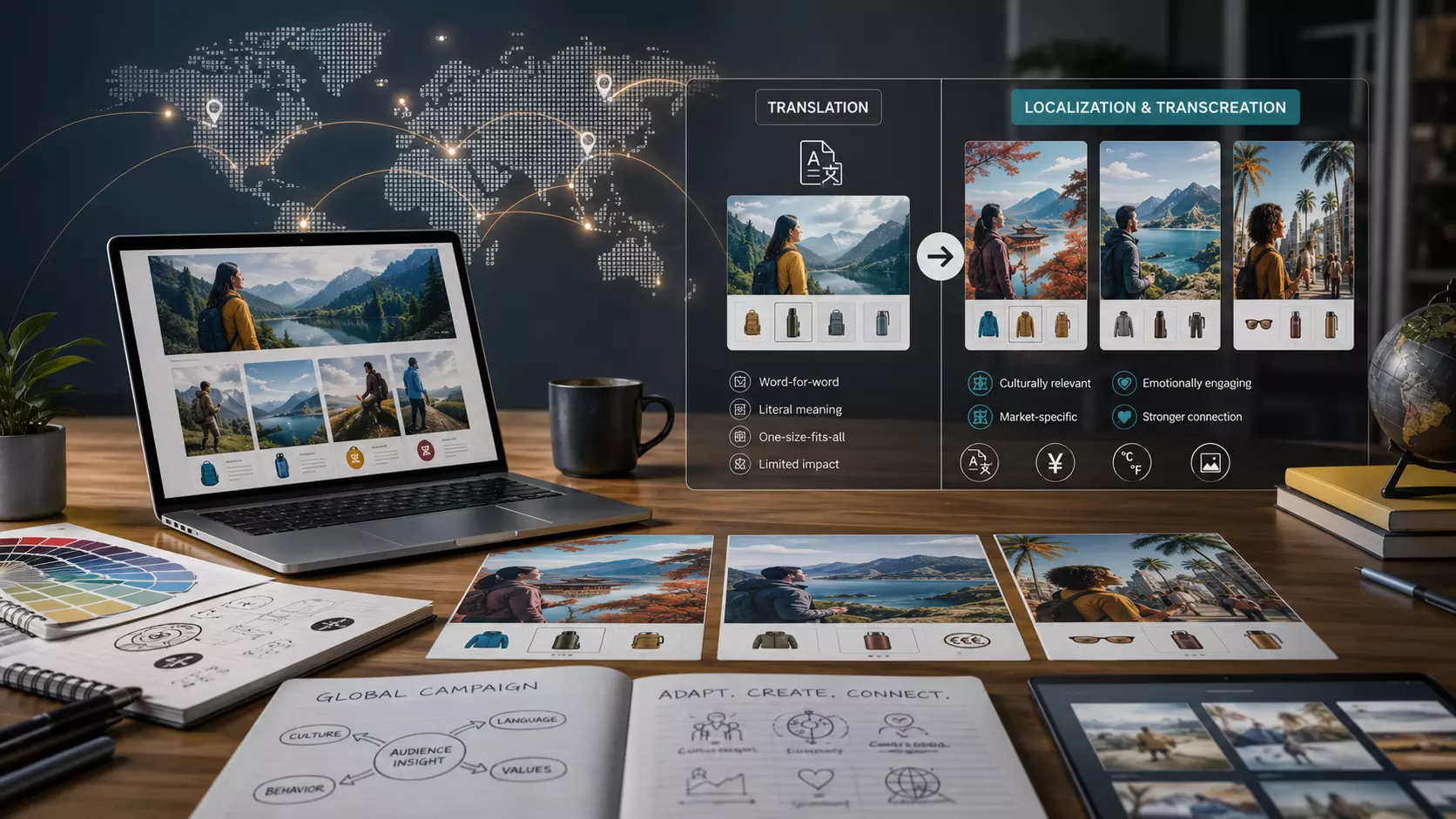
Translation, Localization, and Transcreation Are Not the Same Service
Most people use "translation" as a catch-all word for moving content from one language into another. Inside the language services industry, the word marks only the first of three distinct levels of work, and confusing them is where a lot of global marketing goes wrong.
Judy Jenner, a certified translator and spokesperson for the American Translators Association, draws the first line simply. Translation changes the language.
Localization adapts everything around it. In a technical manual, she's noted, translation converts the words, while localization is what swaps US measurements for metric ones and adjusts a document's units, formats, and references for the country reading it.
Transcreation goes further still. Katie Moakler, lead of translation and transcreation, defines it as the "creation of content in the target language that is inspired by the source." Inspired by, not bound to.
A transcreated slogan might share almost nothing with the original wording and still be doing its job correctly, because the job was never to preserve the sentence. It was to preserve the effect.
As industry coverage of transcreation in content marketing has noted, the decision of when to transcreate versus localize often comes down to how much creative wordplay a campaign carries.
That makes it a genuinely different service, not just a translator working slower and charging more. A transcreation brief often starts without a source text to translate at all, just a description of what the message needs to accomplish.
A quick reference for the three:
Translation
Localization
Transcreation
What it changes
Words only
Words, plus formats, units, currency, imagery
Starts over, keeps intent and emotion
Best for
Manuals, factual content, legal text
Software, websites, product pages
Slogans, taglines, brand campaigns
Bound by the source text?
Yes
Mostly
No, used only as a reference point
The Famous Marketing Translation Fails You've Heard Are Mostly Myths
Start with the car. Chevrolet sold the Nova across Latin America through the 1970s, and the legend says it bombed because "no va" means "doesn't go" in Spanish. It's a tidy story.
It's also wrong on its own terms before anyone even checks the sales figures, since "no va" is two words stressed on the second syllable, while "nova" is one word stressed on the first. Spanish speakers don't confuse them any more than English speakers hear "notable" and think "no table."
Fact-checkers at Snopes traced the claim back for decades and found no record of a failed campaign in any Latin American market, because there wasn't one. The Nova sold reasonably well in Mexico and outperformed projections in Venezuela.
Pepsi's version of the same genre is repeated even more widely. The story goes that "Come Alive! You're in the Pepsi Generation" was mistranslated into Chinese as a promise to raise the dead, offending a culture that reveres its ancestors.
Snopes looked into that one too, and the fact-checking site's conclusion is blunt: despite decades of retelling, the story "has yet to be substantiated".
Nobody can even agree on which exact wording supposedly caused the offense, and the phrase the story blames, "Come alive with Pepsi," was never the campaign's actual tagline in the first place.
Neither correction is new information inside the translation industry. Both stories persist anyway, mostly because they're satisfying. A single wrong word sinking a household name is a cleaner lesson than the truth, which is that real failures rarely produce a punchline.
The Real Risk Isn't a Funny Mistranslation, It's a Campaign That Quietly Underperforms
A real example exists, and it's less funny than the fake ones. In 2009, HSBC took its "Assume Nothing" tagline, built around the idea that the bank made no assumptions about its customers, into markets outside the US.
In several of them, the phrase translated closer to "Do Nothing," roughly the opposite message a bank wants attached to its name. The fix was a rebrand widely reported at the time to have cost the bank in the range of $10 million, replacing the tagline with "The World's Local Bank."
Even that story is the exception, not the rule. Most translation-driven marketing failure doesn't produce a headline. It produces a campaign that simply underperforms, with no error message and no obvious villain, just a market where the numbers never quite arrived.
CSA Research's long-running "Can't Read, Won't Buy" survey, an 8,709-person study across 29 countries, put real figures on that gap in 2020.
Seventy-six percent of online shoppers said they preferred buying where the product information was in their own language. Forty percent said they would not buy from a foreign-language site at all.
That data predates the industry's current AI-driven moment, and it's worth citing honestly as a 2020 figure rather than implying it's brand new. Nothing published since suggests the underlying preference went anywhere.
Read: Top 10 Digital Marketing Agencies in India (2026)
Where Global Campaigns Actually Need Adaptation, Not Just Translation
Not every piece of content carries the same risk. A handful of categories are where the translation-versus-transcreation decision actually matters.
Slogans and Taglines
A slogan is built to be short, rhythmic, and emotionally loaded, exactly the qualities that don't survive literal translation intact. Rhyme, wordplay, and double meaning are the first casualties, since a pun that works in English almost never happens to work in Japanese or Portuguese by accident.
HSBC's tagline is the cautionary case above. The fix isn't a better dictionary. It's a copywriter, briefed on the intent rather than the wording, building something new in the target language.
Visual and Cultural Signals
Color, imagery, humor, and gesture carry meaning that words never touch. White signals mourning in parts of East Asia rather than the purity it suggests in the US. A thumbs-up reads as an insult in some Middle Eastern and West African contexts.
Numbers carry their own baggage too. The number four is avoided in pricing and packaging across parts of East Asia because it sounds close to the word for death, the same way many Western buildings skip a thirteenth floor.
None of that shows up in a translated sentence, because none of it was ever a sentence to begin with.
Brand Voice and Tone
A brand's voice, playful, formal, irreverent, has to survive the trip too, and it rarely survives by accident. A tone that reads as confident in English can read as arrogant in a market with different norms around modesty and directness, and that's a judgment call no glossary makes on its own.
The casual, first-name-basis voice common to US direct-to-consumer brands can land as presumptuous in markets where a first interaction is expected to be more formal, which is a tone problem, not a translation error.
Can AI Translation Handle Global Marketing on Its Own?
Not yet, and the industry's own current data says so. AI has made the mechanical side of localization faster and cheaper than it's ever been, and adoption is accelerating fast.
But a 2026 industry roundtable hosted by the localization platform Phrase, gathering perspectives from Motorola Solutions, Translated, and the analyst firm Nimdzi, converged on the same point from several different directions.
AI is functioning as an orchestration layer, speeding up the handoffs between steps, rather than replacing the human judgment that catches an offensive color choice or a joke that doesn't land.
That distinction lines up with the three-level framework from earlier in this piece. Machine translation is genuinely strong at the first level, literal conversion, where meaning is fixed and there's a defensible right answer.
It gets shakier at the second level. At the third, transcreation is built to diverge from the source on purpose, which isn't really a translation problem for software to solve at all.
How to Tell Which Level a Given Piece of Content Actually Needs
A simple test helps more than a long checklist: ask what happens if the wording changes but the meaning has to stay identical.
For a user manual, a compliance document, or a product spec, nothing should happen, and that's the point. The content is meant to be literal, so translation is the right and sufficient tool.
For a website, an app interface, or a pricing page, the words need to change and so does the context around them, currency, measurement units, layout that accommodates longer or shorter text. That's localization territory.
For anything built to make someone feel a certain way, a slogan, a launch campaign, an ad film, the exact words are almost beside the point. What has to survive is the feeling, and that's what transcreation exists to protect.
Most real campaigns mix all three in a single deliverable. A product launch video might need a transcreated tagline, a localized on-screen price, and a plainly translated legal disclaimer in the same thirty seconds, which is exactly why treating "translation" as one uniform service tends to under-serve the parts of a campaign that were never meant to be literal.
Closing Thought
None of this makes translation obsolete, and nothing here argues against speed or against AI doing more of the mechanical work over time. It's an argument for matching the tool to the job.
A press release can usually survive a fast, literal conversion. A brand's entire relationship with a new market usually can't. Getting the words right was never really the hard part — which is why working with a full-service language partner like Capital Linguists matters, one that can translate, localize, and transcreate within the same campaign.