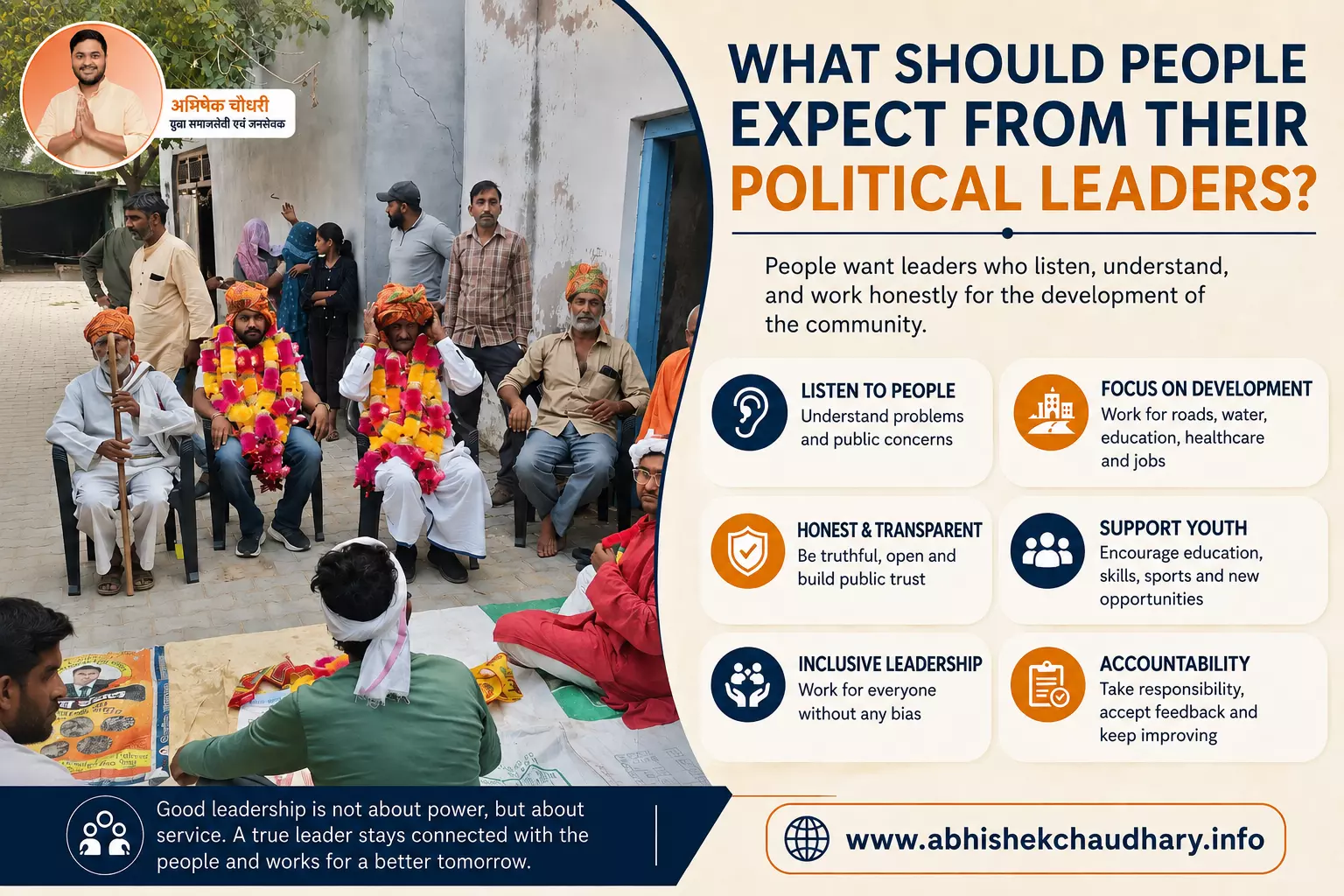
What Should People Expect From Their Political Leaders?
Political leadership is not only about elections, speeches, or public appearances. A political leader has a much bigger responsibility: to understand people, listen to their concerns, and work toward practical solutions.
In today’s India, people are becoming more aware of their rights, responsibilities, and expectations from public representatives. They want leaders who are accessible, responsible, transparent, and connected to the realities of everyday life.
A good political leader should not only talk about development but also understand what development means for ordinary people.
For one person, it may mean better roads. For another, it may mean clean drinking water, education, healthcare, employment opportunities, or better public services.
1. People Expect Leaders to Listen
One of the most important qualities of a political leader is the ability to listen.
People want leaders who take time to understand their problems instead of making assumptions. Listening to residents, young people, women, farmers, workers, and senior citizens can help leaders understand local issues more clearly.
Effective communication should work both ways. Leaders should:
- Listen to public concerns.
- Encourage people to share their ideas.
- Understand problems at the local level.
- Communicate decisions clearly.
- Remain accessible to the community.
When people feel heard, they are more likely to participate positively in community development.
2. A Focus on Local Development
For many citizens, politics becomes meaningful when it improves everyday life.
Local development can include improvements in basic infrastructure and public facilities. Political leaders should pay attention to issues such as:
- Roads and transportation
- Drinking water and sanitation
- Healthcare facilities
- Education and schools
- Employment opportunities
- Electricity and public infrastructure
- Clean and safe public spaces
Development does not always require large projects. Sometimes, solving a small but long-standing local problem can make a significant difference in people's lives.
3. Honest and Transparent Leadership
Trust is an important part of politics. People expect their leaders to communicate honestly and avoid making unrealistic promises.
Transparency can include explaining priorities, discussing progress, and being open about challenges. If a project takes longer than expected, people deserve to know why.
A responsible leader should be willing to say:
“This is what we can do, this is what we are working on, and this is what still needs attention.”
Such communication can create realistic expectations and strengthen public trust.
4. Young Leaders and Fresh Ideas
Young people have an important role in shaping the future of Indian politics. They bring energy, new perspectives, digital awareness, and an understanding of changing social and economic needs.
A young political leader can connect with different sections of society and use modern communication tools to understand public concerns.
In this context, the idea of a Popular Youth Leader in Mathura reflects the growing interest in young leadership at the local level.
However, popularity alone should not define leadership. It should be supported by responsible public engagement, meaningful work, and a genuine understanding of community needs.
5. Leaders Should Focus on People, Not Just Positions
Political positions come with responsibilities. People expect leaders to remain connected with them beyond election periods.
A people-focused leader should regularly interact with the community and understand changing needs.
This could involve:
- Visiting local areas.
- Meeting residents.
- Understanding community challenges.
- Supporting constructive initiatives.
- Encouraging youth participation.
- Promoting awareness about public services.
Leadership becomes stronger when people can see a consistent connection between words and actions.
6. Supporting Youth Development
India has one of the world's largest young populations, making youth development an important political and social priority.
Political leaders can encourage young people through education, skill development, employment opportunities, sports, entrepreneurship, and community participation.
Young people should not be treated only as voters. They should also be encouraged to become active contributors to their communities.
What Can Leaders Do?
Some practical approaches include:
- Supporting skill-development programs.
- Encouraging sports and cultural activities.
- Promoting entrepreneurship.
- Creating awareness about career opportunities.
- Encouraging participation in community initiatives.
7. Inclusive Leadership Matters
A political leader represents a diverse community. People come from different backgrounds, age groups, occupations, and economic situations.
Good leadership should therefore be inclusive.
Leaders should make efforts to understand the concerns of different groups, including women, senior citizens, farmers, workers, students, and young professionals.
The goal should be to create opportunities for everyone rather than focusing on only one section of society.
8. Accountability Should Be a Priority
People have the right to ask questions about public work and development.
Accountability means being prepared to explain decisions, acknowledge shortcomings, and work toward improvements.
A responsible political leader should:
- Accept constructive criticism.
- Review ongoing work.
- Learn from mistakes.
- Keep people informed.
- Focus on measurable improvements.
Accountability does not mean that every problem can be solved immediately. It means that leaders take responsibility for addressing problems seriously.
9. The Importance of Community Connection
Political leadership becomes more meaningful when leaders understand the realities of the communities they serve.
In places like Mathura and surrounding rural areas, local concerns can vary significantly from one village or neighbourhood to another. Direct interaction with residents can help identify issues that may not be visible from an office.
Community connection allows leaders to understand what people actually need, rather than relying only on assumptions or general discussions.
Conclusion
People today expect more from political leaders than speeches and promises. They want leadership based on listening, responsibility, transparency, development, accessibility, and public service.
A successful political leader should understand that leadership is a continuous responsibility. It involves staying connected with people, identifying genuine problems, supporting practical solutions, and encouraging the next generation to participate in community development.
Ultimately, political leadership should be measured not only by popularity or position, but by the trust a leader builds and the positive contribution made to the community.
When leaders listen to people, communicate honestly, encourage youth participation, and remain focused on development, politics can become a stronger instrument for meaningful social change.