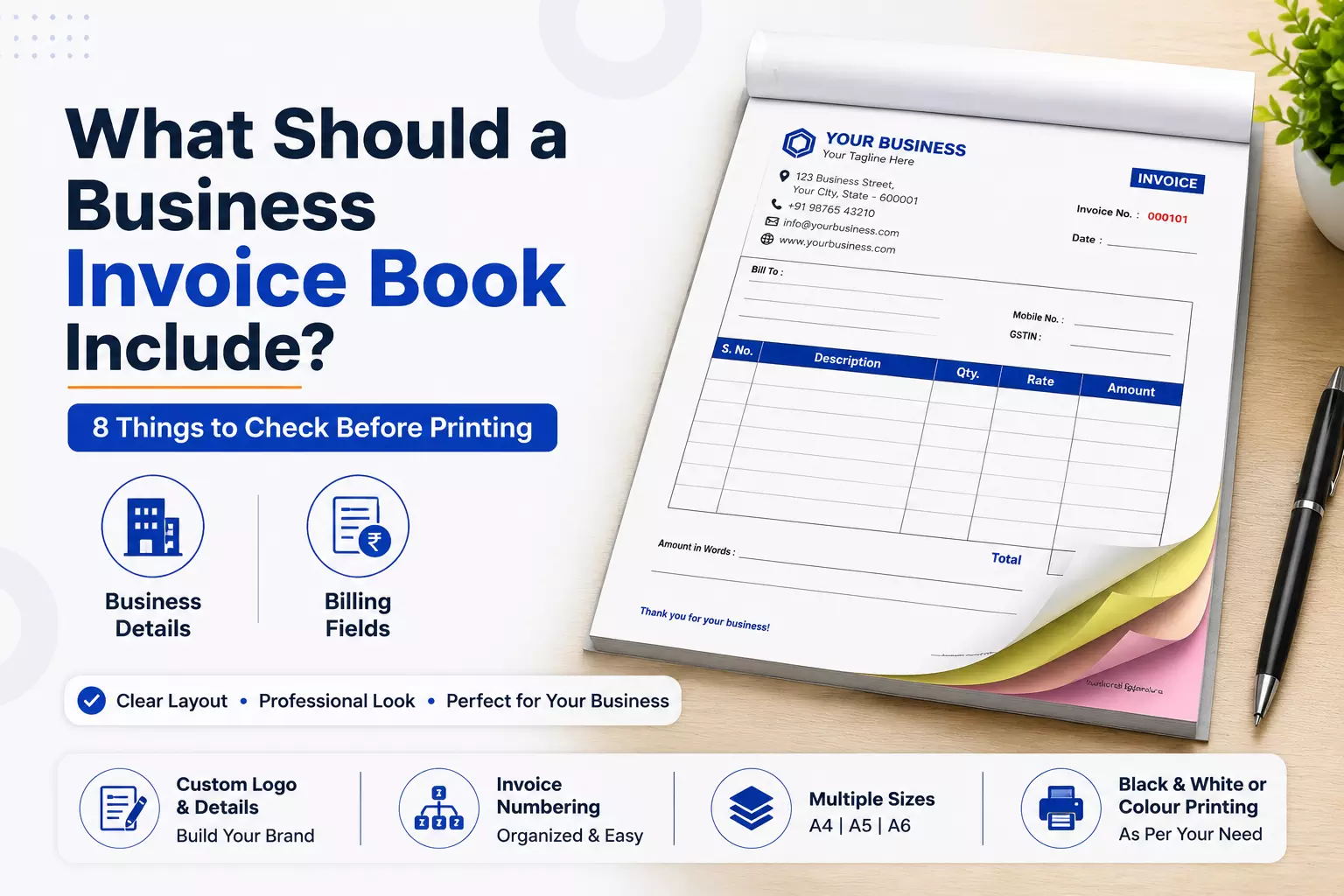
What Should a Business Invoice Book Include? 8 Things to Check
A well-designed invoice book should make billing easier, keep transaction details organised, and clearly display your business information.
Before printing, businesses should check the layout, invoice size, numbering, branding, and required billing fields so mistakes are not repeated across an entire batch.
Here are eight important things to review before choosing or printing a business invoice book.
1. Business Name and Logo
Your business identity should be clearly visible on every invoice.
Include your:
- Business name
- Company logo
- Brand name, if applicable
Use a clear, high-resolution logo so it prints sharply. A branded invoice book also helps customers quickly identify who issued the invoice.
2. Business Contact Details
Your invoice should make it easy for customers to contact you.
Useful details may include:
- Business address
- Phone number
- Email address
- Website
Keep this area simple and readable. Too much information can make the invoice look crowded.
3. Invoice Number and Date
Every invoice should have dedicated space for:
- Invoice number
- Invoice date
Clear numbering helps businesses organise and locate transaction records more easily.
If your business uses sequential invoice numbering, confirm the numbering format before approving a large print quantity.
4. Customer Information
Leave enough space for customer details.
Depending on your business, this may include:
- Customer name
- Company name
- Address
- Contact details
A B2B supplier may require more space for customer information than a retail business, so the layout should match your actual billing process.
5. Product or Service Details
The main billing area should be easy to complete and read.
Common columns include:
- Description
- Quantity
- Rate
- Amount
Businesses that regularly bill multiple products or services should choose a format with enough rows and writing space.
This is one of the main reasons why selecting the right invoice-book size matters.
6. GST and Other Billing Fields
Businesses using a GST invoice format may need fields for relevant tax and transaction information.
Depending on the transaction, the layout may include:
- GSTIN
- Invoice number
- Product or service details
- Taxable value
- Applicable tax fields
- Total amount
The exact information required can differ by business and transaction, so confirm your billing requirements before approving the final artwork.
A generic invoice template should not automatically be assumed to meet every business's tax requirements.
7. Total Amount and Signature Area
The total payable amount should be easy to find.
A clear invoice layout may include:
- Subtotal
- Tax amount
- Final total
- Amount in words
- Authorised signature
If your business regularly applies discounts or different tax components, make sure there is enough room for those details.
8. Choose the Right Invoice Book Size
The best size depends on how much information your business normally records.
A4 – 210 × 297 mm
Best for detailed invoices with multiple products, services, or additional billing fields.
A5 – 148 × 210 mm
A practical option for regular day-to-day business billing.
A6 – 105 × 148 mm
Suitable for compact billing where fewer details need to be recorded.
Instead of choosing a size only by price, consider how much writing space your staff actually needs.
What Printing Options Should You Consider?
Black & white and colour printing can both work well depending on your requirements.
Black & white printing is suitable for a simple, functional invoice format.
Colour printing may be useful when your logo and brand colours are important to your business identity.
Readability should always come first. A clean, well-organised invoice is usually more useful than an overly decorative design.
Real Product Example
Tagsen's current invoice-book product options include:
- A4, A5 and A6 sizes
- 50 pages
- 80 GSM paper
- Black & white or colour printing
- Business name and logo customisation
- Contact-detail customisation
- Invoice numbering options
If a standard template does not match your billing workflow, you can explore custom invoice book printing and choose a format based on your business requirements.
How Much Does Invoice Book Printing Cost?
Invoice-book pricing can vary depending on:
- Size
- Quantity
- Printing option
- Copy requirement
- Customisation
Tagsen's current invoice-book pricing starts from ₹200, while the final price depends on the selected product configuration.
Rather than comparing only the lowest price, consider whether the selected format gives you enough writing space and the fields your business actually needs.
8 Things to Check Before Printing
Before approving your invoice-book artwork, check:
- Business name and address are correct
- Logo quality is suitable for printing
- Contact details are accurate
- Invoice numbering is correct
- Required billing and tax fields are included
- Page size provides enough writing space
- Copy requirements are confirmed
- Final artwork has been proofread
A short pre-print review can prevent the same error from appearing across an entire batch.
Final Thoughts
A useful business invoice book should be clear, practical, and easy to complete.
Focus on:
The best design is not the one with the most elements. It is the one that matches how your business actually creates and records invoices.
Businesses that need a personalised format can review Tagsen's invoice-book printing options and select the size, branding, and print configuration that best fits their daily billing process.