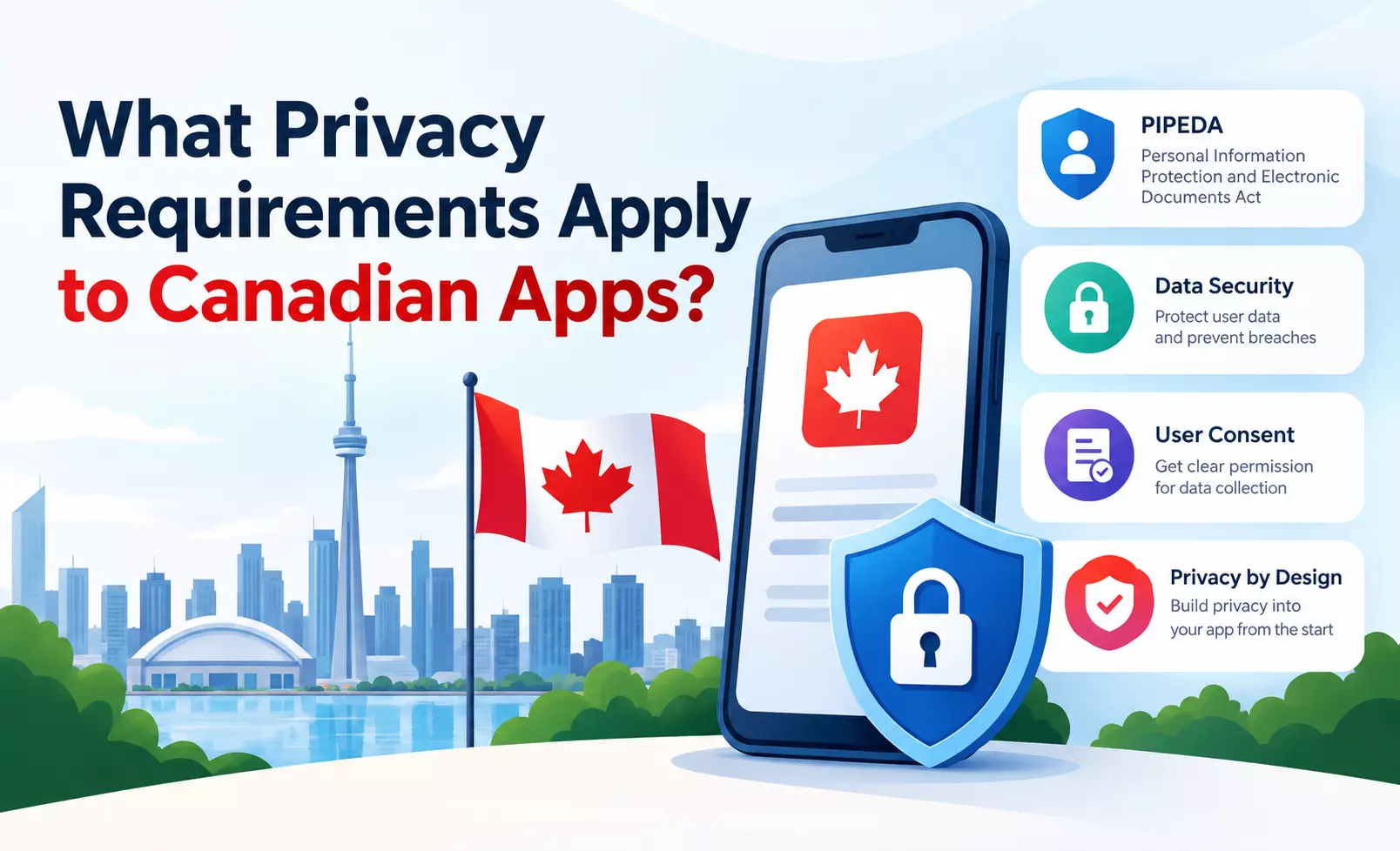
What Privacy Requirements Apply to Canadian Apps?
If you are building or operating a mobile app in Canada, privacy compliance should be considered from the beginning—not added after development.
Canadian apps that collect personal information may need to comply with PIPEDA, as well as provincial privacy legislation depending on where the business operates, the nature of its activities, and where information is processed.
For businesses working with app developers in Canada, the practical goal is to build privacy into the product architecture, user experience, data practices, and security controls.
The main requirements include meaningful consent, limited data collection, transparency, appropriate security safeguards, retention controls, access rights, and breach procedures.
Quick Answer: What Privacy Rules Apply to Canadian Apps?
Canadian apps generally need to:
- Tell users what personal information is collected and why.
- Obtain meaningful consent for collection, use, and disclosure where required.
- Collect only information necessary for identified purposes.
- Use and disclose information only for appropriate, identified purposes.
- Protect personal information with appropriate safeguards.
- Provide users with access to their personal information.
- Maintain reasonable retention and secure deletion practices.
- Have procedures for responding to privacy breaches.
- Review third-party services, analytics tools, SDKs, and processors handling user information.
- Consider provincial privacy requirements in Alberta, British Columbia, and Quebec, which have substantially similar private-sector privacy legislation to PIPEDA.
These requirements make privacy a product-development issue as much as a legal issue.
1. PIPEDA Is a Key Federal Privacy Requirement
The Personal Information Protection and Electronic Documents Act (PIPEDA) applies to private-sector organizations engaged in commercial activities involving personal information, subject to specific provincial and sectoral rules.
PIPEDA is based on ten fair information principles:
- Accountability
- Identifying purposes
- Consent
- Limiting collection
- Limiting use, disclosure, and retention
- Accuracy
- Safeguards
- Openness
- Individual access
- Challenging compliance
For an app, these principles can affect everything from registration forms and location permissions to analytics, payment information, advertising technologies, and cloud storage.
2. Meaningful Consent Matters
Simply displaying an iOS or Android permission request does not automatically mean the user has provided meaningful privacy consent.
Canadian privacy guidance emphasizes that users should understand what information is collected, why it is collected, who it may be shared with, and the potential consequences.
For example, if a food-delivery app needs a user's location to provide location-based delivery services, the app should explain that purpose clearly.
Businesses should also distinguish between information essential to the app and optional data collection. Where collection is not integral to the primary functionality, users should have a meaningful choice.
This is particularly important for sensitive information such as precise geolocation.
3. Collect Only the Data Your App Needs
A common mistake in mobile application development in Canada is collecting information simply because it may be useful for future analytics or marketing.
PIPEDA's limiting-collection principle requires organizations to restrict collection to information needed for identified purposes.
Before development, teams should create a data inventory covering:
- Name and contact information
- Location data
- Device identifiers
- Payment information
- Health or biometric information
- Photos, videos, or files
- Behavioural and analytics data
- Login credentials
- Information shared with third parties
This inventory helps developers determine which information needs to be collected, where it is stored, who can access it, and when it should be deleted.
4. Build Strong Security Safeguards
Privacy compliance is not just about having a privacy policy.
Canadian privacy principles require organizations to protect personal information using safeguards appropriate to its sensitivity.
Depending on the application, security measures can include:
- Encryption in transit and at rest
- Secure authentication
- Role-based access controls
- Secure API architecture
- Tokenization for sensitive information
- Secure cloud configurations
- Vulnerability testing
- Logging and monitoring
- Secure software development practices
- Controlled access to production databases
For businesses hiring app developers Canada has to offer, security architecture should therefore be discussed during discovery and technical planning—not only during final QA.
Read: Top 10+ AI Development Companies in Okotoks, Calgary
5. Give Users Transparency and Access
Canadian privacy requirements also emphasize openness.
An app's privacy notice should explain its information practices in language users can understand.
PIPEDA generally gives individuals rights to learn what personal information an organization holds about them, how it is used or disclosed, and to challenge inaccurate information.
A well-designed app can support these requirements through features such as:
- Account privacy settings
- Data access requests
- Profile editing
- Consent management
- Account deletion workflows
- Clear explanations of third-party data sharing
Privacy information should be easy to find rather than hidden behind complicated navigation.
6. Establish Retention and Deletion Rules
Keeping personal information indefinitely can create unnecessary privacy and security risks.
PIPEDA requires organizations to limit retention to what is needed for the identified purposes, while organizations should establish procedures for retaining, securely destroying, erasing, or anonymizing information when it is no longer required.
Development teams should therefore define retention rules for user accounts, logs, backups, analytics data, documents, and other personal information.
7. Prepare for Privacy Breaches
A Canadian app should have a documented incident-response process before a breach occurs.
Under PIPEDA, organizations must report certain breaches to the Privacy Commissioner of Canada and notify affected individuals when the breach creates a real risk of significant harm.
Organizations must also maintain records of breaches as required by the legislation.
A practical mobile-app security plan should identify:
Detect → Assess → Contain → Notify → Remediate → Document
Third-party vendors and cloud providers should also be included in the incident-response process.
8. Don't Ignore Provincial Privacy Laws
Canada does not have a single privacy rule that works identically for every organization.
Alberta, British Columbia, and Quebec have private-sector privacy legislation that has been deemed substantially similar to PIPEDA. Depending on the organization and its activities, provincial legislation may apply instead of or alongside federal requirements.
For an app serving users across Canada, the development team should therefore assess its geographic footprint, business structure, data flows, and applicable industry requirements before choosing a compliance approach.
How Apptunix Can Help Build Privacy-Conscious Canadian Apps
For companies planning mobile application development in Canada, selecting a development partner with security and privacy considerations built into its process can reduce technical and compliance risks.
Apptunix's Canadian mobile app development team positions its services around secure, scalable iOS, Android, cross-platform, and AI-powered applications.
The company states that its Canadian development offering includes PIPEDA-compliant development and ISO 9001 and ISO 27001 certifications, alongside end-to-end services covering strategy, UI/UX, development, QA, deployment, and ongoing support.
This type of end-to-end approach is particularly valuable when privacy requirements influence product architecture.
Developers can consider data minimization, permission flows, authentication, secure APIs, encryption, access controls, third-party integrations, and privacy-related user experiences during development rather than attempting to retrofit them later.
Canadian App Privacy Checklist
Before launching an app in Canada, businesses should ask:
- What personal information does the app collect?
- Why is each data element necessary?
- Have users been given meaningful consent?
- Does the privacy notice clearly explain data practices?
- Which third parties receive personal information?
- Where is the information stored and processed?
- What security controls protect it?
- How long is information retained?
- How can users access or correct their information?
- What happens when a user deletes an account?
- What is the breach-response process?
- Do Alberta, British Columbia, Quebec, or sector-specific requirements apply?
Privacy should also be considered during product design. Canada's privacy regulators have increasingly emphasized privacy-friendly defaults and avoiding deceptive design patterns that manipulate users into giving up more personal information than necessary.
FAQs About Privacy Requirements for Canadian Apps
Do Canadian mobile apps need a privacy policy?
If an app collects personal information, organizations generally need to be transparent about their information-handling practices and applicable privacy obligations.
A privacy policy is an important mechanism for communicating those practices, but simply having one does not by itself establish compliance.
Is PIPEDA the only privacy law Canadian apps need to consider?
No. Alberta, British Columbia, and Quebec have substantially similar private-sector privacy legislation, and other federal, provincial, or sector-specific requirements may apply depending on the business and information involved.
Does app permission equal privacy consent?
Not necessarily. An operating-system permission may allow technical access to a device feature, but Canadian privacy guidance indicates that meaningful consent requires users to understand the relevant collection, use, or disclosure of their information.
Should privacy be considered during app development?
Yes. Privacy requirements can influence architecture, databases, APIs, permissions, analytics, security, user interfaces, and data retention. Canada's privacy regulator specifically recommends privacy management programs and privacy impact assessments when developing or significantly changing products and systems.
What should Canadian businesses look for in an app development partner?
Businesses should look beyond coding expertise and evaluate a development partner's approach to security, data architecture, compliance requirements, testing, third-party integrations, deployment, and post-launch maintenance. This is especially important for apps handling sensitive personal information.
Bottom line: Canadian app privacy compliance starts with understanding what data the product collects and why. By combining data minimization, meaningful consent, transparent privacy practices, strong safeguards, appropriate retention, breach preparedness, and province-specific legal analysis, businesses can create apps that are not only more compliant but also more trustworthy to Canadian users.