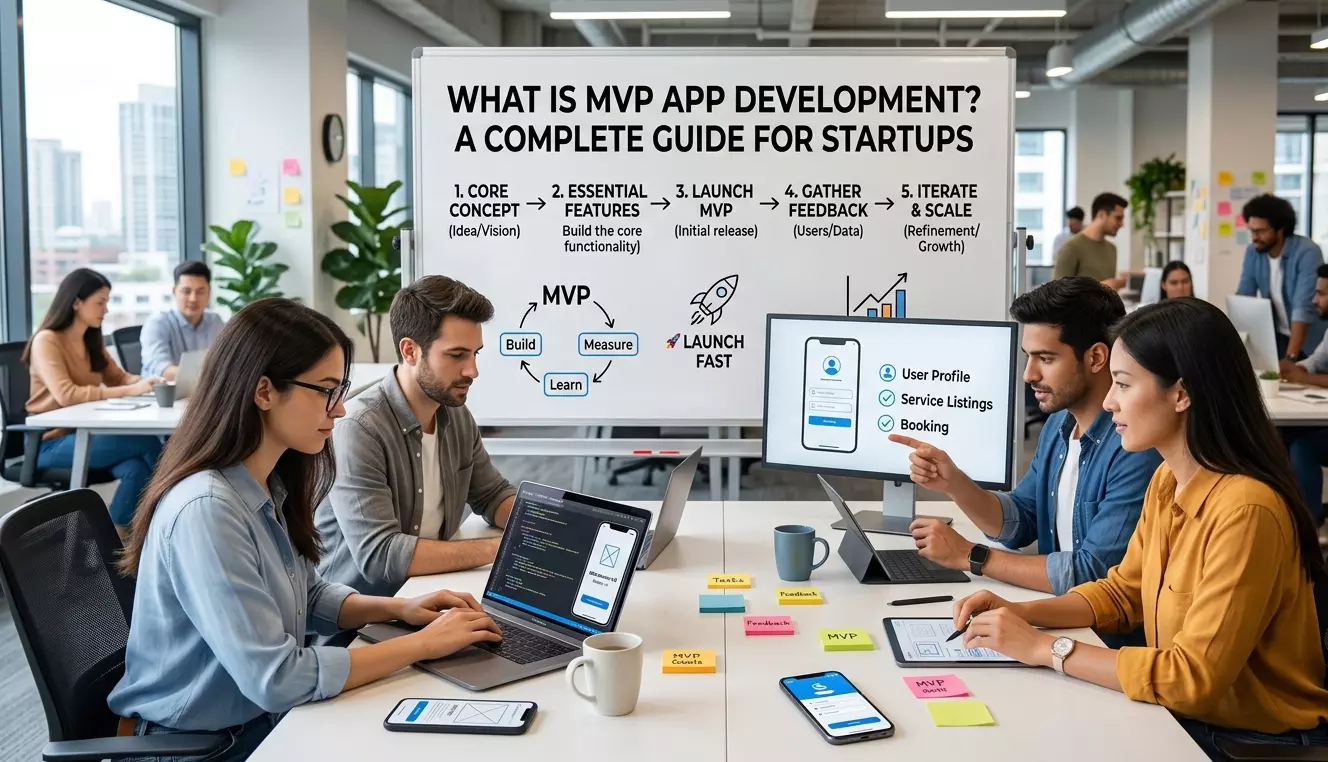
What Is MVP App Development? A Complete Guide for Startups
Every great app started as an idea. But ideas alone don't win markets execution does.
And in today's fast-moving startup ecosystem, the biggest mistake founders make is spending months (and budgets) building a full-featured product before a single real user has tried it.
That's exactly why MVP app development has become the go-to strategy for startups that want to launch smart, test fast, and scale confidently.
If you're a founder, product manager, or entrepreneur trying to bring an app to life in 2026, this guide covers everything you need to know.
What Is MVP App Development?
MVP stands for Minimum Viable Product. In the context of app development, an MVP is a working version of your application that contains only the core features needed to solve a specific problem for a specific audience.
The idea isn't to build something half-baked it's to build something intentionally focused. Instead of spending 12 months developing every feature you've imagined, you launch in 6–10 weeks with the features that matter most.
Real users interact with the product, provide feedback, and your team uses that data to improve and expand.
MVP app development is not about cutting corners. It's about cutting the noise so you can learn faster, spend smarter, and build a product users actually want.
Why Startup MVP Development Is a Game-Changer
Startups operate in conditions of maximum uncertainty. You may have a compelling pitch deck and a solid hypothesis, but until real users engage with your product, you're making educated guesses. Startup MVP development changes that dynamic completely.
Here's why it's the right approach for early-stage ventures:
1. Validate Your Idea Before You Over-Invest
Building a full product only to discover users don't want it is one of the most common and expensive startup failures. An MVP lets you test your core assumption in the market with a fraction of the time and cost.
If it works, you scale. If it doesn't, you pivot before the damage is done.
2. Attract Investors with a Working Product
Investors don't fund ideas they fund traction. An MVP gives you something tangible: real user data, engagement metrics, and proof that your concept works. In 2026, showing a live product with early users is far more convincing than any slide deck.
3. Speed to Market Beats Perfection
In competitive markets, being first matters. Startup MVP development lets you claim your space before a better-funded competitor does. A working product in the market today is worth more than a perfect product six months from now.
4. Reduce Development Risk
When you build incrementally, you reduce the risk of building the wrong thing. Agile MVP cycles mean you can adjust priorities, drop features that don't resonate, and double down on what users love all before you've over-committed your resources.
5. Build a Loyal Early User Base
Early adopters are valuable beyond their numbers. They provide feedback, generate word-of-mouth, and often become long-term customers. Startup MVP development helps you cultivate this community from day one.
Key Features of a Well-Built MVP App
Not every MVP is created equal. A great MVP is lean, but it's never sloppy. The best MVP apps share a few defining characteristics:
• Single, clear core use case - the app does one thing really well
• Smooth user experience - even basic flows should feel intentional and polished
• Reliable performance - it works consistently without crashes or errors
• Scalable architecture - built on code that won't need to be thrown away when you grow
• Feedback mechanisms - ways to collect user input inside the product itself
When you work with a professional MVP app development company, they help you define which features belong in the MVP and which ones can wait for version 2.
The MVP App Development Process: Step by Step
Understanding how a modern MVP gets built helps you set expectations and collaborate more effectively with your development partner. Here's a typical process:
Step 1: Discovery & Scoping
Before a single line of code is written, your development team works with you to understand your target users, your business goals, and your core value proposition. This phase results in a feature list, a product roadmap, and a realistic timeline.
Step 2: UX Design & Prototyping
Designers create wireframes and interactive prototypes so you can visualize the user experience before development begins. This step prevents costly redesigns mid-build and ensures the product makes sense for real users.
Step 3: Agile Development Sprints
Developers build the MVP in short, focused sprints typically one to two weeks each. You receive regular demos and updates, so you can provide feedback in real time rather than waiting until the end.
This is where choosing the right MVP app development company matters most: transparent communication during development is not optional.
Step 4: QA Testing
Every MVP goes through functional testing, performance testing, and device compatibility checks before launch. A product that crashes on launch day isn't an MVP it's a liability.
Step 5: Launch & Post-Launch Monitoring
Your MVP goes live on the app store or web platform of your choice. But the work doesn't stop there. Good development partners continue to monitor performance, collect user data, and support your team in planning what comes next.
How to Choose the Right MVP App Development Company
Your choice of development partner will shape everything about your timeline, your quality, and your ability to grow. Here's what to look for when evaluating an MVP app development company:
Proven MVP Experience, Not Just General Dev Skills
Building an MVP requires a different mindset than building a full product. You need a team that knows how to scope aggressively, make fast decisions, and deliver a focused build. Ask to see specific MVP case studies, not just a portfolio of finished products.
Transparent Communication
You should never wonder what your team is working on. The best MVP app development companies provide regular sprint demos, clear timelines, and direct access to the people doing the work not just a project manager relaying messages.
Technical Depth and Scalability Focus
A great MVP is built on a foundation that grows with you. Ensure your development partner uses modern, scalable tech stacks (React Native, Flutter, Node.js, cloud infrastructure) and writes clean code you'll be proud to build on top of.
Post-Launch Support
The launch is the beginning, not the end. Look for a company that offers ongoing support, bug fixes, and product iteration services after your MVP goes live.
Transparency Around Ownership
You should own your code outright. Reputable firms start with an NDA and transfer full IP ownership to you on project completion. If a company doesn't offer this, walk away.
Startup MVP Development: Common Mistakes to Avoid
Even the best idea can fail if the MVP approach is handled poorly. Here are the most common pitfalls:
• Building too many features - the 'M' in MVP means minimum; resist scope creep ruthlessly
• Skipping user research - your assumptions about users are often wrong; talk to real people early
• Ignoring design - a confusing interface kills adoption even if the core functionality is strong
• Choosing the wrong tech stack - decisions made in the MVP phase affect scalability for years
• Not collecting feedback systematically - launch without a feedback loop and you're flying blind
• Treating the MVP as a final product - it's a learning tool, not the destination
Read:Top Rated React Native App Development Companies in
Types of MVPs You Can Build in 2026
Not all MVPs look the same. Depending on your product type and audience, your startup MVP development might take different forms:
Web Application MVP
Browser-based products that work across devices without installation ideal for SaaS tools, dashboards, and customer portals.
Mobile App MVP (iOS & Android)
Native or cross-platform mobile applications focused on a core user flow, ready for app store submission.
SaaS MVP
Platform-based products with user authentication, subscription architecture, and scalable backend infrastructure.
Marketplace MVP
Two-sided platforms connecting buyers and sellers, service providers and clients, or any other matched users.
AI-Enabled MVP
Products that integrate practical AI features such as recommendation engines, automation, or predictive insights where they genuinely add value for users.
How iQlance Approaches MVP App Development
iQlance is a trusted MVP app development company with a proven process built for startups and growth-stage businesses. Our teams operate across Dallas, Austin, New York, and across the USA, with the ability to meet in person when it matters.
We deliver most MVPs within 6 to 8 weeks. That's not a marketing claim it's the result of disciplined scoping, agile sprint execution, and a team that knows how to say no to feature creep.
Our developers build on scalable foundations using React Native, Flutter, Node.js, and cloud platforms so your MVP can grow into a full product without starting over.
From the first discovery call to post-launch monitoring, you get full transparency, regular demos, and a dedicated team that treats your product like it matters because it does.
Final Thoughts
Building an app in 2026 without an MVP-first mindset is like trying to navigate a new city without a map. You might eventually get where you're going but you'll waste time, money, and energy on dead ends.
Startup MVP development gives you a faster, smarter path to product-market fit. It replaces assumptions with data, guesswork with user feedback, and overbuilding with intentional focus.
If you're ready to take your idea from concept to a live, tested product without the risk of over-investing in the wrong direction the right MVP app development company can make all the difference.