What is Dermatofibroma? Guide to Symptoms, Causes & Care
What is a Dermatofibroma?
A dermatofibroma (also known as a benign fibrous histiocytoma) is a common, noncancerous (benign) skin growth that develops within the dermis—the deeper layer of your skin. These lesions are composed of a localized proliferation of fibrous tissue, fibroblasts, and collagen bundles.
Dermatofibromas can develop in individuals of any age or background, though they are most frequently diagnosed in adults between the ages of 20 and 50, with a higher prevalence in females. They are completely benign, do not mutate into skin cancer, and often remain stable in size for life.
Key Symptoms and Clinical Features
Dermatofibromas have a distinct set of physical traits that allow skin specialists to confidently differentiate them from typical moles, cysts, or malignant lesions.
- Texture and Firmness: Unlike softer epidermal moles, a dermatofibroma feels remarkably hard and solid to the touch. Patients often describe it as feeling like a small stone or pellet trapped under the skin.
- Size and Shape: They are typically small, slow-growing, symmetrical nodules that usually measure between 0.5 cm and 1.5 cm in diameter. It is rare for them to grow larger than a fingernail.
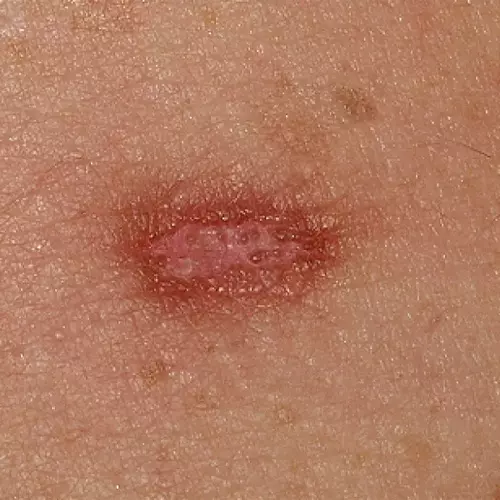
- Color Variations: The color of a dermatofibroma depends heavily on your natural skin tone and the age of the lesion. They can range from pink, red, or dull gray to tan, light brown, or deep purplish-black. Some lesions display a characteristic pale center with a darker border.
- Common Locations: While they can appear anywhere on the body, they are most frequently located on the extremities—especially the lower legs in women and the upper arms or torso.
The Signature "Dimple Sign"
The most reliable clinical hallmark of a dermatofibroma is Fitzpatrick's "dimple sign". Because the fibrous bundle is anchored firmly to the deeper subcutaneous tissue, if you gently pinch the skin on either side of the nodule between your thumb and index finger, the top of the bump will dimple or sink inward rather than protruding outward.
What Causes a Dermatofibroma to Form?
The precise, foundational cause of dermatofibromas remains a subject of ongoing medical discussion. Dermatologists generally consider them to be either a reactive, scarring response to local skin trauma or a true, benign cellular overgrowth.
Many patients can trace the emergence of a nodule back to a minor skin irritation, such as:
- An insect bite or sting
- A superficial puncture wound (e.g., a splinter or rose thorn)
- Minor nicks from shaving
- Ingrown hairs or folliculitis
However, they frequently develop spontaneously without any remembered trauma or injury. They are not contagious, nor are they considered hereditary.
Read: Cancer Treatment Types and Options Available in India
How Are Dermatofibromas Diagnosed?
In most cases, an experienced healthcare provider or dermatologist can diagnose a typical dermatofibroma through a simple clinical exam and palpation.
To confirm the diagnosis with absolute precision, clinicians rely on dermoscopy—a handheld magnification tool that allows them to examine patterns beneath the skin's surface. A classic dermatofibroma will reveal a central white patch or scar-like center surrounded by a delicate, darker pigment network.
If a lesion exhibits atypical features, displays multiple irregular colors, or grows rapidly, a doctor will perform a skin biopsy or diagnostic excision to rule out underlying malignancies such as dermatofibrosarcoma protuberans (DFSP) or melanoma.
Treatment and Removal Options
Because dermatofibromas are completely harmless and medically benign, treatment is entirely optional. If the bump does not itch, hurt, or cause cosmetic distress, the standard clinical recommendation is simply to leave it alone.
However, if a lesion is constantly irritated by clothing, repeatedly nicked while shaving, or causes self-consciousness, it can be removed via several methods:
- Surgical Excision: The most definitive treatment involves cutting out the entire nodule, including its deep dermal roots under local anesthetic. While this eliminates the chance of recurrence, it will always leave a permanent, linear scar that may be more noticeable than the original bump.
- Shave Excision: The surgeon shaves the ra
Frequently Asked Questions
Do dermatofibromas ever go away on their own?
It is exceedingly rare for a dermatofibroma to disappear without intervention. In the vast majority of cases, they persist indefinitely as permanent fixtures beneath the skin unless they are surgically cut out.
Can a dermatofibroma turn into skin cancer?
No. A true dermatofibroma is a benign fibrous proliferation and will not transform into skin cancer. However, because some rare forms of skin cancer can mimic the visual appearance of a dermatofibroma, any new or changing spot should be evaluated by a medical professional.
Why does my dermatofibroma itch or hurt occasionally?
While they are usually asymptomatic, dermatofibromas can become tender, painful, or itchy if they are knocked, compressed, or irritated by tight garments or shaving blades.
Is it normal to have more than one dermatofibroma?
Yes. While most individuals only ever develop a single solitary bump, it is perfectly normal to have a few scattered across your body. The sudden eruption of dozens of lesions, however, is rare and typically warrants an evaluation to check for underlying immune system changes.
Conclusion
Dermatofibromas are a normal, highly common skin phenomenon. Their signature stone-like firmness and positive dimple sign make them relatively straightforward to track. While they don't pose a medical threat, establishing an accurate, professional diagnosis is the best way to safeguard your overall health and prevent unnecessary worry.