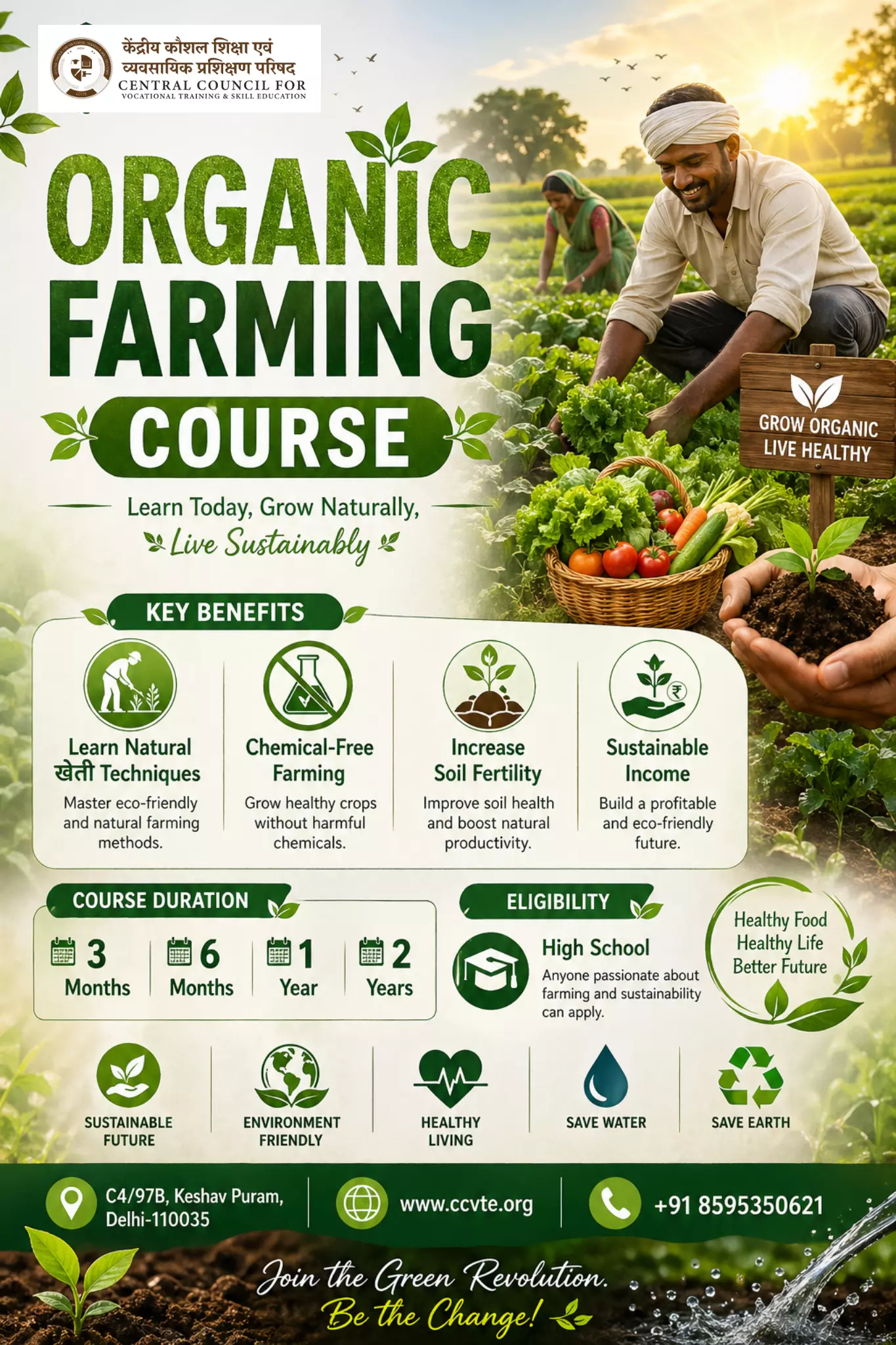
What Is an Organic Farming Course? Complete Beginner's Guide
If you've ever wondered how to grow food without harmful chemicals or how sustainable agriculture actually works, enrolling in an organic farming course might be your ideal first step.
Whether you're a student, a farming enthusiast, or someone looking to build a career in sustainable agriculture, this guide covers everything you need to know before getting started.
What Is Organic Farming? A Quick Definition
Before diving into the course details, let's understand the foundation.
Organic farming definition: Organic farming is a method of crop and livestock production that avoids the use of synthetic pesticides, chemical fertilizers, genetically modified organisms (GMOs), and artificial growth hormones.
Instead, it relies on natural processes, biodiversity, and ecological balance to maintain soil health and produce food.
According to the Food and Agriculture Organization (FAO), organic agriculture is a holistic production management system that promotes and enhances the health of the agroecosystem — including biodiversity, biological cycles, and soil biological activity.
In simple terms, it's farming with nature rather than against it.
What Is an Organic Farming Course?
An organic farming course is a structured educational program that teaches students the principles, techniques, and practices involved in sustainable and chemical-free agriculture.
It covers everything from soil preparation and composting to crop rotation, pest management, and organic certification processes.
These courses are designed for:
- Aspiring farmers and agriculture professionals
- Students with a background in science or biology
- Entrepreneurs looking to enter the agri-business sector
- Individuals passionate about environmental sustainability
- Rural youth seeking skill-based livelihood opportunities
What You'll Learn
A well-structured organic agriculture course typically includes the following topics:
- Fundamentals of organic farming — principles, history, and global relevance
- Soil health management — composting, vermicomposting, green manuring
- Organic crop production — seed selection, planting methods, crop rotation
- Natural pest and disease management — bio-pesticides, companion planting
- Water conservation techniques — drip irrigation, rainwater harvesting
- Organic livestock management — natural feeding, disease prevention
- Organic farming certification — standards, documentation, and certification bodies
- Marketing organic produce — farm-to-table supply chains, export opportunities
Organic Farming in India — Why It Matters
Organic farming in India is not just a trend — it's a growing movement with significant economic and environmental importance.
India is one of the world's largest producers of organic products and ranks among the top countries in terms of the number of organic farmers.
Key facts about organic farming in India:
- India has over 4.43 million organic farmers (one of the highest globally)
- States like Sikkim, Madhya Pradesh, Rajasthan, and Maharashtra are leading in organic cultivation
- The Indian government actively promotes organic farming through initiatives like Paramparagat Krishi Vikas Yojana (PKVY)
- Demand for organic produce in domestic and international markets is growing rapidly year over year
With this growing demand, trained professionals in organic agriculture are needed more than ever — making organic farming training a smart career investment.
Course Duration, Eligibility & Certification
One of the most common questions beginners ask is: How long does an organic farming course take?
Duration Options
Programs are available in multiple formats to suit different learning goals and schedules:
Duration
Best For
3 Months
Quick skill development, basic understanding
6 Months
Intermediate knowledge with practical training
1 Year
In-depth learning with fieldwork experience
2 Years
Comprehensive professional-level training
Eligibility
- Minimum Qualification: High School (10th or 10+2 pass)
- No prior farming experience is required
- Open to students from any stream — Science, Commerce, or Arts
Organic Farming Certification
Upon successful completion, students receive an organic farming certification that is recognized by employers, agri-businesses, and government bodies.
This certification validates your skills and opens doors to professional opportunities in the agriculture sector.
Career Opportunities After an Organic Farming Course
Completing organic farming courses in India can lead to a wide range of career paths:
- Organic Farm Manager — oversee day-to-day operations of an organic farm
- Agricultural Consultant — advise farmers on sustainable practices
- Agri-Entrepreneur — start your own organic farm or food brand
- NGO & Government Programs — work with rural development organizations
- Export & Marketing Professional — manage organic produce supply chains
- Trainer/Educator — teach organic farming practices in rural communities
The salary potential and job stability in this sector continue to grow as consumers increasingly prefer organic and naturally grown food products.
Why Choose a Formal Organic Farming Training Program?
You might wonder — can't I just learn organic farming from YouTube or books? While self-study has its place, a formal organic farming training program offers significant advantages:
- Structured curriculum designed by agricultural experts
- Hands-on practical training in real farm environments
- Industry-recognized certification that boosts employability
- Mentorship and guidance from experienced professionals
- Networking opportunities with peers and industry contacts
- Updated knowledge on the latest government schemes and market trends
A certified course gives you credibility that informal learning simply cannot.
Read: Anjan Trees: A Smart Choice for Long-Term Farm Benefits
Frequently Asked Questions (FAQ)
Q1. Who can enroll in an organic farming course?
Anyone who has completed high school (Class 10 or 10+2) can enroll. No prior farming background is needed.
Q2. Is organic farming a good career option in India?
Absolutely. With rising consumer awareness and government support for sustainable agriculture, organic farming professionals are in high demand across India and internationally.
Q3. What is the difference between an organic farming course and a regular agriculture course?
A regular agriculture course covers conventional farming methods including chemical inputs, while an organic agriculture course focuses specifically on natural, sustainable, and chemical-free farming practices.
Q4. Are there government-recognized organic farming certifications in India?
Yes. Bodies like APEDA (Agricultural and Processed Food Products Export Development Authority) and certifications under NPOP (National Programme for Organic Production) are widely recognized in India.
Q5. Can I start my own organic farm after completing the course?
Yes. Many graduates go on to establish their own organic farms, agri-startups, or consultancy services after completing their training.
Q6. Is the course available online or only offline?
Depending on the institution, courses may be available in both online and offline formats. Practical training components are typically conducted on-site.
Conclusion
Organic farming is more than an agricultural method — it's a commitment to healthier food, a cleaner environment, and a sustainable future.
Whether you're a young student exploring career options or an adult looking to make a meaningful switch, an organic farming course can be the turning point you're looking for.
ETNA (Education & Training Network for Advancement) offers comprehensive agriculture courses designed for today's learners.
With flexible durations ranging from 3 months to 2 years, beginner-friendly eligibility criteria, and a curriculum built around real-world skills, ETNA equips you with the knowledge and certification needed to thrive in the growing organic agriculture sector.
Take the first step toward a greener, more purposeful career — explore ETNA's Agriculture Courses today.