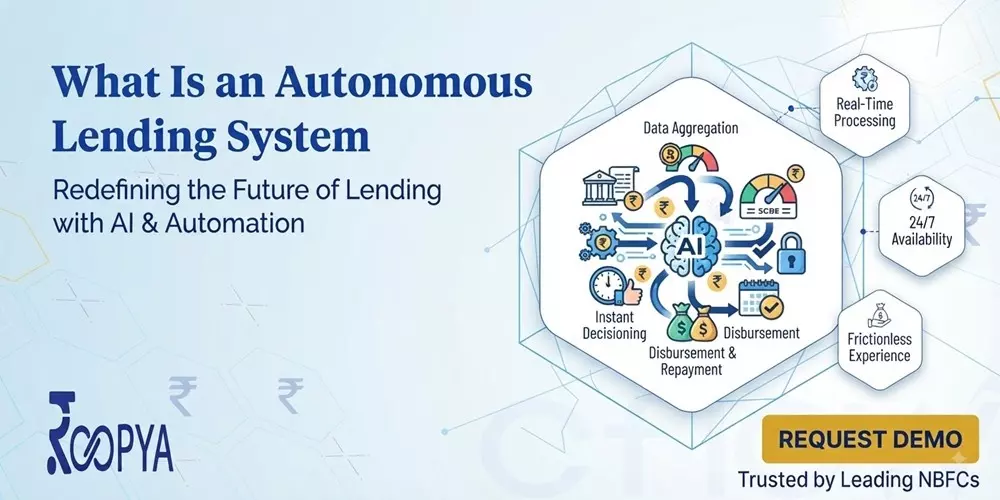
What Is an Autonomous Lending System? A Complete Guide for Banks, NBFCs & Fintechs
The lending industry is rapidly moving from manual, fragmented processes toward intelligent and automated lending infrastructure.
Banks, NBFCs, fintech companies, microfinance institutions, and other lenders are increasingly using artificial intelligence, automation, business rule engines, APIs, analytics, and digital workflows to make lending faster and more efficient.
An Autonomous Lending System is the next evolution of this transformation.
An autonomous lending system is a technology platform designed to automate and intelligently coordinate multiple stages of the lending lifecycle, from customer onboarding and loan application to credit assessment, underwriting, decisioning, disbursement, loan management, monitoring, and collections.
Unlike traditional lending software that primarily digitizes individual processes, an autonomous lending system connects multiple lending functions into a unified workflow.
It can collect and validate data, execute predefined lending rules, evaluate risk, identify potential fraud, route applications, trigger actions, and support decisions with minimal manual intervention.
For modern lenders, the objective is not simply to automate one task. The goal is to create a faster, smarter, scalable, and data-driven lending operation.
What Is an Autonomous Lending System?
An Autonomous Lending System is an intelligent lending platform that uses automation, artificial intelligence, machine learning, decision engines, APIs, data analytics, and configurable workflows to manage and optimize lending processes with limited manual intervention.
A traditional lending process may require loan officers, credit teams, operations teams, verification teams, and collection teams to perform multiple activities manually. Information may move between spreadsheets, emails, CRM systems, credit bureaus, verification platforms, and core lending systems.
An autonomous lending system brings these processes together through a unified technology layer.
It can automate activities such as:
- Digital customer onboarding
- Loan application processing
- KYC and identity verification
- Document collection and verification
- Credit bureau checks
- Credit scoring
- Risk assessment
- Business rule evaluation
- Fraud detection
- Automated underwriting
- Loan decisioning
- Approval workflows
- Document generation
- Disbursement workflows
- Loan servicing
- Portfolio monitoring
- Collections workflows
- Reporting and analytics
The result is a lending environment where technology performs repetitive and rule-based activities automatically while human teams can focus on exceptions, complex credit decisions, customer relationships, risk management, and strategic activities.
How Does an Autonomous Lending System Work?
An autonomous lending system works by connecting data, lending rules, decision engines, integrations, and workflows into a single operational framework.
A typical process can work as follows.
1. Digital Customer Onboarding
The lending journey begins when a borrower submits an application through a website, mobile application, branch, partner, LSP, or other digital channel.
The system captures borrower information digitally and creates an application record.
This reduces manual data entry and allows lenders to process applications through standardized workflows.
Read: AI Agents for Cyber Security: Enterprise Use Cases, Architecture .
2. Automated KYC and Verification
After application submission, the platform can initiate identity, KYC, document, and other verification processes through integrated services.
Instead of requiring employees to manually verify every document and piece of information, automated workflows can trigger appropriate verification checks.
3. Data Collection and Enrichment
An autonomous lending platform can connect with external data sources and APIs to collect relevant information required for underwriting.
Depending on the lender's policies and integrations, this may include:
- Credit bureau information
- Bank and financial data
- GST-related information
- Income information
- Identity information
- Business information
- Existing liabilities
- Application data
- Alternative risk indicators
The platform can then organize this information for automated assessment.
4. Automated Credit Assessment
Credit assessment is one of the most important components of digital lending.
An autonomous system can evaluate borrower information against predefined credit policies, scorecards, risk models, and business rules.
For example, a lender may configure rules based on:
- Credit score
- Income
- Existing obligations
- Loan amount
- Employment or business profile
- Repayment history
- Customer segment
- Debt-to-income indicators
- Geographic criteria
- Fraud indicators
The system can automatically evaluate these conditions and determine the appropriate next step.
5. Business Rule Engine
A Business Rule Engine (BRE) allows lenders to convert credit policies into configurable technology rules.
For example:
If the applicant meets the minimum credit score, income requirement, eligibility criteria, and verification conditions, route the application for automated approval.
If an application does not meet a specific condition, the system can route it to another workflow, request additional information, or send it for manual review.
This allows lenders to standardize their credit policies while reducing repetitive manual work.
6. Automated Decisioning
Once the required information has been collected and evaluated, the system can generate a lending decision according to the lender's configured policies.
Applications may be:
- Approved
- Rejected
- Referred for manual review
- Sent for additional verification
- Assigned to another workflow
Automated decisioning can significantly reduce turnaround time for eligible applications.
7. Disbursement Workflow
After approval and completion of required documentation, the system can trigger the next steps in the disbursement workflow.
This may include:
- Loan agreement generation
- E-signing
- Mandate setup
- Final verification
- Payment processing
- Disbursement confirmation
The objective is to create a seamless journey from approval to disbursement.
8. Loan Management and Monitoring
Autonomous lending should not stop after loan disbursement.
A modern lending platform can continue supporting the loan lifecycle through servicing, payment processing, portfolio management, customer communication, monitoring, and collections workflows.
This creates a connected lending ecosystem rather than isolated loan-processing software.
Key Features of an Autonomous Lending System
A modern autonomous lending platform can include several important capabilities.
AI-Powered Lending
Artificial intelligence can help lenders automate data analysis, document processing, fraud detection, risk analysis, customer interactions, and other operational activities.
AI should complement structured credit policies and governance rather than replace appropriate risk controls.
Automated Loan Origination
The system can automate the journey from application intake through verification, underwriting, approval, and disbursement.
Intelligent Underwriting
Automated underwriting can evaluate borrower information against credit policies and risk models, helping lenders process applications more consistently.
No-Code Business Rule Engine
A no-code BRE enables business and credit teams to configure eligibility rules, approval policies, decision logic, and workflows without depending entirely on developers.
API Integrations
APIs allow the lending platform to connect with credit bureaus, KYC providers, payment systems, CRMs, ERPs, banking systems, and other financial infrastructure.
Fraud Detection
Automated fraud checks can identify suspicious applications, inconsistent information, identity-related risks, and other potential warning signals.
Real-Time Decisioning
When the required data and integrations are available, automated decision engines can evaluate applications rapidly and route them to the appropriate workflow.
Loan Management
An autonomous lending ecosystem can extend beyond origination into servicing, portfolio management, payment processing, monitoring, and collections.
Lending Analytics
Analytics can help lenders monitor application volumes, approval rates, portfolio performance, credit risk, customer segments, and operational performance.
Autonomous Lending System vs Traditional Lending
Traditional lending frequently depends on manual verification, multiple systems, spreadsheets, emails, physical documents, and human intervention at several stages.
An autonomous lending system aims to replace these disconnected processes with integrated digital workflows.
Traditional Lending
Autonomous Lending
Manual data entry
Automated data capture
Paper-heavy processes
Digital documentation
Manual verification
Automated verification workflows
Separate systems
Integrated lending infrastructure
Manual credit checks
Automated credit assessment
Fixed workflows
Configurable workflows
Manual rule application
Business Rule Engine
Limited real-time visibility
Centralized dashboards and analytics
High operational dependency
Automation-led operations
Slow processing
Faster decision workflows
Benefits of an Autonomous Lending System
1. Faster Loan Processing
Automation can reduce the amount of time employees spend on repetitive verification, data entry, and workflow activities.
2. Lower Operational Costs
Automating repetitive tasks can help lenders process higher application volumes without increasing operational resources at the same rate.
3. Better Customer Experience
Borrowers increasingly expect digital, simple, and fast financial services. Automated lending can reduce unnecessary paperwork and waiting periods.
4. Consistent Credit Policies
When lending rules are configured within a decision engine, applications can be evaluated consistently according to approved policies.
5. Improved Scalability
A unified lending platform can help lenders scale products, channels, partners, and application volumes without relying entirely on manual processes.
6. Better Risk Management
Automated credit checks, fraud detection, scorecards, analytics, and monitoring can provide lenders with more structured risk-management capabilities.
7. Greater Operational Visibility
Centralized workflows and analytics provide management teams with better visibility into applications, approvals, disbursements, portfolio performance, and operational bottlenecks.
8. Faster Product Launches
Configurable workflows and no-code tools can help lenders modify lending products and business rules without rebuilding their entire technology infrastructure.
Who Can Use an Autonomous Lending System?
Autonomous lending technology can be useful for various financial institutions, including:
- Banks
- NBFCs
- Fintech companies
- Microfinance institutions
- Digital lenders
- Consumer finance companies
- MSME lenders
- Business lenders
- Embedded finance providers
- Lending marketplaces
The exact configuration depends on the lender's products, risk policies, regulatory requirements, customer segments, and technology architecture.
Why Autonomous Lending Is Important for Modern Lenders
The lending market is becoming increasingly digital and competitive. Customers expect faster onboarding and decisions, while lenders need better control over credit risk, fraud, compliance, operating costs, and portfolio performance.
Simply digitizing paperwork is no longer enough.
The next stage is intelligent process orchestration.
An autonomous lending system connects different components of the lending lifecycle so that data can move between systems, rules can be applied automatically, exceptions can be routed to appropriate teams, and routine activities can be handled with minimal manual intervention.
This creates a more efficient operating model for lenders.
What Should Lenders Look for in an Autonomous Lending Platform?
Before selecting an autonomous lending platform, financial institutions should evaluate:
Scalability
The platform should support increasing application volumes, customers, products, and channels.
Configurability
Credit policies and workflows should be configurable without requiring extensive development for every change.
Integration Capabilities
The platform should integrate with the lender's existing technology ecosystem and relevant financial APIs.
Security and Compliance
Lenders should evaluate security architecture, data protection, auditability, access controls, regulatory requirements, and governance capabilities.
Decisioning Capabilities
The platform should support scorecards, business rules, underwriting workflows, and appropriate manual-review processes.
Analytics
Strong reporting and analytics are important for monitoring credit performance and operational efficiency.
Human Oversight
Autonomous does not necessarily mean completely human-free. A robust lending system should support human review for exceptions, complex applications, disputes, and decisions requiring professional judgment.
How Roopya Supports Autonomous Lending
Roopya is positioned as a unified lending infrastructure platform designed to support the lending lifecycle from origination through collections.
Its platform includes capabilities such as loan origination, loan management, automated decisioning, document management, automated credit scoring, real-time decisioning, fraud detection, configurable business rules, lending analytics, and API integrations.
Roopya also positions its platform around a no-code approach, allowing lending teams to configure lending operations and business rules without building every workflow from scratch.
For banks, NBFCs, fintech companies, and other lenders looking to modernize their lending infrastructure, an autonomous lending approach can help bring origination, underwriting, decisioning, servicing, and collections into a more connected operating model.
The Future of Autonomous Lending
The future of lending is likely to involve increasing levels of automation combined with human oversight.
AI and machine learning can help lenders analyze increasingly large volumes of structured and unstructured information. Agentic workflows can potentially coordinate multiple operational tasks, while traditional rule engines continue to provide deterministic policy controls.
However, responsible deployment is essential.
Lenders must consider explainability, fairness, privacy, security, regulatory compliance, model governance, auditability, and human oversight when introducing AI into credit processes.
The most effective autonomous lending model is therefore not simply “AI makes every decision.”
Instead, it is a controlled technology ecosystem where automation handles repetitive processes, decision engines apply approved policies, analytics support risk management, and human experts manage complex or exceptional cases.
An Autonomous Lending System is an intelligent lending infrastructure designed to automate and connect major stages of the lending lifecycle.
From customer onboarding and KYC to credit assessment, underwriting, decisioning, disbursement, loan management, monitoring, and collections, automation can help lenders create faster and more scalable operations.
For modern banks, NBFCs, and fintech companies, autonomous lending represents a shift from fragmented manual processes toward connected, data-driven, and configurable lending infrastructure.
Platforms such as Roopya are designed to help lenders move toward this model by bringing loan origination, loan management, business rules, decisioning, integrations, fraud detection, analytics, and other lending capabilities into a unified technology environment.
The ultimate goal is simple: make lending faster, smarter, more scalable, and easier to manage while maintaining appropriate risk, compliance, and human oversight.
Frequently Asked Questions
1. What is an Autonomous Lending System?
An Autonomous Lending System is a technology platform that uses automation, AI, decision engines, business rules, APIs, and analytics to automate and coordinate multiple stages of the lending lifecycle with minimal manual intervention.
2. How does an Autonomous Lending System work?
It connects customer onboarding, KYC, data collection, credit checks, underwriting, business rules, risk assessment, decisioning, disbursement, loan management, monitoring, and collections into integrated digital workflows.
3. What is the difference between autonomous lending and traditional lending?
Traditional lending relies heavily on manual processes and disconnected systems. Autonomous lending uses integrated technology, automated workflows, decision engines, APIs, and analytics to reduce repetitive manual activities.
4. Can NBFCs use an Autonomous Lending System?
Yes. NBFCs can use autonomous lending platforms to digitize and automate loan origination, underwriting, credit decisioning, disbursement, servicing, portfolio management, and collections workflows.
5. Does autonomous lending mean there is no human involvement?
No. Autonomous lending is generally about minimizing unnecessary manual intervention. Human experts can remain involved in exceptions, complex credit cases, policy decisions, risk management, compliance, and other activities requiring professional judgment.
6. What technologies are used in autonomous lending?
Common technologies include artificial intelligence, machine learning, business rule engines, workflow automation, APIs, cloud infrastructure, data analytics, credit scoring, document processing, and fraud detection.
7. What are the benefits of autonomous lending?
Key benefits include faster processing, reduced operational effort, consistent application of lending policies, improved customer experience, better scalability, enhanced visibility, and stronger automation across the lending lifecycle.
8. What is a Business Rule Engine in lending?
A Business Rule Engine allows lenders to configure eligibility criteria, credit policies, approval conditions, risk rules, and workflow logic that can be automatically applied to loan applications.
9. Can autonomous lending support loan origination and loan management?
Yes. A comprehensive autonomous lending platform can support both loan origination and post-disbursement activities such as servicing, portfolio management, payment processing, monitoring, and collections.
10. Why should lenders consider autonomous lending technology?
Lenders can use autonomous lending technology to modernize legacy processes, improve operational efficiency, accelerate loan processing, support scalable growth, and create a more connected lending experience.
11. Is Roopya an Autonomous Lending System?
Roopya positions its lending infrastructure around autonomous lending capabilities and provides technology covering loan origination, loan management, business rules, decisioning, fraud detection, analytics, integrations, and collections.
12. Is autonomous lending suitable for fintech companies?
Yes. Fintech companies can use autonomous lending infrastructure to automate lending workflows, integrate financial APIs, configure credit policies, and scale digital lending operations.