What Is a Data Pipeline? How It Works, Architecture, and Benefits
Firms collect lots of data via websites, applications, customer databases, and their operational activities.
Nevertheless, data collection is just a beginning point. In order to use data, firms need a way to deliver, organize, and process it for analysis purposes. Here, the data pipeline comes into play.
It is necessary to understand what is a data pipeline in order to effectively use information for the benefit of businesses and get rid of manual data processing.
What Is a Data Pipeline?
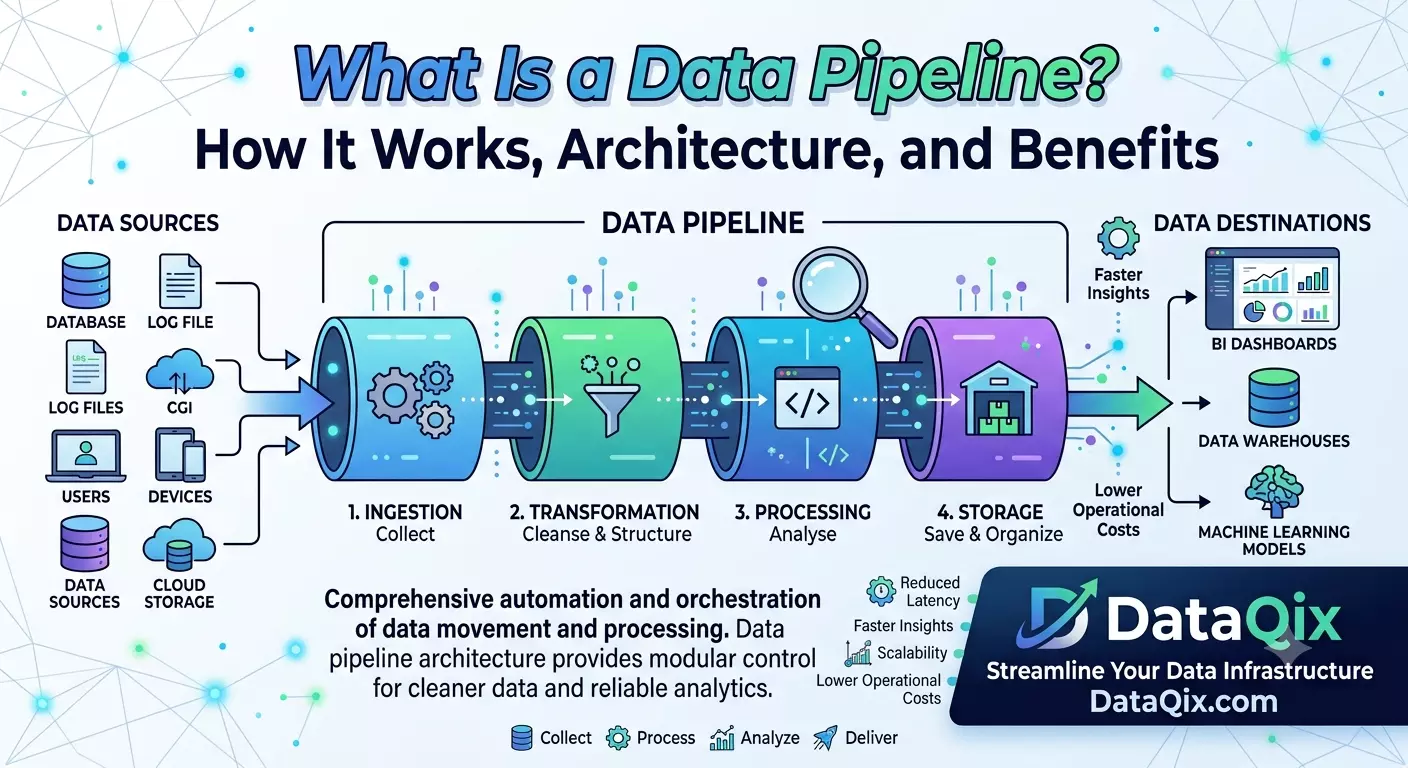
A data pipeline is a sequence of actions aimed at the collection of data, its transformation into the usable format, and the delivery to the destination point. Such a destination can be a database, data warehouse, cloud storage service, or analytics platform.
For instance, an e-commerce firm can collect data regarding sales from its website, process customer orders, and deliver them to a report dashboard.
Why Are Data Pipelines Needed?
Data pipelines have several use cases in businesses, among others: sales reporting, analysis of customer behavior, inventory management, financial reporting, and machine learning.
For instance, a marketing team may merge such data as website traffic, advertisement performance, and conversion rate to know which marketing campaign works best. Companies may also structure data from different systems to increase efficiency.
In addition, modern data pipelines may be used in real-time processing, thus, companies process data in the moment when it is received, without waiting for scheduled processing.
Data Pipeline Architecture Explained
Data pipeline architecture is the way components of the data pipeline interact with each other. Data pipelines usually consist of sources of data, tools of ingestion, processing technologies, storage solutions, and analytics tools.
An appropriate architecture is selected according to the volume of data, speed of processing, security issues, and company needs. Batch pipelines process data periodically, and streaming pipelines process data constantly.
Scalable architecture must provide error handling, data validation, security measures, and monitoring.
Read: Top 10 AI/ML Development Companies to Watch in 2026
Advantages of Data Pipeline Automation
A data pipeline allows automating the process of data collection, processing, and delivery, reducing the need for tedious manual operations. It might help to ensure better consistency, save time, and detect the problems with the processing of the data quicker.
Furthermore, automation along with data validation and monitoring may allow for getting cleaner data sets, faster reporting, and data management in general.
Conclusion
Having an understanding of what is a data pipeline might be very useful for companies aiming to convert the available unstructured data into valuable insights.
With the help of data pipelines, one can build reliable processes within the organization to manage its data.
Choosing appropriate software tools, creating a scalable architecture, and using automation may help to achieve higher data accuracy and efficiency in the decision-making process of companies.