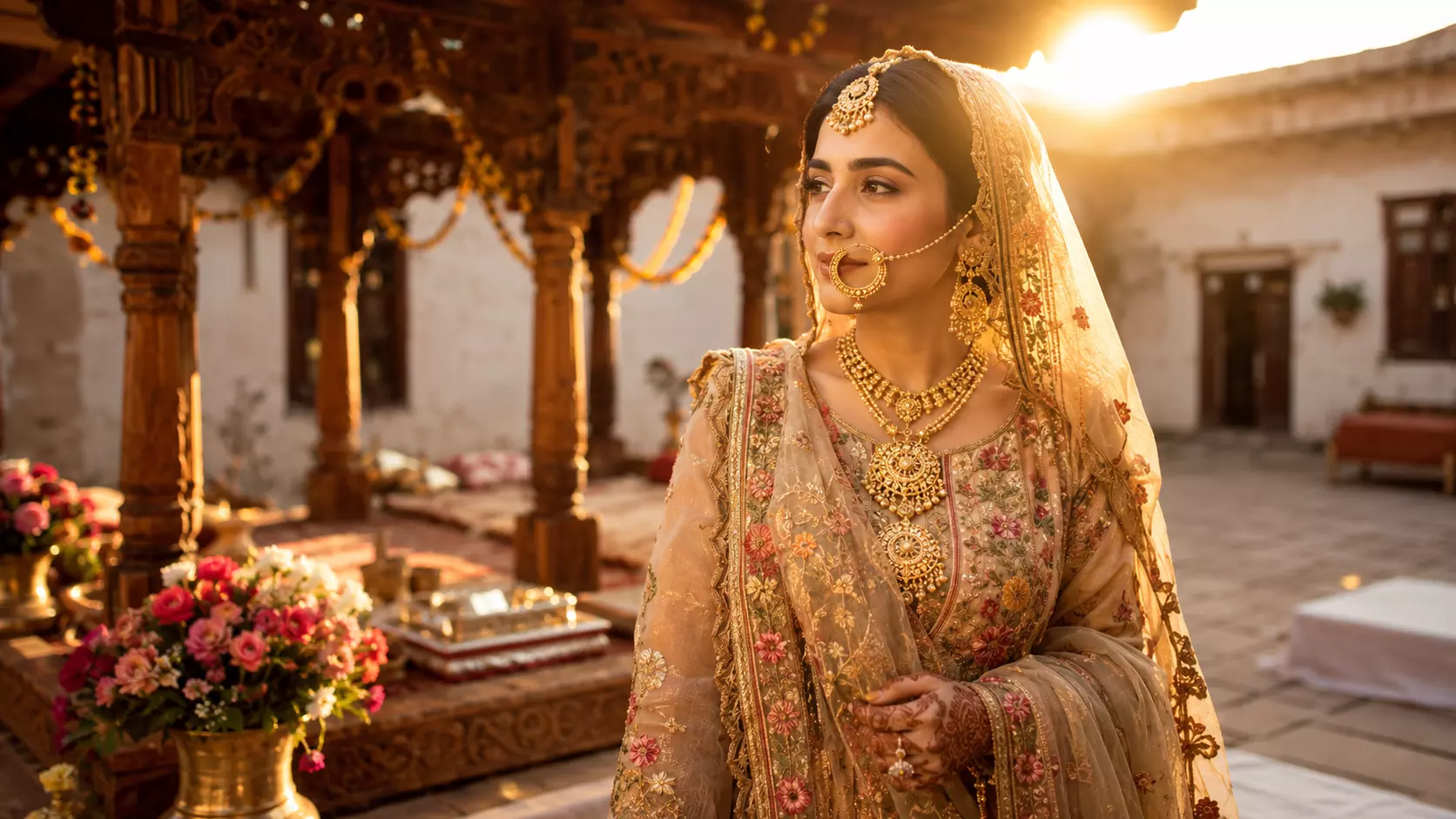
What Dogri brides actually wear at each wedding function
Most bridal content treats "the wedding" like a single event.
A Dogra wedding is not a single event. It's four or five days of distinct ceremonies, each with its own rituals, its own emotional register, and yes, its own specific expectations for what the bride wears.
Get this wrong and you end up overdressed for the Butna and underdressed for the Bharali Ved. I've seen it happen.
Here's what you actually need to know, function by function.
Before anything else: the Geetain da sadda
Before the formal ceremonies begin, there are evenings of singing.
The Geetain da sadda is an oral invitation, historically delivered by the nain (the barber's wife) to the neighbourhood women, asking them to gather for Suhaag and Sithniyan folk songs. Suhaag songs are sung for the bride, full of emotion and blessing. Sithniyan are the teasing ones, and they get loud.
The bride at these evening gatherings wears comfortable, brightly coloured traditional suits. This is spectator territory. She's watching her own transition unfold around her, not leading it yet. No heavy jewellery. No formal bridal look. Just colour and presence.
The Saant: where the wedding officially begins
The Saant is the ritual that starts everything. A wooden miniature temple structure called the Daryas is set up inside the home. It represents the family's Kuldevta and Kuldevi, the ancestral deities whose blessing makes the wedding possible. Nothing auspicious begins without invoking them.
At the entrance of the house goes the Toran. The Dogri Toran is carved wood, featuring parrots. Eleven of them, traditionally, representing the attendants of Lord Shiva, though some families use five, seven, or nine depending on custom.
These aren't decoration. They're peheredars, guardians of the wedding house, and they're ritually fed babru (sweet bread made of flour and jaggery) to take up their post.
What she wears: Simple, vibrant clothing. Yellow, green, pink. Colours that work for sitting through lengthy fire rituals (homas) in warm conditions. The Saant is a spiritual occasion, long and detailed. Comfort matters.
The Butna: turmeric and family
The Butna, sometimes called Ubtan, is the purification ceremony. A paste of turmeric, sandalwood, and fragrant oils is applied to the bride by her female relatives.
What she wears: An older suit she doesn't mind staining. Because it will be stained. The turmeric goes everywhere, and that's the point. The mess is the ritual. It means something that you're surrounded by the women of your family, all of them with their hands on you, and nobody cares about the fabric.
This ceremony is about the communal joy before the gravity of what comes next.
The two weddings: Anderlee and Bharali Ved
Here's where most people don't realise there are two distinct ceremonies happening.
The actual Dogra Hindu marriage is split into the Anderlee Ved (indoors) and the Bharali Ved (outdoors).
This isn't redundancy. It's a deliberate theological structure.
Ceremony
Where
What happens
Why it matters
Anderlee Ved
Inside the home, in front of the Daryas
Varpujana (worship of the groom), Kanyadaana (the giving away)
The private, familial, spiritual transition, witnessed by the family deities
Bharali Ved
The courtyard, open to sky
Panigrahana, Agnipardakshina, Saptpadi
The public declaration, witnessed by the panch-tatvas, the five elements
The marriage is spiritually complete after the seventh step of the Saptpadi in open air. The outdoor ceremony needs to happen outside because the elements are the witnesses. Not metaphorically. Theologically.
The Vedee: the wooden mandap with parrots
The Bharali Ved happens under a structure called the Vedee (or Bedi). It's a pyramid shape, four vertical pillars, slanting beams that meet at the top. At the convergence sits a carved wooden parrot.
Historically, the Vedee had 21 of these parrots, the Vedee de tote. They're connected to Madana, the Hindu God of Love, whose mount is the parrot.
During the ceremony, the women sing Suhaag folk songs that directly address the wooden parrots. They ask the birds to speak for the bride as she weeps, leaving her father's home. The parrots are silent witnesses, and the songs acknowledge that silence.
In villages, the Vedee was provided by the local tarkhan (carpenter) through the jajmani system, and he was paid in clothes and sweets afterward. In urban Jammu today, most families rent from wedding decorators. The wooden parrots are the same. The social fabric around them has changed.
Read: Silver Jewelry Manufacturer in Jaipur
What she actually wears on the wedding day
The Dogri Suit is the traditional bridal attire, and it's distinct from everything you've seen in mainstream bridal content.
The cut: A narrower salwar than the Punjabi version, with voluminous pleats at the front that require stiff fabric to hold their shape. The silhouette is structural and regal, not flowing.
The fabric: Pure Chanderi silk or Bamberg satin. Both are stiff enough to maintain the pleats. Both photograph beautifully. The fabric choice is as important as the embroidery.
The embroidery: Tila work (gold and silver thread) and Gota work, both reflecting the region's history of Mughal and Persian craft influence layered over indigenous Dogra techniques. This is not mass-produced embroidery. A well-embellished Dogri suit takes weeks to make.
The odhani: A heavily embroidered veil covers the bride's head. It frames the Nath and the Nama set. Together, these three elements, the odhani, the Nath, the Nama, create a silhouette that can't be mistaken for Punjabi or Kashmiri or any pan-Indian bridal aesthetic. It's specific to this region, this community.
Modern brides often ask about combining the Dogri suit with a contemporary lehenga for different functions. This is reasonable and common. If you're wearing a lehenga for the reception and the Dogri suit for the main wedding ceremonies, that's a sensible split.
After the wedding: the reception
The reception gives the most flexibility. By this point, the ritual-specific requirements are complete. Brides in Jammu typically wear either a contemporary lehenga or a designer saree for the reception, with jewellery that can be lighter than the wedding day set.
A word of advice: don't underestimate how tired you'll be by the reception. Whatever you choose to wear, make sure you've actually sat down in it for two hours before committing. You'll thank yourself at the event.
Book a free Shaadinama stylist consultation to plan your function-wise look → Shaadinama
Frequently asked questions
What does a Dogri bride wear for Mehendi?
Mehendi isn't traditionally part of Dogra ritual structure the way it is in Punjabi ceremonies, but many Jammu families now incorporate it as a pre-wedding function. For Mehendi, most brides choose vibrant yellow or green outfits, keeping jewellery minimal since the hands are covered in henna.
Can a Dogri bride wear a lehenga instead of a Dogri suit?
Yes. Many contemporary Jammu brides wear lehengas for one or more functions. The traditional Dogri suit is often reserved for the main wedding ceremony. Neither choice cancels out the other.
What is the Bharali Ved?
It's the outdoor wedding ceremony in the Dogra tradition, conducted under the wooden Vedee mandap, in which the core marriage rituals (Saptpadi, Agnipardakshina) are completed in the presence of the five elements.
Why does the Dogri Toran have wooden parrots?
The parrots are connected to Madana, the Hindu God of Love, and are considered divine witnesses and protectors of the wedding home. The number varies by family tradition, typically 5, 7, 9, or 11. They're ritually fed sweet bread to take up their role as guardians.