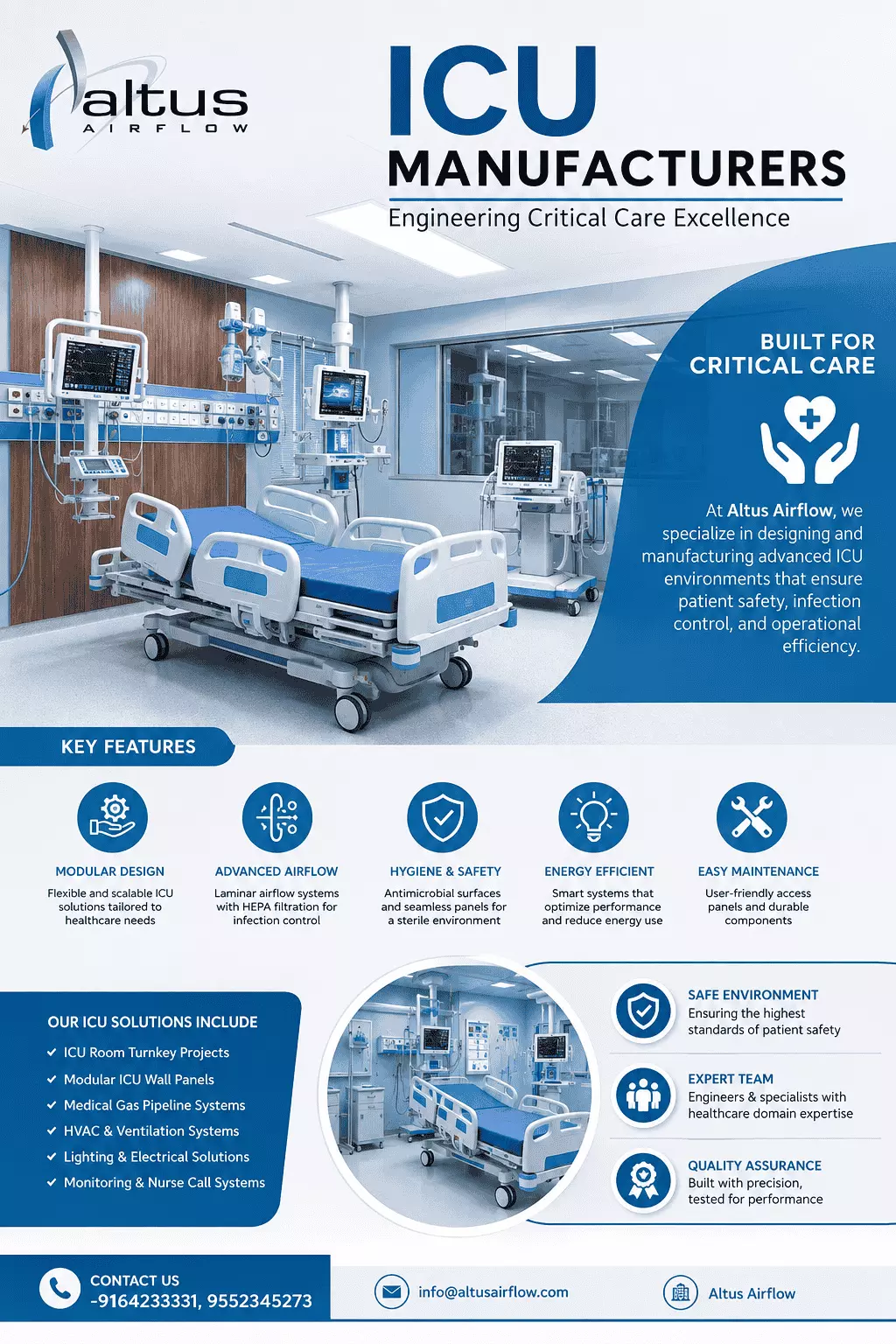
What Are the Key Features of Top ICU Manufacturers?
Choosing reliable ICU Manufacturers is important for hospitals developing modern critical-care facilities.
A capable manufacturer should offer more than individual products by understanding ICU planning, equipment integration, patient-care workflows, safety requirements, and long-term maintenance.
Hospitals should evaluate technical expertise, product quality, customization, installation capabilities, and after-sales support before selecting a provider.
Strong Technical Expertise
One of the most important features is technical knowledge of critical-care environments.
ICU solutions may involve beds, ventilators, multiparameter monitors, syringe pumps, infusion pumps, suction systems, ECG equipment, defibrillators, portable ventilators, and other specialized devices. NHSRC's critical-care guidance provides an indicative equipment list covering these types of equipment.
A technically capable manufacturer should understand how these systems need to work together within the planned ICU environment.
Quality Equipment and Specifications
Top manufacturers should provide clearly defined technical specifications and suitable documentation. NHSRC maintains technical resources intended to support medical-device procurement and minimum equipment standards in public healthcare facilities.
Hospitals should examine product functionality, safety features, durability, compatibility, ease of operation, and suitability for the intended clinical application rather than relying only on appearance or brand recognition.
Practical ICU Design
A well-designed ICU should support efficient patient care and staff movement. Equipment must be positioned so that clinical teams can access patients and essential devices without unnecessary obstacles.
Manufacturers should consider patient-bed arrangements, monitoring systems, emergency equipment, medical infrastructure, and available space during planning.
Hospital planning also involves broader considerations such as patient safety, infection control, fire safety, and hospital engineering services. NHSRC identifies these areas among important components of hospital planning and design.
Customization and Flexibility
Every hospital has different bed capacities, room dimensions, specialties, equipment requirements, and expansion plans. A strong manufacturer should be able to adapt solutions to the facility's specific requirements.
Flexible planning can also make it easier to accommodate future equipment upgrades or changes in clinical services without completely redesigning the ICU.
Read: Patient Bed Price in Pakistan – Latest Costs, Types, and
Focus on Safety and Reliability
Safety should be incorporated into both infrastructure and equipment selection. Hospitals should assess electrical requirements, emergency access, equipment placement, infection-control considerations, and the availability of essential emergency devices.
NHSRC's critical-care equipment guidance includes items such as crash carts, defibrillators, suction apparatus, ventilators, monitors, and emergency-support equipment, demonstrating the range of systems that may need to be coordinated within critical-care facilities.
Professional Installation and Training
A reliable manufacturer should provide appropriate installation, testing, commissioning, documentation, and user training. Proper installation helps ensure that equipment and supporting infrastructure are ready for clinical operation.
Training can also help healthcare and technical teams understand equipment operation, routine checks, and basic troubleshooting procedures.
Strong Maintenance and After-Sales Support
Long-term service is another key feature. NHSRC's Biomedical Equipment Management and Maintenance Program includes guidance on equipment maintenance, calibration, and testing and links equipment management with maintaining appropriate uptime.
Hospitals should therefore ask manufacturers about preventive maintenance, calibration, spare-parts availability, corrective repairs, technical assistance, and service response. A strong support system can contribute to more dependable long-term equipment performance.
Conclusion
The key features of dependable ICU Manufacturers include technical expertise, quality equipment, practical design, customization, safety-focused planning, professional installation, staff training, and structured maintenance support.
Hospitals that compare manufacturers across these areas can make more informed decisions and develop critical-care facilities that are better aligned with clinical workflows and long-term operational needs.
FAQs
1. What is an important feature of a reliable ICU manufacturer?
Technical expertise is essential because ICU infrastructure and equipment need to work together within a complex clinical environment.
2. What equipment may be required in a modern ICU?
Requirements can include ICU beds, multiparameter monitors, ventilators, syringe pumps, infusion pumps, suction equipment, ECG machines, defibrillators, portable ventilators, and crash carts.
3. Why is customization important for ICU projects?
Customization allows solutions to be adapted to room dimensions, bed capacity, equipment configurations, clinical workflows, and future expansion requirements.
4. Why should hospitals consider maintenance support?
Preventive maintenance, calibration, testing, and corrective servicing can help maintain equipment performance and support better equipment availability over time.
5. What should hospitals compare before selecting a manufacturer?
Hospitals should compare technical specifications, equipment quality, customization, safety, installation, training, documentation, maintenance, service support, and relevant healthcare experience.