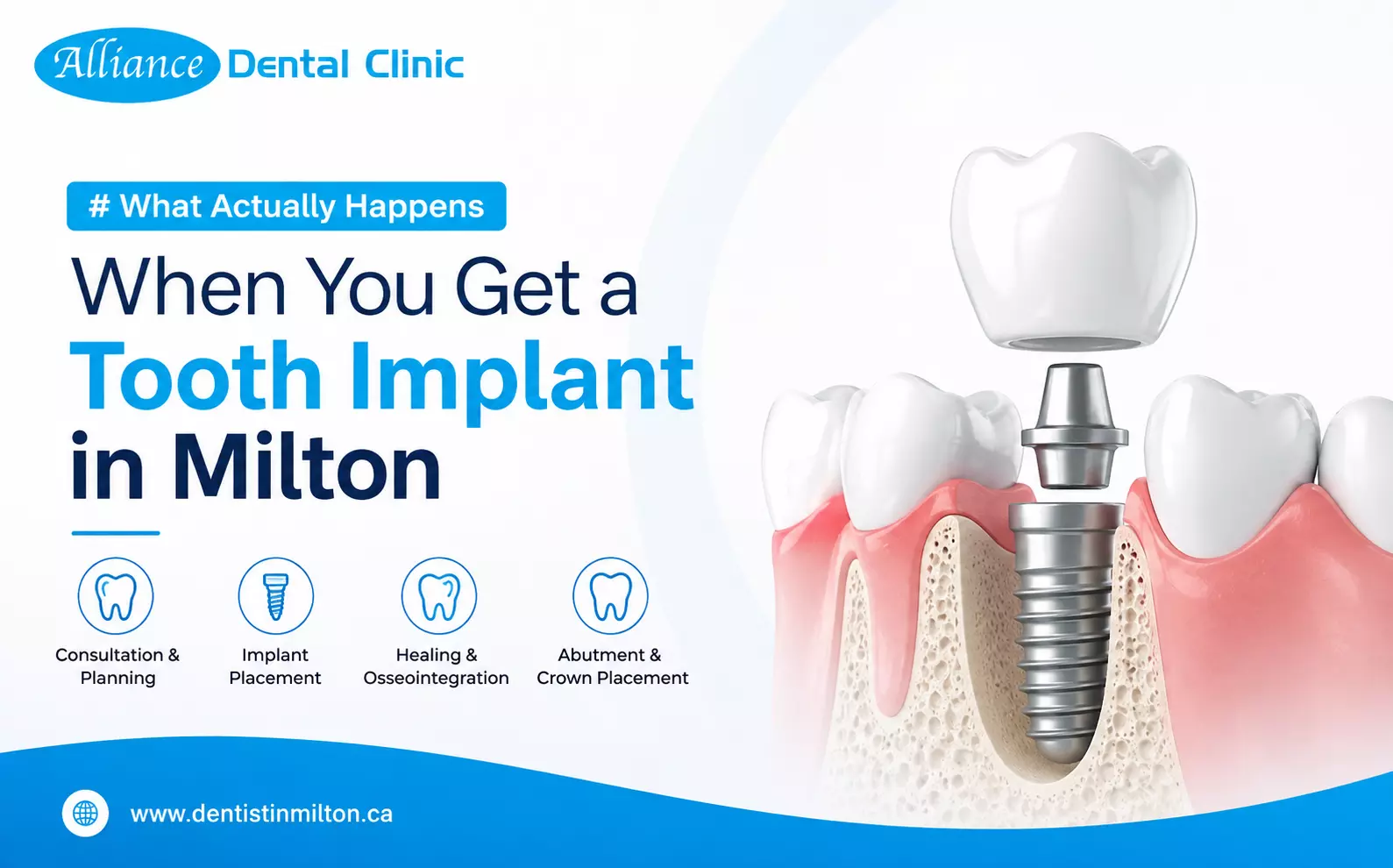
What Actually Happens When You Get a Tooth Implant in Milton
If you've lost a tooth and you're comparing options, here's the short answer: a dental implant replaces both the root and the crown of a missing tooth, typically takes three to six months from placement to final restoration, and costs more upfront than a bridge but tends to outlast one by decades.
The rest of this article walks through why that timeline looks the way it does, what the appointments actually involve, and the questions worth asking before you commit to a clinic.
Milton has grown fast over the last decade, and with that growth has come a wider range of dental practices — some general, some cosmetic-focused, a few with in-house oral surgeons.
That variety is good for patients, but it also means implant pricing and protocols vary more than people expect.
Understanding the process before your first consult puts you in a much better position to evaluate what a clinic is proposing.
Why Tooth Loss Isn't Just a Gap
Losing a tooth changes more than your smile. Underneath the gum, the jawbone that used to support that tooth root starts to resorb — shrink — because it no longer receives the chewing pressure that keeps it dense.
Research on post-extraction bone remodeling has shown that a significant portion of that resorption happens within the first twelve months after a tooth is lost, with the width of the ridge narrowing noticeably even before height changes become visible on an X-ray.
This is the main reason dentists tend to recommend implants sooner rather than later.
Waiting years to replace a missing tooth can mean the bone is no longer wide enough to anchor an implant without a bone graft first, which adds both time and cost to the process.
Read: What Are Dental Implants: How They Restore Your Smile?
How the Implant Process Actually Unfolds
Step 1: Diagnostic Workup
Before anyone touches a drill, a proper workup includes a 3D cone-beam CT scan, a review of your medical history, and an assessment of gum health.
This step matters because it tells the dentist exactly how much bone is available and where the nerve canals and sinus cavities sit — details a flat 2D X-ray simply can't show with the same precision.
Step 2: Placement Surgery
The titanium (or increasingly, zirconia) post is placed into the jawbone under local anesthetic. Most single-tooth placements take under an hour.
What surprises a lot of patients is that discomfort afterward is usually milder than a tooth extraction — most people manage it with over-the-counter pain relief for two to three days.
Step 3: Osseointegration
This is the waiting period, and it's non-negotiable. Over three to six months, bone cells grow directly onto the implant surface, fusing it to the jaw.
Rushing this stage is one of the more common causes of implant failure, so a dentist who pushes to finish "in weeks" for a standard case is worth asking more questions about.
Step 4: Abutment and Crown
Once integration is confirmed, a small connector piece (the abutment) is attached, and a custom crown — shade-matched to your surrounding teeth — is fitted on top. This is usually the shortest phase, often just two visits.
What Drives the Cost Range
Implant pricing varies for reasons that aren't always explained clearly upfront:
- Material choice — titanium alloy versus zirconia posts
- Whether a bone graft or sinus lift is needed
- Single-tooth versus multi-tooth or full-arch cases
- Whether the crown is milled in-house or sent to an external lab
Patients comparing quotes across Milton clinics often find the numbers hard to line up, largely because one quote might bundle the CT scan and follow-ups while another prices them separately.
Asking for an itemized breakdown before treatment starts avoids surprises later.
For a closer look at how single-tooth cases are typically priced and staged locally, this breakdown on tooth implant Milton options is a useful reference point for what a realistic quote should include.
Questions Worth Asking at Your Consult
A consult is also an evaluation of the clinic, not just your mouth. A few questions tend to separate a thorough practice from a rushed one:
- Do you take your own CT scans in-house, or refer out?
- What's your failure/revision rate, and how do you handle it if integration doesn't take?
- Is the crown milled on-site or outsourced, and what's the turnaround?
- What does the warranty or guarantee actually cover?
If a clinic can't answer the second question with a specific figure or process, that's worth noting.
Aftercare That Actually Matters
Implants don't decay the way natural teeth do, but the gum tissue around them can still develop peri-implantitis — inflammation similar to gum disease — if plaque builds up at the base.
Daily flossing with an implant-specific floss threader or a water flosser, plus keeping up with six-month cleanings, is the main defense. Patients who skip cleanings in the first two years after placement are statistically more likely to see early bone loss around the implant.
The Bottom Line
A tooth implant is a multi-stage process built around biology, not convenience — bone needs time to fuse, and shortcuts at any stage tend to show up later as complications.
Going in with realistic expectations about timeline, cost breakdown, and the right questions to ask makes the difference between a smooth outcome and a frustrating one.