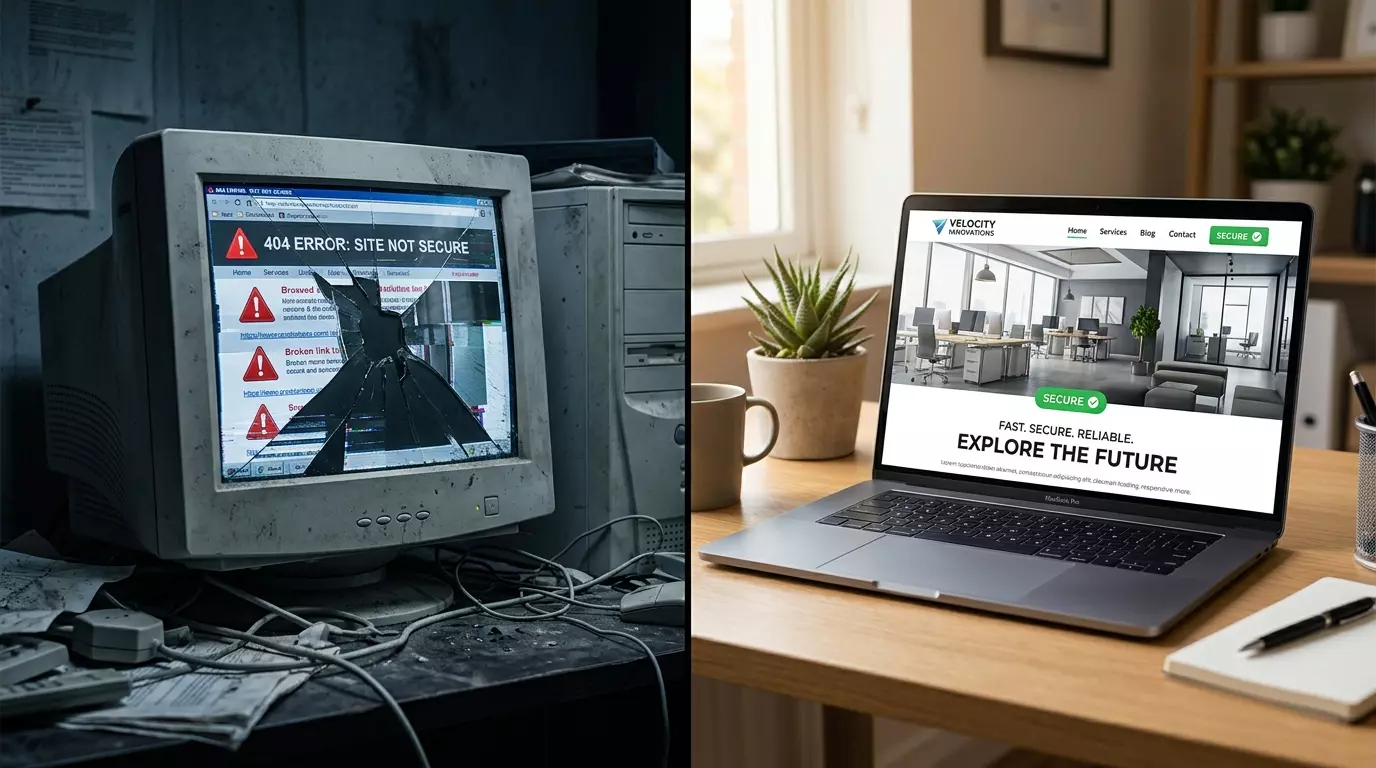
Website Maintenance Services: Why Ignoring Them Costs More Than Building the Site Itself
Most business owners treat their website like a piece of furniture. Buy it once, put it in the corner, and expect it to sit there working forever.
The reality is a lot closer to owning a car. Without regular servicing, small problems become big ones, performance quietly drops, and one day it just refuses to start.
That is why website maintenance services are one of the most underrated investments a business can make. They rarely show up in the marketing budget conversation, and they never make anyone excited.
But the businesses that skip them almost always regret it — usually in the middle of a busy sales week when the site crashes, gets hacked, or slowly falls off Google without anyone noticing.
This guide breaks down what website maintenance actually involves, why it matters more in 2026 than ever, and how to choose the right partner to keep your site running clean and fast.
What Website Maintenance Services Actually Cover
There is a common misconception that maintenance means "fixing things when they break." Real website maintenance services are far broader. They cover everything that keeps your website secure, fast, functional, and search-engine friendly on an ongoing basis.
A proper maintenance scope typically includes core software updates, plugin and theme updates, database optimization, malware scanning, uptime monitoring, security hardening, backup management, performance tuning, broken link checks, form testing, SSL renewal, and small content updates.
Some agencies bundle in monthly SEO health checks, Google Analytics monitoring, and even light copy edits. The best providers treat maintenance as an active discipline, not a passive checkbox.
Think of it this way: development builds the machine, and maintenance keeps the machine tuned so it actually delivers on the promise every day of the year.
Why Website Maintenance Matters More in 2026
The web is more hostile and more competitive than it has ever been. Three forces have made professional website maintenance services essential rather than optional.
First, cyberattacks have exploded. WordPress alone powers more than 43% of the internet, and it is targeted by tens of thousands of automated bot attacks every single day.
Outdated plugins are the number-one entry point. A single ignored update can hand a hacker full access to your site, your customer data, and your reputation.
Second, Google's ranking algorithms now weigh technical health heavily. Core Web Vitals, page speed, mobile usability, HTTPS, and structured data are all measured continuously. A site that was fast last year can slip into the slow zone quickly if plugins bloat, images pile up, and code gets dusty.
Third, customer expectations have hardened. If your site takes more than three seconds to load, most visitors leave. If a contact form silently breaks, you lose leads without ever knowing they tried to reach you. Regular maintenance catches these silent killers before they cost you money.
Read: Best Web Development Services In Jaipur for Business Growth
The Real Cost of Neglecting Maintenance
Business owners often ask why they should pay a monthly retainer for something they cannot see. The honest answer is because the alternative is much more expensive.
A hacked website typically costs between AED 5,000 and AED 30,000 to clean, restore, and secure — and that is only the technical bill. The reputational damage, lost sales, and Google blacklisting can multiply that number by ten. Recovery can take weeks.
A slow website quietly bleeds conversions. Studies consistently show a 4.4% drop in conversion rate for every additional second of load time. If your site does AED 50,000 per month in sales, a two-second slowdown can quietly cost you AED 4,400 monthly without anyone realizing why.
A site that falls off page one of Google due to broken pages, missing structured data, or outdated content can take months of paid effort to recover. Ongoing website maintenance services prevent all of this at a small fraction of the recovery cost.
The Main Categories of Website Maintenance Work
Not every maintenance task happens at the same frequency. A well-structured plan usually breaks into four categories.
1. Security Maintenance
This is the most critical layer. It includes core CMS updates (WordPress, Shopify, Magento), plugin and theme updates, SSL certificate renewals, firewall rule tuning, malware scans, brute-force login protection, and two-factor authentication setup for admin users. Serious providers run security scans daily or weekly.
2. Performance Maintenance
Websites accumulate weight over time. Uncompressed images pile up. Databases fill with revisions and spam. Caching plugins fall out of date.
Performance maintenance covers image optimization, database cleanup, cache configuration, CDN tuning, and Core Web Vitals monitoring. Aim to review this monthly.
3. Content and Functional Maintenance
Broken links, outdated blog posts, expired offers, dead contact forms, and Google Map embeds that stop working all fall into this bucket. This is where regular audits matter. Reviewing key pages monthly and running a full site audit quarterly keeps everything honest.
4. Backup and Recovery Maintenance
Automated backups are only useful if they actually restore. Good website maintenance services run daily automated backups, store copies off-site (usually in Google Cloud or AWS S3), and periodically test restores to make sure nothing is corrupt. Without this, one bad update can wipe out years of work.
Signs Your Website Needs Urgent Maintenance
Even if you do not have a formal maintenance plan, watch for these red flags. Any of them is a sign you should act quickly.
- Pages take more than four seconds to load on a normal 4G connection.
- Contact forms have gone quiet, or you are getting sudden spam floods.
- The WordPress or CMS admin dashboard shows a stack of pending updates.
- Google Search Console is flagging errors, mobile usability issues, or security warnings.
- Your SSL certificate is expiring soon (or worse, has already expired and the browser shows a warning).
- The site has been slower than usual for weeks with no clear reason.
- You have recently added new plugins or themes and something feels off.
If more than two of these apply, treat it as urgent. Waiting almost always makes the fix bigger and more expensive.
DIY vs Professional Maintenance
Some business owners try to handle maintenance in-house. If your team includes a technically confident member with time to spare, that can work for a small brochure site. But the risk profile changes fast.
DIY maintenance usually breaks down for three reasons. Time — the routine tasks add up to several hours a month, more than most owners can spare.
Skill — updates sometimes break site functionality and need developer knowledge to fix. Coverage — no one is watching the site at 2am on a Friday when something goes wrong.
Professional website maintenance services solve these three problems in one retainer. You get scheduled work, proactive monitoring, and someone accountable when things break. For anything beyond the simplest sites, this pays for itself within the first year.
What to Look For in a Maintenance Provider
Once you decide to hire a professional partner, use these criteria to separate serious agencies from the ones that just want a monthly recurring fee for doing very little.
Clear scope in writing. The retainer contract should list exactly what is included and what is not. Vague promises like "general maintenance" are a warning sign.
Response time commitments. Serious providers commit to response times for both routine tickets and emergencies. Look for same-day responses on urgent issues.
Monthly reporting. You should receive a plain-English report every month showing what was updated, what was scanned, backup status, and any recommendations. If you cannot see the work, it may not be happening.
Backup and rollback processes. Ask how backups are stored, how often they are tested, and how quickly they can restore your site if something breaks. A good answer includes off-site storage and documented recovery times.
Real developer skill on the team. Some agencies outsource maintenance to bots and interns. Ask who actually handles the work. Real developers spot problems that automated tools miss.
Transparent pricing. Reputable website maintenance services publish clear tiers or provide detailed quotes. Anyone charging for "premium care" without explaining what changes at each tier is playing games.
Realistic Pricing for Website Maintenance
Prices vary by site complexity, but here are honest UAE market ranges for 2026.
A basic maintenance retainer for a small business WordPress site typically runs AED 500 to AED 1,500 per month. This usually covers updates, backups, uptime monitoring, and a handful of small content edits.
A standard business site with e-commerce, custom plugins, or multi-language support usually falls between AED 1,500 and AED 4,000 monthly. Expect deeper monthly reports, performance monitoring, and priority response times.
Enterprise sites, marketplaces, or custom-built platforms can run from AED 4,000 to AED 15,000 or more per month, often bundled with development hours, SEO health monitoring, and dedicated account management.
If a provider offers full maintenance for AED 200 per month, be skeptical. At that price they are almost certainly running only automated update scripts with no human eyes on your site.
Final Thoughts
Websites are living systems. They respond to the internet around them — new browser updates, new Google requirements, new security threats, new plugin releases. A site that is not actively maintained is quietly falling behind every single day, whether the owner notices or not.
Professional website maintenance services are the difference between a website that grows with your business and one that slowly becomes a liability. They protect your investment, your customers, and your peace of mind for a small fraction of what recovery would cost.
If you launched a website in the last two years without a maintenance plan, now is the time to fix that. Waiting until something breaks is always more expensive than paying to prevent it.